Why Wellesley-Pole should be commemorated by Ascot

Creating Tradition – Wellesley-Pole and Ascot (Part 5)

The Importance of Wellesley-Pole’s Legacy

Intro | Master of the Buckhounds | The Age of Reform | Anger Management | Legacy
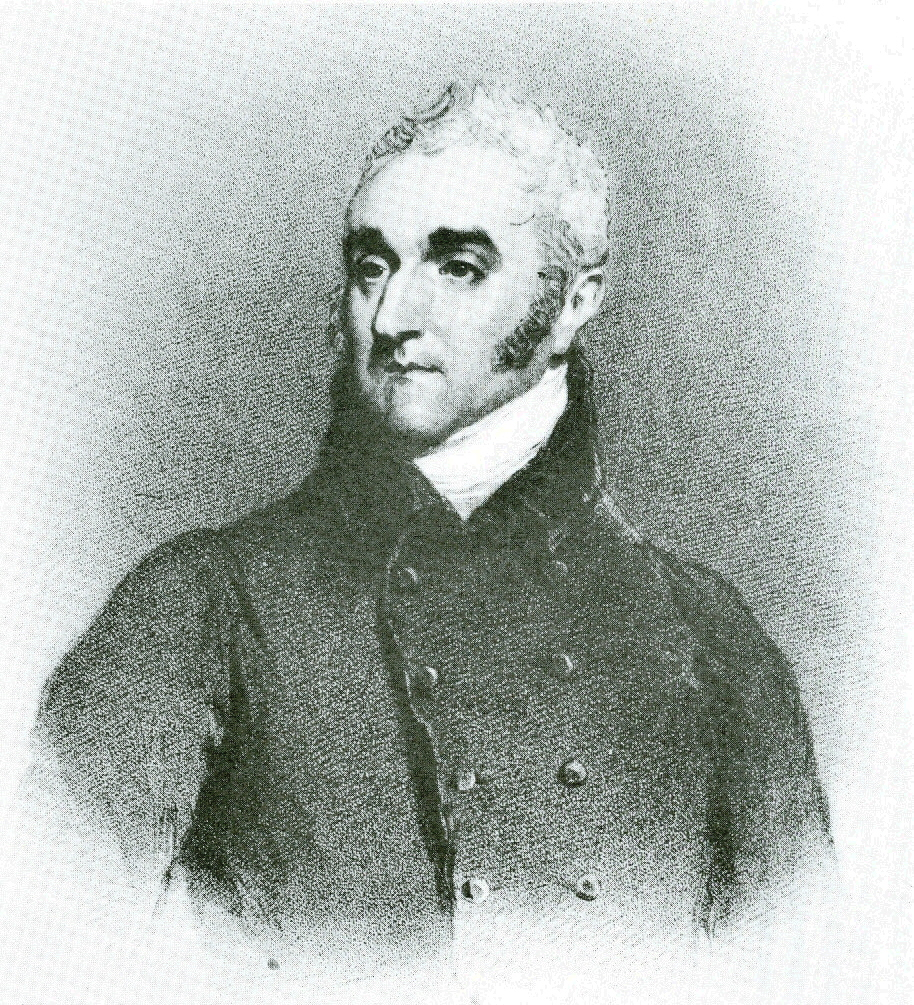
maryborough

William Wellesley-Pole (Lord Maryborough) 1763-1845

It is tempting to turn the concluding part of my study of Wellesley-Pole’s impact upon Ascot into an open letter to the powers that be, in the hope that our man will finally gain the credit he deserves. Instead, however, I want to explain why the invention of tradition was not just about Ascot, but more to do with the relationship between the monarchy and the people.
Monarchy

A Perfect Marriage : the Monarchy &  the People

We have seen how Wellesley-Pole’s structural and organisational changes transformed Ascot into the best race track in Britain, and how his rules of racing added a much-needed backbone of professionalism upon which horse racing (as a sport) has thrived. We must must acknowledge that great innovators can make mistakes, & there certainly were one or two wrong decisions made along the way.

Wellesley-Pole’s true legacy, however, must lie in the adoption of ceremonial rituals via the ‘Royal Procession’ – an entirely new creation that gave the instant impression of being a long-held tradition- bringing the people and their King together as one joyous ensemble. It was a simple but brilliant idea that has served us right up to the present time.
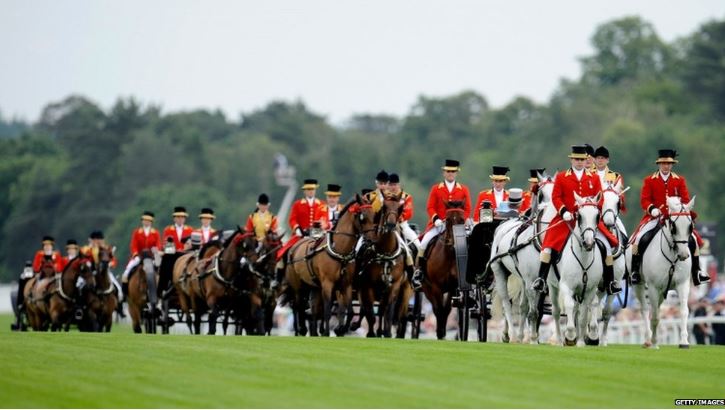
Royal Procession

To illustrate this better I will firstly examine why ‘Royal Ascot’ meant so much to George IV, and secondly show how it played a significant role in popularising his successor, William IV.

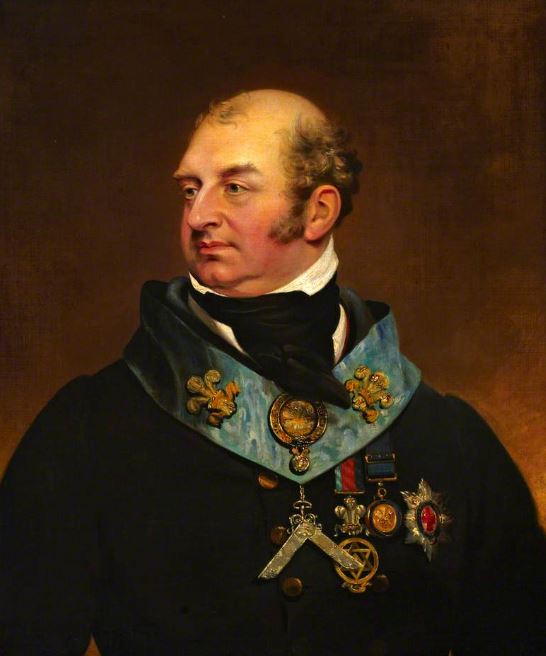
It must be clarified that Ascot was inaugurated under the reign of Queen Anne in 1711. This was more of a permit to hold meetings, and it was not until after 1750 that an annual 4-day meeting was held. The first royal to show a great interest in Ascot Heath was the Duke of Cumberland – who, as Lord Warden of Windsor Forest, was a enthusiastic and regular attendee. King George III also went frequently until his descent in madness in 1810. But it was his two eldest sons George (Prince of Wales) and Frederick (Duke of York) who really took Ascot to their hearts. The Duke of York was perhaps the most pivotal supporter of Ascot in this period as he regularly entered his own horses, sponsored races, and was always on the course. George, on the other hand, was more of a gambler than a participant – so much so that his debts led to exile from Ascot after 1807. Even after he became Prince Regent, George was remained wary of Ascot – principally because he was deeply unpopular and genuinely feared for his safety. The Duke of York by contrast was a soldier, widely respected, and loved by the people – amongst whom he could freely mingle.
york

Frederick, Duke of York – a massive fan of Ascot Heath Races

So, by 1820 when the Regency ended and George IV became King – Ascot Heath was certainly considered a race meeting frequented by Royalty – but there was no real glue to bind each together into one synonymous concept

George IV
caroline

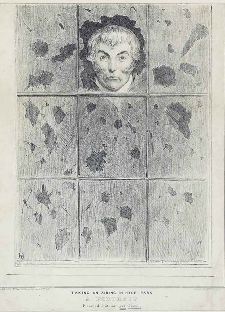
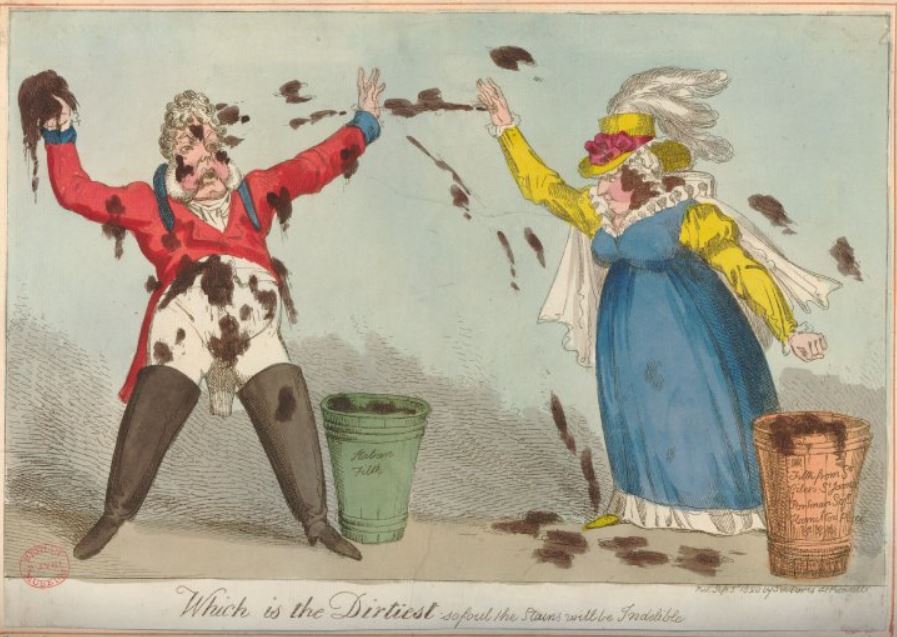
George IV’s early reign was marred by mud slinging

It is actually quite incredible to think that speculation about the King’s health was gauged throughout 1830 on the basis of whether he was likely to attend Ascot Races. On April 24th reports that the King spent three hours instructing the Royal Stud groom regarding horses to enter, was taken to mean his illness wasn’t serious. Yet as the weeks passed by and it became clear that George IV would miss Ascot the nation braced itself for bad news. This sense of foreboding reveals the bond that had formed between King and Royal Ascot and can be explained thus:
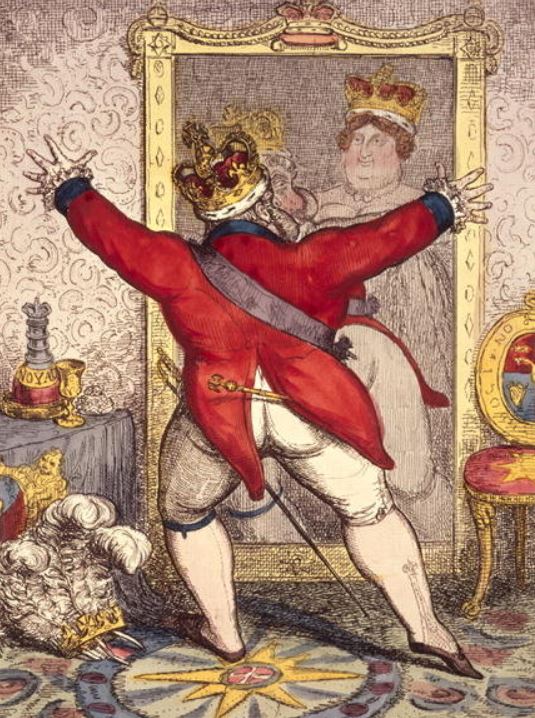
George Satire

The press loved to hate the King, and he became withdrawn

The first years of the King’s reign were dogged by social and political unrest, and problems with his estranged wife Queen Caroline of Brunswick. Her trail for adultery, exclusion from the Coronation and sudden death in 1822 combined to make George IV deeply unpopular at all levels of society. Not suprisingly by 1823, the King was largely reclusive – spending months on end at his Royal Cottage in Windsor Park. After his death it was revealed that aside from an occasional visit to the theatre, Ascot Races was the only public engagement at which the King appeared.
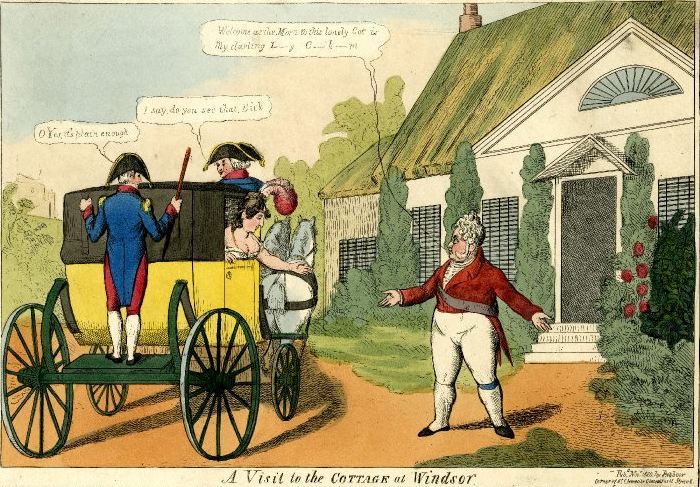
the Royal cottage at Windsor

Home from home – The Royal Cottage, Windsor Park

Ascot Races was to become a unique and pivotal occasion for the King. His decision to embrace and improve Ascot, by employing  Nash then Wellesley-Pole, was a bold move hoping to carve out one small corner of Britain where he could feel at home amongst his subjects. As an excercise in public relations, Wellesley-Pole’s newly devised ‘Royal Procession’ was a masterstroke. By 1826 it was reported

A little before one the heath was well filled, and the eyes of the spectators were then anxiously turned towards the straight mile, and the Royal Cavalcade approached amidst the cheerings of the people. The carriages stopped at the Royal Stand, and his Majesty alighted, and during the whole of the races was at the window, conversing with the noblemen of his suite… & was highly delighted at the affectionate demonstration of loyalty with which his progress was attended. He bowed repeatedly, and smiled upon the multitude in the most affable manner

If the King liked it, the public was just as enamoured, as this slightly offensive 1828 report shows

It cannot be denied that the popularity of these races arises more from the sanction afforded them by his Majesty, than from the mere running. Horses may be seen every day, but Kings are scarce; and the sight of one is something to talk of, and is recompense for an immensity of fatigue and expense. Of the thousands congregated at least three out of every five came to see the King; and it is a fortunate circumstance for his admiring subjects, that the Royal Person is sufficiently bulky not to be mistaken for that of any less personage

When Wellesley-Pole created the Royal Procession, therefore, he did an enormous service to the King, paving the way for his popular acceptance. In one fell swoop, Ascot Heath was permanently transformed into ‘Royal Ascot’ – for the benefit of both instititutions.

William IV

It is a curious thing that Ascot proved to be an important turning point for George IV’s successor, William IV  (even though Wellesley-Pole was no longer in charge). The new King was never much of a fan of horse-racing and seldom attended Ascot. However, one of his first engagements was at Wellesley-Pole’s second Ascot meeting in August 1830 where he received a rapturous reception.
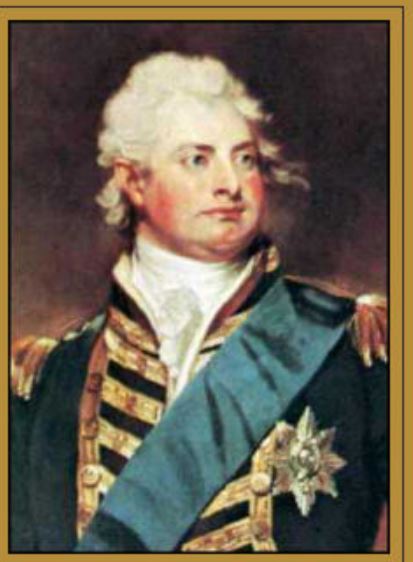
WilliamIV

William IV – the ‘Sailor King’

The following summer was less enjoyable as the King found himself snubbed by the aristocracy, who boycotted Ascot in protest at William IV’s support for the Reform Bill, reportedly ‘evincing the coldness of their feelings towards the Crown’. But when the public heard of this snub they turned out in even greater numbers than before. The Morning Chronicle wrote

It is clear that the expectation of seeing the King is paramount over every other consideration with three-fourths of those who visit Ascot; without this attraction, certain we are that the brilliant company assembled on the Heath would have been fewer by some thousands… the great popularity of the Sovereign excited an interest ensuring a full attendance.

In 1832 the Royal Procession ceremony provided one last final, and unexpected endorsement proving beyond question that Wellesley-Pole’s marriage of Ascot to Monarchy was both secure and permanent. When making his initial public salute at the balcony of the Royal Stand…

A ruffian, in the garb of a sailor suddenly threw a large flint stone directly at the King…striking our venerable Sovereign on the forehead, just above the rim of his hat… the sound was loud and the King fell back one or two paces and exclaimed ‘My God, I am hit’. Happily his Majesty soon relieved all anxiety… and appeared smiling at the front window of the Stand to huge cheers from the populace

Concluding Words

So we can see the pivotal role Ascot played in re-connecting one monarch (George IV) with his subjects, and reviving another (William IV) at a time when the ruling elite tried to slap him down. In both instances the Royal Procession provided a perfect platform for the exchange of affection needed between citizens and Kings. Wellesley-Pole therefore created a pageant that elevated Royal Ascot above the status of a mere sporting occasion into a popular celebration of the monarchy.

That Ascot became the venue for a vitally important patriotic affirmation, whilst at the same time undergoing unprecedented improvements in all aspects of horse-racing – is the reason why I think Wellesley-Pole ought to be thanked by today’s owners.
ascotroyale

If you have read and enjoyed this, I hope you will try to remember Wellesley-Pole next time you happen to see Ascot’s ‘Royal Procession’. At least that way his hard work will never be forgotten.

Recommended Links

The main Ascot website has detailed information on days out at Royal Ascot 

I would heartily recommend a stay in Windsor, as besides Ascot there is so much to do in this beautiful town
Anger Management? Wellesley-Pole’s Ascot Disaster (1829-1830)

Creating Tradition – Wellesley-Pole and Ascot (Part 4)

The Decline & Fall of Wellesley-Pole

Intro | Master of the Buckhounds | The Age of Reform | Anger Management | Legacy

By the end of the 1820s Royal Ascot was the most important occasion in the sporting calendar, attended by huge crowds from all levels of society. On racing week London was quite simply drained of its inhabitants, & a great many rival events and pastimes forced to reschedule or close their doors as they could not hope to compete. Other sports, such as boxing cleverly capitalised on Ascot’s success – as for a number of years it became customary for a big bout to be arranged to attract the returning hordes on the evening of the final day’s racing.

London’s loss was not only commercial and social, for there was a marked rise in both burglaries and fires in the many unattended homes. Criminals must have loved the absense of Bow Street Runners, many of whom were sequestered to Ascot by Wellesley-Pole.

 ascot 1836
Wellesley-Pole’s grandiosely remodelled Royal Stand

However, by 1828 Wellesley-Pole began to become a victim of his own success, and his control over Ascot unravelled
Second Meeting Syndrome

George IV was so delighted with ‘Royal’ Ascot that he commanded Wellesley-Pole to arrange a second meeting to be held from 1828 onwards- proposing that it be held a mere fortnight after the first one finished. It is easy to see why the King craved more of Ascot, given the rapturous reception he was now accustomed to receiving each day he attended.

george iv

George IV loved Ascot and was greedy for more

Wellesley-Pole was as anxious to make the King happy, as the King was willing to give Wellesley-Pole absolute authority over the new arrangements. But as the King’s health declined, Wellesley-Pole’s workload doubled, meaning that his temperament and judgement was to be sorely tested by these new arrangements.

A second meeting was duly held at Ascot from 1828 onwards, but it was soon apparent that the King’s enthusiasm was insufficient to overcome the many problems created by trying to replicate another ‘Royal Ascot’ a mere fortnight after its conclusion. In the first place the new meeting did not suit many of the leading horse owners, who were used to taking their horses on to Goodwood after ‘Royal Ascot’. Secondly there was an inevitable loss in quality of the main meeting as several high-prize races were transferred to the second meeting. Thirdly and most importantly, no allowance was made for the ordinary folk whose attendance at Ascot was crucial to its carnival atmosphere. In 1829 the Morning Post summed up the problem

After the first Ascot meeting the better horses generally leave… leaving a small quantity of bad horses for the second meeting… We do have other thoughts upon the subject which we also consider of consequence to the support of the race course- the middling classes of society are the principal frequenters, who cannot afford to give up so much time in so short a space.

It was obvious that a second meeting was a bad idea, but Wellesley-Pole still went ahead in 1830 – though he did push the date back to August. Wellesley-Pole went against his better judgement to avoid disappointing the King, instead of calling the whole thing off. In fact George IV died on 26 June 1830 so was not around to witness the demise of this failed experiment, and Wellesley-Pole was held responsible for the whole idea. Not surprisingly, as soon as Wellesley-Pole stepped down as Master of the Buckhounds, ‘Royal Ascot’ reverted back to its old single meeting format.
Don’t Question MY Authority

The most inevitable consequence of Wellesley-Pole’s increased power was the knock on effect it had upon his emotions.  As his temper began to overheat, decisions became rash and ill-considered & his well-ordered management system began to crumble and subside.

endofrace

Arguments often flared up before the race had even set off

Wellesley-Pole’s megalomania boiled over during the Ascot Gold Cup in 1829. Prior to the race and to avoid any delay in his strict timetable, Wellesley-Pole made a rule that the horses gather together- setting off at the same time. The Morning Post wrote

When Mr Gully heard of [the new rule], after all the horses were brought to the post, knowing that his horse was of a frightful temper, he became apprehensive he might lose his chance of the prize, and hastily rode up to [Wellesley-Pole] to induce him to rescind the order. In doing so he passed the Royal Stand & neglected to take off his hat.

Wellesley-Pole seized on this breach of protocol to deny Gully a hearing and the race was run. Afterwards Gully sent a letter of apology to the King, which was graciously accepted, but this merely served to stir Wellesley-Pole’s resentment further. On the grounds that Gully’s explanation was not unsatisfactory to him as Lord Steward of Ascot – Wellesley-Pole decreed that Gully was henceforth forbidden to run a horse for the Gold Cup!!

Considering that the King had taken no offence for Mr Gully’s faux pas, Wellesley-Pole’s punishment was very mean-minded and personal. But it did not end there because Wellesley-Pole subsequently issued an edict declaring that from 1830 Ascot would only accept horses

The bona fide property of a member of the Jockey Club, a member of the Upper or Lower Rooms at Newmarket, or one of those clubs in London whose members may be admitted into the above clubs without a ballot

This was an extraordinary dictat, unilaterally imposed by Wellesley-Pole – and had immediate and far-reaching consequences. Most country-based owners suddenly found themselves excluded from entry meaning that by 1831 the Gold Cup was reduced to a ‘commonplace affair’. Royal Ascot was seriously damaged because of this. By this time both Wellesley-Pole and George IV were off the scene,  so it presented new King William IV with a perfect opportunity to boost his own popularity with Ascot patrons by rescinding this elitist rule.

donkey-pole

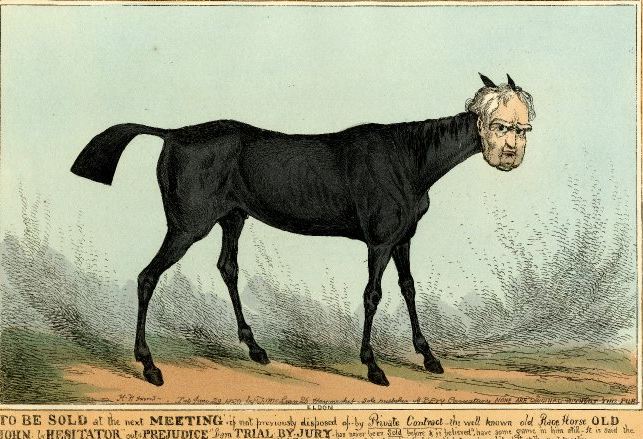
Wellesley-Pole was starting to act like a donkey.

You Damned Scoundrel!!

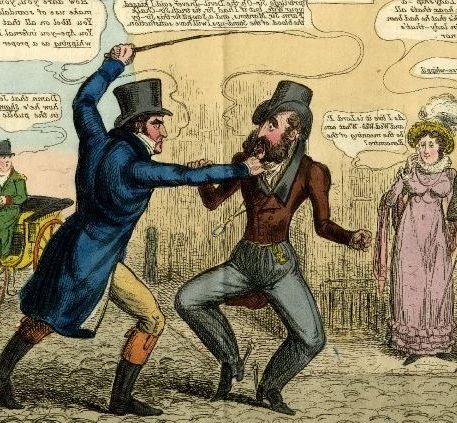
Perhaps the final straw for Wellesley-Pole came as a result of a moment of madness, as his fierce temper exploded and he resorted to violence. It must have been pure comedy to witness what occurred. During the second Ascot meeting of 1829 Wellesley-Pole observed a man dragging an old lady off the race track, and heard her shout ‘Murder’ as she tried to resist. In an instant he rushed from the Royal Stand and ‘struck the man two desperate blows with the butt end of a whip, hitting him on the forehead and damaging his cap.’ Not waiting for an explanation Wellesley-Pole then grabbed the man by his lapels, throwing him to the ground with the words ‘You damned scoundrel!’

horse whipped

Wellesley-Pole loses the plot, June 1829

All of this was quite a feat for a 66 year old man dressed in ceremonial garb, but Wellesley-Pole had totally mis-read the situation. For the lady in question was a blind beggar unaware of the danger she faced wandering onto the race track. Her ‘assailant’ was in fact a special constable from Windsor whose sole concern had been for for her safety. Not knowing why she had been grabbed the beggar had indeed cried ‘Murder,’ and this was what triggered Wellesley-Pole’s protective instincts.

Just a few days after King George IV’s death, Wellesley-Pole found himself before a judge at Abingdon where he was convicted of common assault, receiving a fine of £50. Several witnesses testified that Wellesley-Pole’s reaction was disproportionately violent and that his rage had got the better of him.

After this embarrassment Wellesley-Pole changed his mind about staying on to serve William IV and announced his departure by the end of 1830.

Such sequence of unfortunate events is one that sadly repeated itself throughout Wellesley-Pole’s life. Once again his achievement were subsumed by the ignominy of his departure, and the impression he left was of being volcanic in nature, liable to erupt at any time. When viewed like this, it is not so hard to see why his son ‘Wicked’ William turned out so bad.

horseraces

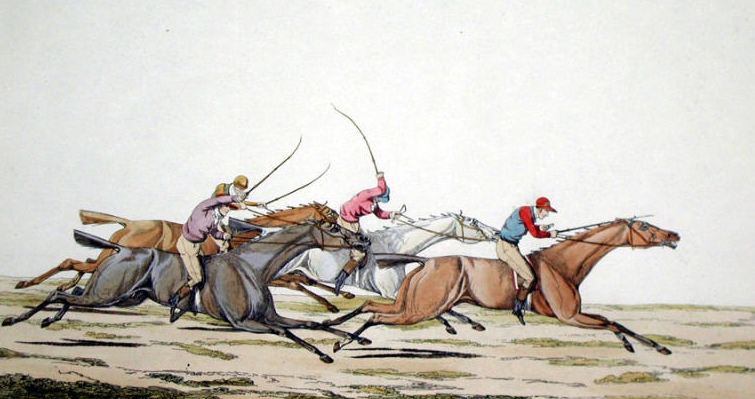
His race may have been run, but ‘Royal Ascot’ ultimately was the winner

Yet none of the above errors should detract from the permanent changes instigated by Wellesley-Pole, and the skilful way in which he welded ‘Royal’ into Ascot. Hence, in the final part of this blog I will sum up the Wellesley-Pole’s legacy as Steward, suggesting that Ascot really ought to find a place, any place, to honour his achievements.

For more about Wellesley-Pole’s defence of the poor you might like ‘She’s MY vagrant’ or to see Wicked William’s equine escapades read Wicked William’s Hunt

A great way to find out more about King George IV is via The Royal Pavilion Website

Or you could visit Rachel Knowles’ excellent Regency History Blogspot  & Sarah Murden’s Georgian Era

Last but not least look out for The Angel & The Cad Geraldine Roberts’ forthcoming true story of love & loss in Regency England, which will be published by Macmillan June 2015 & features more on Wellesley-Pole

The invention of ‘Royal Ascot’ 1823-1830

Creating Tradition – Wellesley-Pole and Ascot (Part 3)

How Wellesley-Pole invented ‘Royal Ascot’

Intro | Master of the Buckhounds | The Age of Reform | Anger Management | Legacy

George IV

George IV – A great patron of Ascot Races

The transformation of Ascot Heath races to ‘Royal Ascot’ between 1813 and 1830 must largely be credited to George IV. At the beginning of his Regency (1813) Parliament enacted an Act of Enclosure securing the future of Ascot Heath as a public racetrack. But it was not until his accession to the throne in 1820 that the King really made his mark. Almost immediately his favoured architect John Nash was engaged to construct a Royal Stand.  This began a decade of almost continuous change and improvement. Between 1820 and 1830 racing at Ascot and the Royal Family became synonymous- This happened because it was transformed into an incredibly well-organised and massively popular event- one of the few venues where the unloved and extravagant King genuinely felt at ease.

Wellesley-Pole was the man George IV entrusted to revitalise Ascot, but the King could never have imagined this undertaking could lead to the creation of ‘Royal Ascot’ AND the rehabilitation of the King in the eyes of his subjects.

Wellesley-Pole’s changes can be briefly be categorised as follows:

Building Works

The Roal Stand - Ascot 1825

The Royal Stand c.1825

Though the Royal Stand was first opened in 1822 (having been built by Nash in just 5 weeks), it was greatly improved and modified under Wellesley Pole’s stewardship. Additional rooms were added, and the windows hung with rich rose-coloured drapery. The King now had the option to make himself more visible to the public from its rooftop terrace, or to retreat to the privacy of his entourage. He greatly enjoyed the ability to wave to his subjects from the security of his suite.

In 1826 a new stand was erected for the Duke of York next to a further smaller stand for Wellesley-Pole’s use as steward. Sadly the Duke of York died in 1827, whereupon the King assigned his brother’s stand to the Jockey Club. Before it was handed over Wellesley-Pole reconfigured the windows so that Jockey Club members would not be able to overlook the King’s Stand.

For the benefit of the betting circles a new three storey building was erected to afford a better view of proceedings for aristocratic gamblers as well as more than doubling the capacity for licensed book-makers. This building too was set back to prevent over-looking the Royal Stand.

All these improvements were eventually superseded by the opening of a magnificent Nash inspired public stand in 1839, but the plans for that were laid down during George IV’s reign, when Wellesley-Pole was in charge.

But the most important and lasting changes to Ascot undertaken by Wellesley-Pole related to the course itself. Wellesley-Pole recognised that the quality of racing was totally dependent upon the state of the racetrack, and set out to ensure that (whatever the weather) Ascot would rise to the occasion. His first action was to ensure that race-goers could not enter the running area. He did this by employing a host of security guards and police men who rigidly prevented any intrusion likely to damage the course, or worse still hinder the races when in progress.

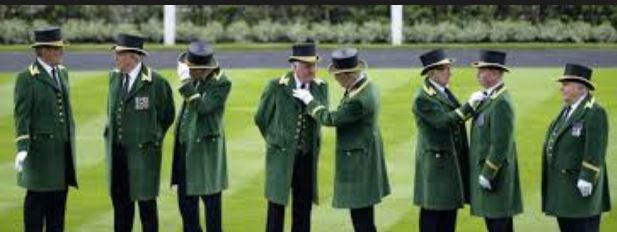
yeoman prickers

‘Yeoman Prickers’ nowadays known as Greencoats -entrusted with keeping pedestrians off the course

By 1824 the course was closed to cattle grazing- only sheep were permitted onto the course when it was not in use. An extensive program of under-draining began so that by 1828 it could no longer be considered a ‘heath’ since standing water simply drained away. That same year Wellesley-Pole remodelled the turns at Swinley & Pike corners, creating a wider sweep, giving the horses more room for running with greater safety – immeasurably improving the race standards. Finally in 1829 £300 was spent forming a new gallop for the horses in training – meaning that the course was now pristinely preserved solely for the annual race meeting. The Morning Chronicle described these structural improvements as making ‘Ascot on of the most complete race courses in the Kingdom… which cannot fail of proving beneficial to the sport’.

Ceremonial

It was already a long-held tradition that the Royal Family attended Ascot Races. Since the 1750s the event was held once annually lasting four days. There was no fixed date in the calendar for Ascot, it seemed to be determined a fixed number of weeks after Easter- hence the meeting could fall in May, but was most commonly held in the early part of June. Attendances were always greater when it was known that the Royal Family would be there, so Wellesley-Pole set about adding a much-needed touch of pageantry to the occasion.

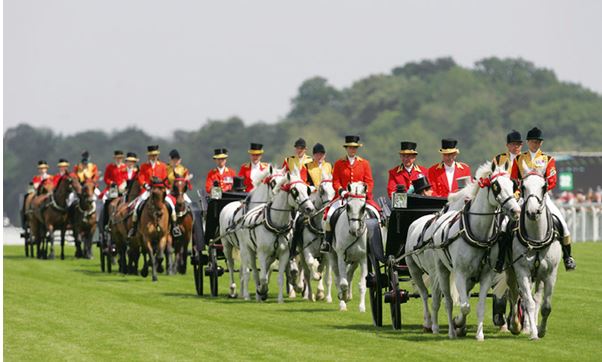
Royal Procession

The Royal Procession – Inaugerated by Wellesley-Pole 1825

Wellesley-Pole decided that the Royal Family should arrive at the fixed time of 1pm, and that a ceremonial procession be devised to celebrate the occasion. Given that Ascot was open to all, and the King was genuinely fearful of public hostility – Wellesley-Pole ramped up the pomp to such a high level as to create a sense of awe. This had two effects – firstly it put the King at his ease to feel that he was partaking in a State Occasion – secondly it appealed to the patriotic fervour of the people. Yes, they may have resented George IV as a profligate wastrel – but the institution of the British Monarchy meant so much more than that, and Ascot was neither the time or the place to undermine it.

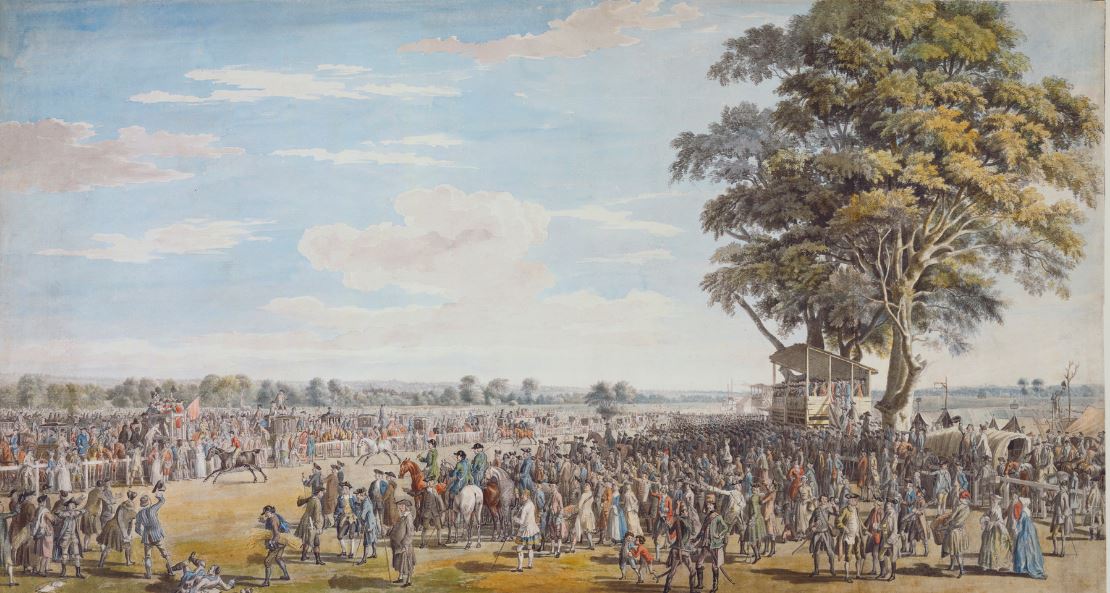
So, on 31st May 1825 his Majesty and a party of distinguished visitors emerged from trees within the Park and began a parade down the straight mile section of Ascot’s racecourse. The procession continued up to the newly built Royal Stand, and the newspapers reported

His Majesty was preceded by Wellesley-Pole and several yeomen prickers in their scarlet jackets, and came in his plain travelling-carriage drawn by four horses. Three carriages followed with the members of His Majesty’s suite. His Majesty, on alighting, was received by the Duke of York, who had previously arrived… and walked to the Stand with great firmness and appeared to be completely relieved from his recent attack of gout. On reaching the Royal Stand he instantly advanced to the window and on throwing up the sash was received with the customary demonstrations of loyalty and affection. He was highly delighted by the brilliant and numerous assemblage which was presented to his view.

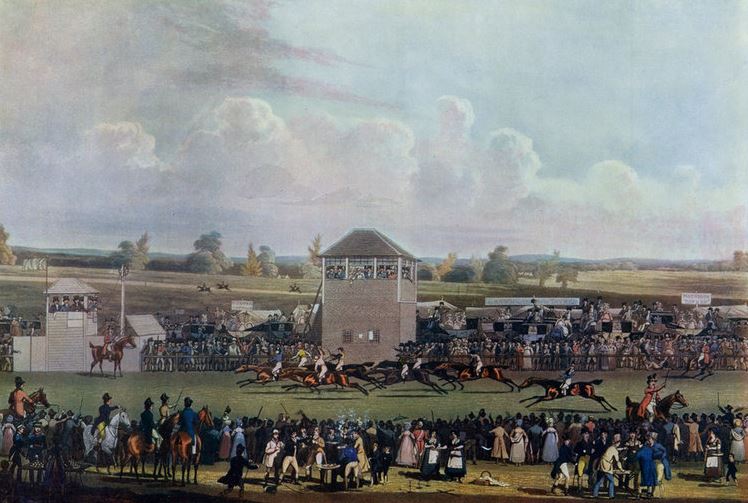
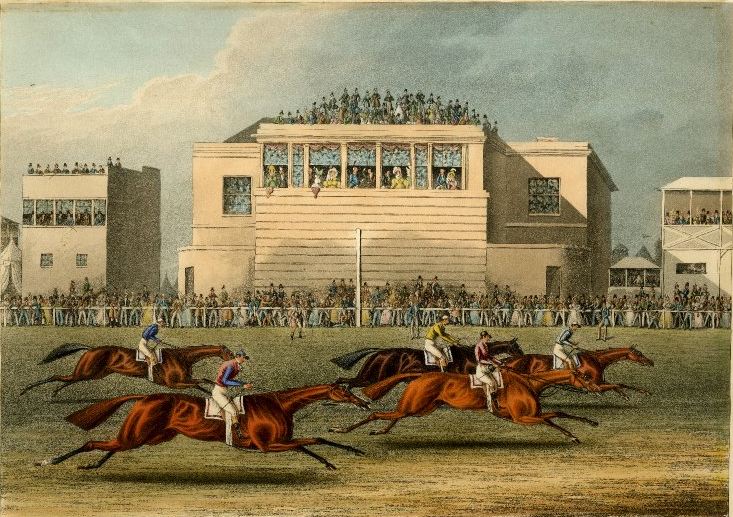
Ascot Heath Races

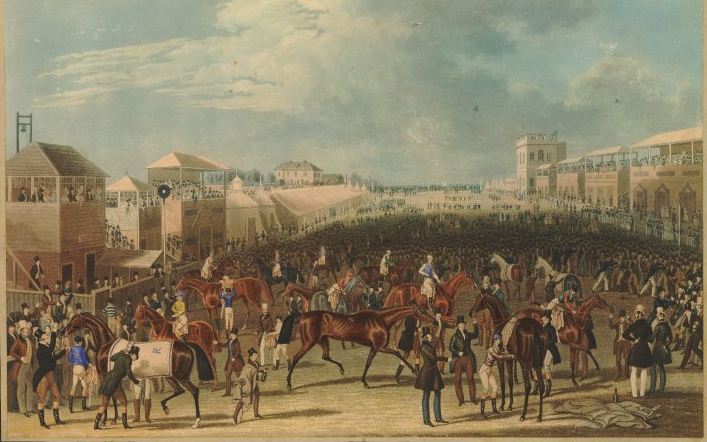
The Gold Cup 1829, King George IV’s final appearance at Ascot

At one o’clock precisely Lord Maryborough desired the bell for the first race to be rung, and at the same moment the Yeoman Prickers and Constables under his Lordship’s direction, and with great propriety forced every person to retire outside of the ropes and railings, thereby enabling his Majesty, and those in elevated situations, to command an uninterrupted view of the running, which began at 1-30pm sharp. Newspapers enthused that ‘the regulations adopted in this respect were most judicious, and were strictly adhered to throughout the day… It would be well if at Epsom so admirable a precedent were followed.’

So strikingly successful was the Royal appearance in 1825 that it was permanently adopted thereafter. Thus, as early as 1826 ‘Ascot Heath’ was no more, and the press hereafter referred to it as the ‘Royal Races’ at Ascot.

Rules and Regulations

Wellesley-Pole was a stickler for order and propriety, and his unremitting demands for conformity played a huge role in changing Ascot into a public occasion worthy of the Royal Court.

Ascot Heath Races 2

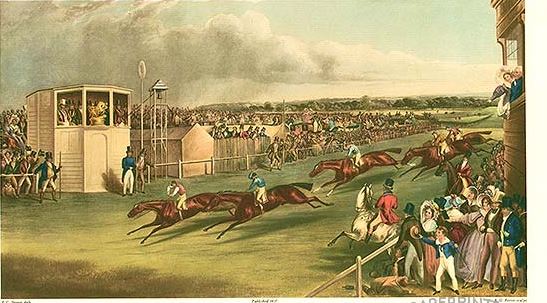
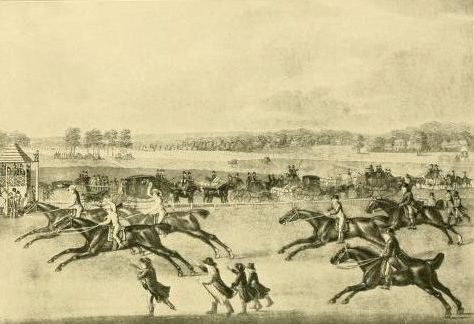
Determining race winners was never easy

We have seen that Wellesley-Pole laid down the rule that the Royal Family arrived at their Stand at 1 o’clock precisely via a procession down the straight mile. He employed hordes of security to keep the people off the race surface. As Steward he requested that all ranks of the aristocracy were on the course by 12 noon, emphasising that the new ‘Royal Procession’ was to become an integral part of the Ascot races.

When it came to the races themselves, Wellesley-Pole really came into his own. He insisted that all races start on time. A notice was fitted on the weighing room that every jockey not attending to weigh at the proper time would be fined.

The outcome of races was often the subject of great controversy, so Wellesley-Pole employed Mr Clarke the well-renowned judge from Newmarket in order to raise the Ascot’s standards of professionalism to the highest level. He also made it a strict rule that all horses start from the same point as this was often the source of dispute and accusations of cheating. Finally Wellesley-Pole ended the practice of running heats for various prized events, since on one occasion it got too dark for the final races to be ran.

It was generally agreed that Ascot needed an officious and firm stewardship, and though Wellesley-Pole did not endear himself to anyone unlucky enough to breach his rules, there was a grudging admiration for what he had achieved.

Licensing & Security

One of Wellesley-Pole’s greatest attributes was his ability to involve all staff in the process of change. Adding the Yeoman Prickers to the Royal Procession gave them a very real sense of inclusion, and made it easier for Wellesley-Pole to encourage them to secure the racetrack from trespass. On race days each person employed was made fully aware of the importance of their contribution. Better still, Wellesley-Pole paid special bonuses to reward everyone involved in the successful outcome of each meeting.

From 1825 there was a noticeable decline in crime and illegal gambling. The Morning Chronicle enthused that ‘those ruffians with cups and balls, garters, and other swindling devices, by whom Epsom downs was infested, were altogether excluded from the course’. A large contingent of Bow Street Runners were on hand to deter pickpockets and other petty thieves. The aim was to make the occasion a safe one, but not to exclude ordinary folk who came there in their droves.

Public at Ascot - Sandhay 1809

Ascot was a great public occasion, and there was not a bed to be had for miles around during race week

As mentioned earlier, the betting circle was extended after 1826 – but a license charge of 5 guineas was set so that Ascot could benefit financially. Also a team of inspectors was engaged to proceed against all vendors intending to serve wines and spirits without purchasing the appropriate license – again at 5 guineas each.

Such was the effect of Wellesley-Pole’s reforms that the Morning Chronicle wrote

Ascot cannot be too highly praised. The precision in which the races were run the keeping of the course- and the spirit displayed by the principle supporters of them, cannot but have satisfied the most fastidious; for everything evinced liberality and good management. To [Wellesley-Pole] the public are indebted for the management and execution of those measures to which the excellence of the sport was owing.

So, by 1830 Ascot had truly transformed to become ‘Royal Ascot’. It was in fact so popular with the King that he ordered Wellesley-Pole to arrange a second meeting to be held just a few weeks later. In the King’s eyes Wellesley-Pole could do no wrong. But change was coming – the King was ailing and Wellesley-Pole himself was soon to overstep his authority and fall from grace.

Tune in for part 4 of Wellesley-Pole and Ascot to see how Wellesley-Pole’s hot temper and over-bearing rules & regulations combined to bring the curtain down on his illustrious Stewardship of Ascot race track.

My blog sheds light on the extraordinary life and times of the Wellesley-Pole family, including their three daughters (dubbed the three graces), and, of course ‘Wicked’ William his notoriously scandalous son. It is only when we learn the calibre and achievements of his family that the real scale of ‘Wicked’ William’s depravity is revealed.

I would be please to receive any comments or feedback and thank you for reading this blog!


Lord Liverpool’s Masterstoke

Creating Tradition – Wellesley-Pole and Ascot (Part 2)

How Wellesley-Pole came to be Master of the Buckhounds, 1823

Intro | Master of the Buckhounds | The Age of Reform | Anger Management | Legacy

buckhounds

Where’s Wellesley-Pole? Why, He’s Gone to the Dogs!

All things considered 1823 was not a great year for William Wellesley-Pole. After 9 successful years as Master of The Mint culminating in his deserved elevation to the peerage (under the title of Lord Maryborough) Wellesley-Pole fully expected to earn a senior Cabinet position upon Lord Liverpool’s ministerial reshuffle. But when the Prime Minister summoned Wellesley-Pole in January 1823 he dropped the bombshell that our man was surplus to requirements. To put it bluntly, Wellesley-Pole had reached the end of his useful life and the time had come for Liverpool to bring in new blood, such as Robert Peel and the racey and exciting William Huskisson,  who would help to bolster his unpopular administration

But Wellesley-Pole’s reaction placed Lord Liverpool in a quandary, for he flew into a rage and point blank refused to leave the Cabinet. Charles Arbuthnot recorded that Wellesley-Pole considered ‘the usage he has met with is quite atrocious & that he would not accept of any office but the one he has. He talked a great deal of stuff about the respect due to him as the Duke of Wellington’s brother, & in short, was like a madman.’ Such defiance of Prime Ministerial order threatened to undermine the very foundations of Liverpool’s Government. He had to get rid of Wellesley-Pole, but needed to devise a stratagem to achieve his aims without further rancour.

liverpool  wellesley-pole hulk

Lord Liverpool didn’t like Wellesley-Pole when he was angry

In the Autumn of 1823 Liverpool at last found the perfect opportunity to offload his angry Minister. He did this by exploiting Wellesley-Pole’s close relationship with King George IV. The death of Charles Cornwallis on 9th August created a vacancy in the Royal Household, in the office of Master of the Buckhounds. Wasting no time at all Liverpool wrote to the King suggesting that Wellesley-Pole wanted to apply for the job because he was practically George IV’s number one fan.The King was led to believe that Wellesley-Pole he always dreamt of having a country home near Windsor, but that he was far too modest to apply. Needless to say the King was receptive to such gushing adulation, took up his pen and wrote a plea for Wellesley-Pole to take the job. Perhaps with Liverpool’s connivance the salary offered was generous-  plus he was promised the gatehouse to Windsor Park upon which to make his establishment.

When Wellesley-Pole received the King’s letter has was surprised and flattered, but unsure as to whether a man of his age (60 years old) could be capable of taking on such a youthful and athletic role. However it was a place in the Royal Household dating back to the 1300s which appealed directly to Wellesley-Pole’s strong respect for of tradition. For Mrs Wellesley-Pole it was a no-brainer because she really did want a country retreat and this golden opportunity was quite simply too good to pass up. The King’s offer was therefore speedily and gratefully accepted.

It was only after the deal was done that Liverpool played his trump card. He wrote to Wellesley-Pole congratulating him on his appointment to the Royal Household but reminding him that an employee of the King could not be a Cabinet Minister – since the King would be embarrassedby the accusation of putting his own men into Government. This was a masterstroke leaving Wellesley-Pole no option but to fall on his sword – for he could not go back on his word to the King, still less dash his wife’s hopes of rural paradise. In private Wellesley-Pole roundly abused all in Government, not least the Duke of Wellington in whom he felt a keen sense of betrayal, but the fear of upsetting the King meant that ultimately Wellesley-Pole went quietly into political retirement.

buckounds at salt hill

The Buckhounds at Salt Hill, near Windsor c.1850

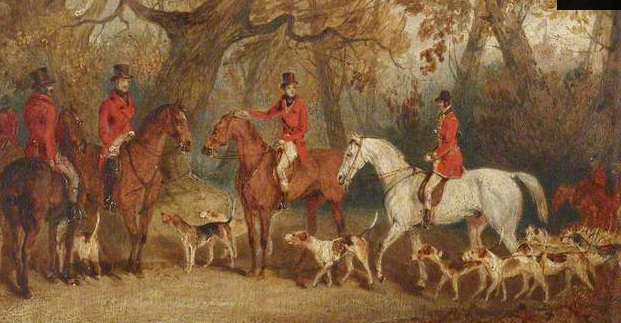
So just what was Wellesley-Pole letting himself in for? Well its fair to say his task largely involved acting as the Royal entertainments officer. This principally involved gathering the horse and hounds together for organised hunts, usually in Windsor Forest; but from the mid-1750s it began to embrace other sporting activities – particularly equine sports. Because the Royal Family controlled the wardenship of Windsor Forest, their patronage over horse-racing at Ascot Heath was long-established – dating back to Queen Anne (1711). Responsibility for ‘Royal Ascot’ really was the jewel in the crown of duties expected from the office of Master of the Buckhounds.

royalascotregency

Ascot Heath Races – The ‘Royal’ tag was to come much, much later

It is no secret that Wellesley-Pole had a hot temper, or that he could be a very fearsome adversary when roused. But his temper tantrums were never of long duration and, like his brother Wellington, he refused to let emotion become an obstacle to giving his all in service of his country.

Just a month after taking up his duties, Charles Bagot saw Wellesley-Pole ‘in light buckskins with a jockey cap and gold couples to his belt’ acting as Master of the Buckhounds. Wellesley-Pole insisted he was ‘exceedingly pleased with the appointment…he was getting tired of politics and the hounds were just the hobby he would most like.’ Whether this was bravado or the plain truth, it was obvious that Wellesley-Pole was going into this job enthusiastically. He quickly realised its possibilities went far beyond dog-minding,  offering him the chance to take control of Royal Ascot, a once great event whose reputation was tarnished by years of disorganisation  and neglect. Nearby racetracks (such as Epsom and Newmarket) threatened to leave Ascot in their wake. So, for Wellesley-Pole the task was on!!

So, on 13th October 1823 the King’s staghounds made their first appearance of the hunting season, near Winkfield Plain at Windsor. Several ladies in carriages and a great crowd of ordinary folk turned up to witness Lord Maryborough’s debut as Master of the Buckhounds- and to witness how a Cabinet Minister really had gone to the dogs.

To find out more about how brilliantly devious Lord Liverpool could be you should look no further than Norman Gash, whose The Life and Political Career of Robert Banks Jenkinson, Second Earl of Liverpool 1770–1828  was first published in 1984. Sadly Norman died in 2009 but a new paperback version of his book is due for publication in 2015.

For more on Wellesley-Pole’s hot-headedness, and how he turned anger into a positive energy, you may like to read his battle to save a tramp.

To find out how Wellesley-Pole ‘created’ Lord Wellington please read my guest blog on Number One London

I’d love to hear any comments or questions you may have about the Wellesley-Pole family, not least Wicked William, the blackest of all black sheep. So please contact me and I’ll be delighted to respond.


Creating Tradition: Wellesley-Pole & Royal Ascot


Tell Lord Maryborough that whatever may happen to me, I declare no interruption may be given to the races at Ascot

King George IV on his deathbed June 11, 1830

Intro | Master of the Buckhounds | The Age of Reform | Anger Management | Legacy

modernday royal ascot

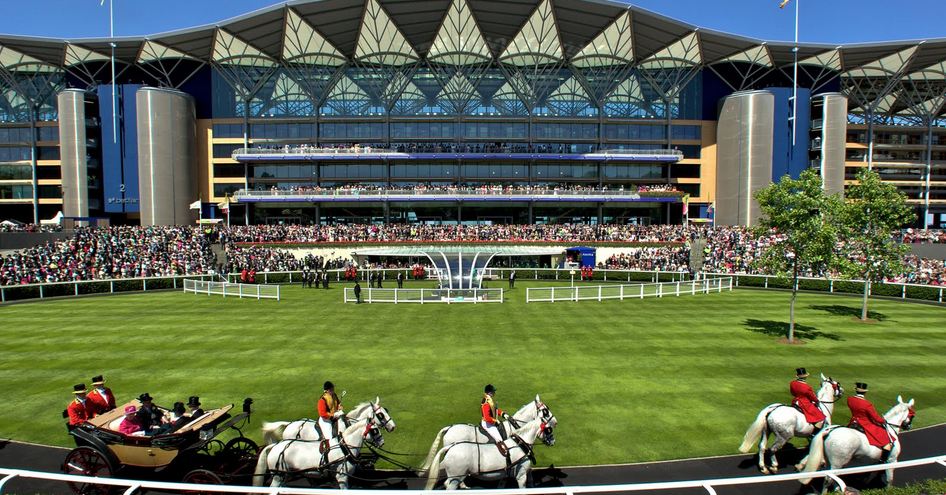
Modern day Ascot -a beautiful race venue

A day out at Ascot Races earlier this month encouraged me to look into its history in the hope that Lord Maryborough (William Wellesley-Pole) would feature prominently. But despite his pivotal role in elevating Royal Ascot from a run of the mill race meeting to a must-see event in the British sporting calendar, I could find no commemorative picture or plaque adorning the walls of Ascot’s magnificent new stand. Ascot’s website is equally unforthcoming in its brief history page – meaning that Wellesley-Pole (as per usual) has been airbrushed from history.

 brothers

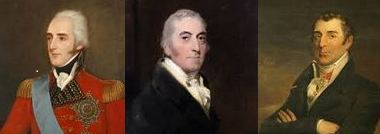
Spot the nonentity? – Wellesley-Pole (Centre)

Sandwiched between successful brothers Richard (Marquis Wellesley – Governor General of India 1797-1805, Foreign Secretary 1809-1812) and Arthur (Duke of Wellington), Wellesley-Pole is destined to remain in the shadows. But this hardly justifies why numberless books about the Wellesley brothers feature Wellesley-Pole in a cameo only – He flits about like a kind of pantomime villain – a social climber, grasping opportunist and perpetually angry ‘with anything and anyone’ who gets in his way. I’m not sure what is worse about these assessments – the lazy complacency of poor historical research or the complete inability/unwillingness to place Wellesley-Pole in his correct context. Because the fact is that even a rudimentary study of Wellesley-Pole reveals the important role he played in establishing and consolidating the Wellesley family dynasty.

waterloo medal

Wellesley-Pole’s Waterloo Medal (1816)

coin


It doesn’t come more iconic than this! Wellesley-Pole’s Gold Sovereign (1817)

In his own right Wellesley-Pole was responsible for the Waterloo Medal (1816), opening of Waterloo Bridge (1817) and the iconic Britannia design for gold sovereigns (1817). As Master of the Mint (1814-1822) his finest achievement was the introduction of new silver currency in 1817, dubbed the ‘Great Recoinage’. Over a period of two weeks Wellesley-Pole organised the nationwide distribution of 2.6 million coins whilst simultaneously collecting up and melting down all the old currency – a task completed without a single mishap –at a time when there was only a rudimentary transport and communication system in Great Britain. Sir Joseph Banks enthused

The bold manner in which [Wellesley-Pole] devised, and… executed one of the most difficult works…during the present Reign, or possibly any former one, does honour to the name of Wellesley

This new silver coinage was to remain legal tender right up until 1971. That’s over 150 years in which Wellesley-Pole’s handiwork permeated every nook and cranny of British society – becoming a recognisable symbol of Britishness – His coins even outlasted the Beatles (whose last public performance was coincidentally held on the roof of Wellesley-Pole’s old family mansion in Savile Row). All this and no blue plaque!!

savilerow

No 3 Savile Row, Wellesley-Pole’s mansion & latterly Apple Studios

This series of blogs will look at Wellesley-Pole’s 7-year tenure as Steward of Royal Ascot, a time in of great change, during which Ascot’s place was embedded in the annual sporting calendar. This may not be the most important duty Wellesley-Pole undertook in his many years of public service– but it tells us a lot about him as a man – revealing both his brilliant and irrational nature. (Links will come live as they are added)

  1. Master of the Buckhounds – How Wellesley-Pole was unceremoniously dumped from the Cabinet and duped into accepting a role in the King’s Household – which included responsibility for Ascot races.
  2. The Age of Reform – Detailing structural, ceremonial, and organisational changes effected by Wellesley-Pole  as Chief Steward of Ascot between 1822 and 1830
  3. Anger Management – A look at the advantages and disadvantages of Wellesley-Pole’s hot temper, and how it led to his departure from Ascot
  4. Legacy – Why Ascot ought to re-examine its history and traditions to give Wellesley-Pole the credit he deserves

For more information on Ascot Racing visit their website or read the BBC’s brief history

For more equine-related japes on this blog you might like a brief history of the Epping Hunt


Fitzroy Somerset gave his right arm for Wellington – but was it reciprocated?

wellingtonsmall   fitzroy somersetsmall

Brothers in arm? Wellington & Fitzroy Somerset

Perhaps the biggest cloud hanging over the military career of Arthur Wellesley, 1st Duke of Wellington is the perception that he was cold and unfeeling to his troops. Countless biographies remind us that the Iron Duke rarely showed his emotion. He was said to be prone to condescension to anyone that he deemed inferior – which was practically everyone. For many the legendary description of his men as ‘scum of the earth’ in 1813 underlines Wellington’s ruthless reputation – yet when the quote is used in full context the picture become less clear:

[these men are] the scum of the earth; it is really wonderful that we should have made them to the fine fellows they are

The above seemingly blatant insult could now be reinterpreted as Wellington’s appreciation for how far such lowly men had progressed under his command, though it was hardly a glowing compliment.  In fact there are many instances of Wellington’s sense of feeling in the arena of battle – and just how keenly he felt the loss of men under his command. Despite these occasions an over-riding sense remains that Wellington was never quite willing or able to give credit where it was due – even towards his closest military aides.

waterloo

Wherever Wellington went, Fitzroy was sure to follow (Waterloo 1815)

One such stalwart was Fitzroy Somerset, youngest son of the 5th Duke of Beaufort, who joined Wellington’s staff in 1807 and became his military secretary in 1811. In August 1814 Fitzroy married Emily Harriet Wellesley-Pole, Wellington’s niece (and Wicked William’s sister).  She was in Brussels with him and gave birth to a baby daughter just weeks before the battle of Waterloo. In the heat of the battle Fitzroy was shot in the arm by a French sniper, whilst he was fighting alongside Wellington. He was taken to a nearby farmhouse where the arm was amputated – but not before he insisted on removing a ring his wife had given him.


arm-loss siteAfter Waterloo, Fitzroy’s arm was amputated in this terrace (left)

One of the first duties Wellington had to perform on his return to Brussels was informing Emily of her husband’s situation, which can hardly have been the easiest news to impart to a young mother wrought with anxiety.

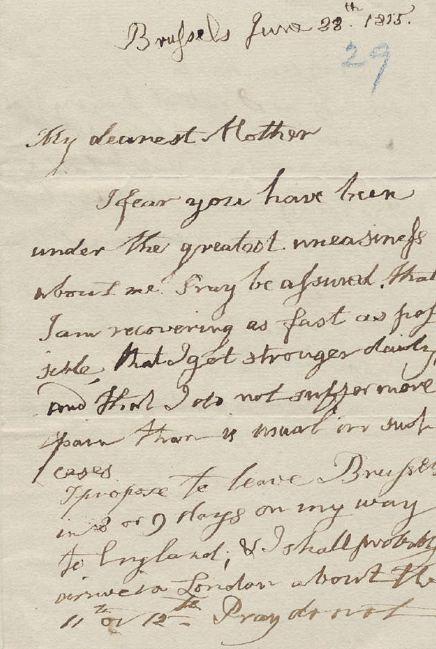
Shortly afterwards Wellington penned this letter to Fitzroy’s brother:

To His Grace to Duke of Beaufort
Bruxelles, June 19th 1815

My dear Lord
I am sorry to have to acquaint you that your brother Fitzroy is very severely wounded, and has lost his right arm. I have just seen him, and he is perfectly free from fever and as well as anybody could be under such circumstances.
You are aware how useful he has always been to me; and how much I shall feel the want of his assistance, and what regard & affection I feel for him; and you will readily believe how much concerned I am for his misfortune.
Indeed the losses I have sustained have quite broken me down, and I have no feeling for the advantages we have acquired. I hope however that your brother will soon be able to join me again; and that he will long live to be as he is likely to become, an honour to his country, as he is a satisfaction to his family and friends.
Believe me my dear Lord ever your most faithful servant
Wellington

It is plain how desperately sad Wellington was for the injuries sustained by his young protégé – and very touching (with the benefit of hindsight) to know that Fitzroy went on to fulfil his destiny as ‘an honour to his country’.
But questions arise as to the true measure of their relationship when we look at the many years of service that Fitzroy gave to Wellington  – suggesting that Wellington received much more than he was prepared to reciprocate.
Having endured Wicked William’s antics at the battlefront for two months in 1808, it must have come as a relief for Arthur Wellesley to find someone as reliable and discreet as Fitzroy Somerset amongst his aide-de-camp staff.  Over the course of 6 the next years Fitzroy became as essential part of Wellington’s command.

Even after the calamity of Waterloo, Fitzroy quickly learned to write with his left hand and remained part of Wellington’s inner circle. Following a stint as aide de camp to the Prince Regent, he returned as Wellington’s secretary in the latter’s new capacity as Master-General of the Ordnance in 1819. When Wellington became Commander-in-Chief of the Forces in January 1827, Fitzroy duly followed to become Military Secretary.  But hereafter came a parting of the ways since Wellington was obliged to relinquish command of the army when he became Prime Minister in January 1828. Fitzroy stayed on as Military Secretary until 1852 (the year Wellington died) – effectively becoming the Duke’s eyes and ears in army-related matters.

letter home to mum

Fitzroy’s first shakey left-handed letter to his mother

On the face of it there is plenty to suggest that Wellington took a very keen interest in Fitzroy’s career, and he certainly ensured that Fitzroy’s disability proved no hindrance to high office.  When we look at the recently auctioned Raglan Collection, there are many items that could only have been gifts bestowed on Emily and Fitzroy through Wellington’s personal generosity.
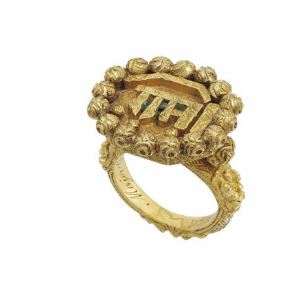
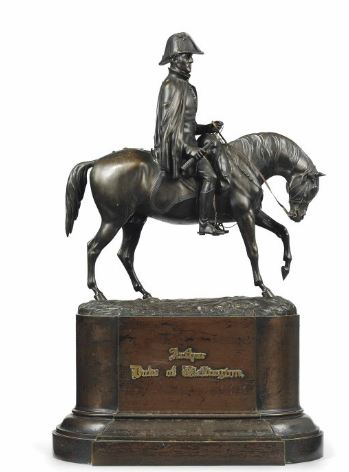
For example Lot 10, a ring allegedly taken from Tipoo Sultan’s finger after the Battle of Seringapatem in 1799, or Lot 78 which originally stood in Apsley House

tippo ring bustof wellington

But here’s the rub – Wellington’s private generosity ran counter to his preparedness to intervene in matters of public concern.  For we find that Fitzroy’s willingness to serve, his loyalty and commitment was rewarded with mediocre pay.

Throughout his life Wellington was exasperated by constant demands upon his patronage, privately acknowledging that his refusal to bow to such pressure when forming his first cabinet in 1828 lost him many friends. Even Charles Arbuthnot sulked for days on that occasion, but the Duke held firm and kept his friend from office. Why was this?

Wellington often said:

I am nimmukwallah, as we say in the East; that is…I conceive it my duty to serve with unhesitating zeal and cheerfulness, when and wherever the King or his government may think proper to employ me.   

This rigid sense of duty compelled Wellington to suppress private needs wherever they impinged upon matters of Government and state. It made him circumspect not only in regard to patronage for others, but also in terms of his own rewards.  For example in the aftermath of Waterloo when the nation was happy to lavishly treat their conquering hero, Wellington modestly opted for Stratfield Saye House – & returned £100,000 to state coffers. We can therefore see that Wellington’s over-riding desire to maintain high standards of decorum in office, created the dichotomy between private generosity and public mean-spiritedness.

bunker mentaility

In public life Wellington often felt isolated, but saw approachability as a weakness

Another factor separating Wellington’s private and public image was his hostile attitude towards the press, of which he once wrote… ‘blackguard editors of newspapers [attempt to] deprive us of our reputation by their vulgar insinuations’. Wellington repeatedly declared that he would never have anything to say to the ‘gentlemen of the Press’.  Acting like this he developed a bunker mentality, going out of his way to avoid accusations of impropriety in public office – making him appear hard-hearted towards genuine appeals for placement.

It is therefore unsurprising that Fitzroy Somerset was not raised to the peerage until after Wellington’s death, or that he remained a relatively poor man throughout his life. Both of these could (and perhaps should) have been tackled through Wellington’s influence. Fitzroy was created Baron Raglan in 1852 and given command of the British troops sent to the Crimea in 1854. He died there in 1855 from complications brought on by an attack of dysentery. Even in his final cruel days at the battlefront Raglan was heard exclaiming ‘What would Wellington have done, if he had been here?’  This poignant plea reveals how much Raglan appreciated the comradeship and ability of his old commander in arms.

raglan crimealarge

Dear Arthur, Wish you were here. Fitzroy x

In conclusion we must consider Raglan’s feelings when examining Wellington’s commitment to their friendship. We see that Lord Raglan idolised Wellington and seems to have had no sense of being taken for granted. The plain truth is that the Iron Duke would not have given his right arm for anyone, and those who knew him intimately would have accepted this unequivocally – because Wellington’s private character could never usurp his desire to serve the nation.

This blog does not shed more light on the complexities of Wellington’s character – but it does show that he was loyal and dependable, whilst also aloof and ungenerous. This combination is the crux of the continuing debate about Wellington the man.

As for Lord Raglan, his death proved him a wealthy man indeed for in 1858 some 1800 friends, admirers and comrades purchased Cefntilla house and estate in Monmouthshire, presenting it to his family in perpetuity – a fitting memorial to a man who indeed was ‘an honour to his country’.

cefntilla

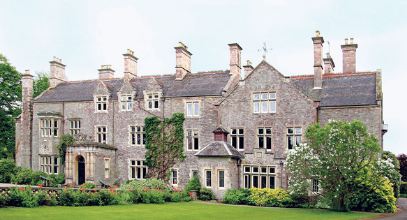
Cefntilla Court, Raglan’s ancestral home

If you are interested in more about Wellington’s character you may like Wicked William goes to war or find out whether Emily Somerset was Wellington’s favourite niece.

Christie’s auction catalogue for the Raglan Collection (London, 23 May 2014) really is a triumph of academic research containing a veritable treasure trove of items of interest.

Raglan Rescue is an ongoing campaign to save Lord Raglan’s collection for the nation

I cannot recommend highly enough the superb new archive in Ebbw Vale and its helpful staff, where the Raglan MS is housed.

There are so many excellent internet and archival resources devoted to Arthur Wellesley, Duke of Wellington. However it is impossible to ignore the forthcoming Wellington Congress which will be staged at the University of Southampton from 9-12 April 2015. This is a great way to hear many diverse papers about the life and times of the Duke of Wellington, and it is not too late for those wishing to submit a paper and be part of this event celebrating the bicentennial of Waterloo. Who knows? I might even be there!


Three to See at the First Georgians Exhibition, Queens Gallery

first georgians

The beauty of going to any exhibition is the fact that each and every item being shown has the power to strike a chord, providing every visitor both a unique and a personal experience.

This fact can be no better demonstrated by going to ‘The First Georgians’ which is on at the Queen’s Gallery, Buckingham Palace until October 12th. Organised to mark the 300th anniversary of the accession of George I, Britain’s first constitutional monarch – this exhibition focusses on works of art collected by the royal family (at various times) dating from 1714 until the death of George II in 1760, what we might describe as the early Georgian era.

 hogarths card

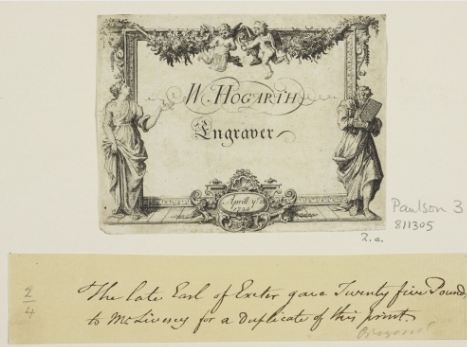
Hogarth’s business card as an engraver – but he was so much more

Fans of William Hogarth (1697-1764) will not be disappointed. His series of six paintings A Harlot’s Progress (1732) & Marriage A La Mode (1743-45) can be seen side-by-side in a section dedicated to perhaps the first exponent of British satirical art.

Seeing Johannes Kip’s incredibly detailed London maps and Canaletto’s overly idyllic views of the Thames from Somerset House was a great pleasure, but for me there are three stand-out exhibits worthy of the admission price alone.

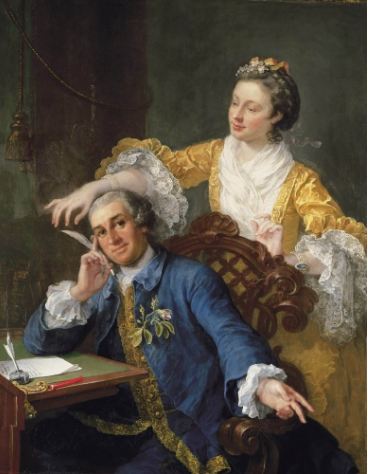
  1. David Garrick and his wife, Eva-Maria Veigel, by William Hogarth (c.1757)

garrick

I have always associated Hogarth with the representation of idleness and debauchery via engravings such as Gin Lane (1751) but here we find an almost seaside-postcard style of painting with truly vibrant colours and little nuances of humour encapsulating his subjects perfectly.

David Garrick (1717-79) was one of the most frequently painted subjects in eighteenth-century Britain. He befriended Hogarth after the artist painted Garrick as the King in William Shakespeare’s Richard III in 1745 (Liverpool, Walker Art Gallery). But it is thought that the pair fell out over this particular portrait. Garrick was displeased with his likeness and disliked the original domestic setting. Hogarth amended the scene by adding a hanging chord in the background reminiscent of the stage, but Garrick never collected the painting and it was still in Hogarth’s possession when he died in 1764.

What I especially like is the depiction of Veigel sneaking up behind her husband to snatch his pen away. This gives me a sense of the warmth of their relationship, with Garrick’s smile adding further to the playfulness of the scene.

This painting is hung in the main gallery well away from the other Hogarth exhibits, and for this I think it benefits greatly and the style in which it is painted makes it refreshingly timeless.

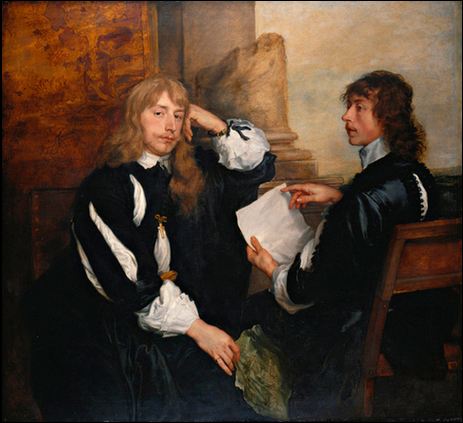
  1. Thomas Killigrew with an Unidentified Man, by Van Dyck (1638)

 killigrew

This painting really is mesmeric to see in the flesh. Painted by Sir Anthony van Dyck (1599-1641) it depicts two figures united by grief. On the left is Thomas Killigrew (1612-83), who is in mourning for his wife Cecelia Crofts, who died in 1638 just two years into the marriage. Killigrew wears his wife’s wedding ring attached to his left wrist by a black silk band. A silver cross inscribed with her intertwined initials is attached to his doublet and he wears a mourning ring next to his wedding band. In his hands is a piece of paper on which there are drawings, possibly made with a funerary monument in mind. Killigrew is being comforted by a friend, but is too distracted by grief to acknowledge what he is being shown.

Such is the incredible clarity of van Dyck’s brushwork that Killigrew really does come to life and his doleful eyes seem to draw you in from far away so you can come and pay your respects. Killigrew’s expression and his long hair would not look out of place on a 1960s hippie, but the sombre tone really does transmit his pain. There are some interesting theories about who the other gentleman may be, but I think the beauty of this painting renders knowing an irrelevance.

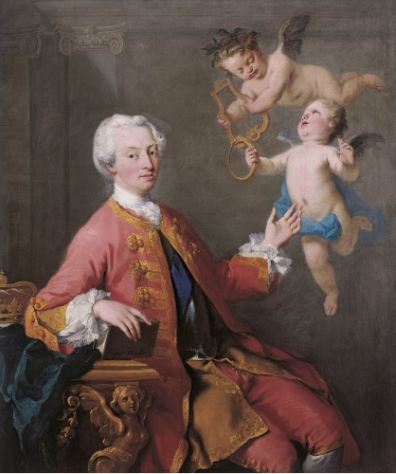
  1. Frederick, Prince of Wales, by Amigoni c.1736)

 frederick

This may seem like an odd choice for my top three, but I have selected it because one of the very knowledgeable curators at the Queen’s Gallery gave a very informative 10-minute talk about it during my visit. Unfortunately she had to compete with a completely ignorant guide who stood at the opposite end of the main gallery talking very loudly to a party of tourists. Given that the guide had ample other points of interest to show her enthusiastic troupe, it was incredibly bad manners for her to blather on whilst the curator bravely soldiered on.

Above all this painting has exposed my ignorance about the Georgian succession. Up until now I have been happily deluding myself that George III was the son of George II and followed him as naturally as princes follow kings. But the fact is that Frederick, Prince of Wales (1707-1751) was the man who ought to have succeeded George II, & whose death meant that it was a grandson who became George III in 1760.

Frederick seems to have had a very neglected childhood, having been left back in Hanover at the age of 7, and not seeing his parents for the next 14 years. Not surprisingly his relationship with George II was strained, and he spent his life trying to carve a separate identity. As Prince of Wales he fraternised with opposition politicians and became a patron of the arts. His knowledge and good taste led to the accumulation an outstanding cache of art, which now forms part of the Royal Collection.

Frederick was eventually banned from the King’s court in 1737 after he sneaked his heavily-pregnant wife out of Hampton Court Palace in the middle of the night, to ensure that the King and Queen could not be present at the birth. His poor spouse was forced to get into a carriage which raced over to St James’s Palace just in time for the birth. The King and Queen were furious at this perceived snub and never forgave Frederick for this act of independence.

This portrait by Amigoni was commissioned by the Prince’s friend, George Bubb Dodington (1691-1762), & given to Frederick as a peace-offering following a spat between them. As is appropriate for a friend’s portrait the Prince appears in an informal and affable guise, as patron of the arts. Frederick holds a book inscribed ‘Pope’s Homer’, alluding to Pope’s famous recently-published translations of The Iliad and The Odyssey. Cherubs fly above the Prince holding a lyre (the attribute of Poetry) and a snake biting its tail (the attribute of Eternity, the duration of a true poet’s fame).

Though his pose is relaxed, the Prince does have formal attributes: a crown on the table, and a riband of the Garter reminding us that this is not just any patron of the arts but a heroic and a royal one.

Frederick certainly seems a character worthy of greater investigation, not just for his contribution to the development of the arts, but also for his love of English culture. Whenever you next hear ‘Rule Britannia’ spare a thought for our lost King for it was Frederick, Prince of Wales whose patronage brought this song into creation.

Because I am really more of a Regency historian, I have shamelessly pillaged the Royal Collection website for background information on these great works of art. Any errors made are all mine though.

If you have been or are considering going to the First Georgians Exhibition I’d love to hear back regarding the works of art you found most compelling – As I have a free return voucher and it would be great to look from another perpective!!

Click Here for more info and facts on the First Georgians Exhibition:

The peerless Lucy Worsley has made a BBC4 TV show about the current exhibition

If you liked this you may like the following excellent Georgian era  Blogs:

Jacqueline Riding is a fountain of knowledge on Georgian art amongst other skills

Who could resist the legend that is Madame Gilflurt 

The British Society for Eighteenth Century Studies promotes all things Georgian

And finally, partly because Ireland is steeped in Georgian era culture, and partly because Frederick, Prince of Wales served as the tenth Chancellor of the University of Dublin (1728-51), I would recommend a visit to the Irish Georgian Society  – Me being Irish might have had a hand in this too.

‘Uncle Arthur Wellesley? He’s not all that!’ – Wicked William goes to War


 wickedwilliamyoung         wellington

‘Wicked’ William and the Duke of Wellington were remarkably alike in appearance


Little has been written about ‘Wicked’ William Long-Wellesley beyond his role in the destruction of Wanstead House. My research (and this blog) will show that William’s long and turbulent life encompassed far more than the mere dozen years it took him to plunder Wanstead’s treasures and lay waste to its estates.

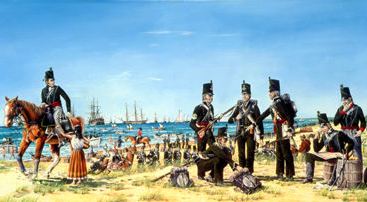
Today we go back to 1808; the place is Portugal and it is mid-summer. General Arthur Wellesley (later Duke of Wellington) has just landed at Mondego Bay leading a British expeditionary force numbering 14000 men – this being the very start of his 6-year fight to liberate the Iberian Peninsula from Napoleon’s occupying forces. Amongst Arthur’s considerable retinue we find one William Pole, a 20-year-old aide-de-camp on his first tour of duty. Considering Arthur’s already legendary reputation for precision, this seems an odd appointment. Yet closer scrutiny shows that even the greatest military strategists are often bound by family obligation – thus lumbered with errant relatives, in the hope some good may come of the exercise.

 mondego bay

 He’s out there somewhere – ‘Wicked’ William lands in Portugal, 1808


William Pole was one such stray – foisted upon Arthur by older brother William Wellesley-Pole. It was a kind of trade-off in favours because Wellesley-Pole was Arthur’s most reliable and trusted confidante, protecting his interests at home – therefore Arthur could hardly refuse taking this wild but spirited boy under his wing. So it came to pass that ‘Wicked’ William and Arthur Wellesley went off to war together, offering a possibly unique opportunity to see our greatest General on the battle front, through the eyes of his own family.


rolica

At Roliça & Vimeiro William’s role involved delivering messages between regiments


Without delving too deeply into events in the field, it was a very exciting beginning for William. He first saw action at the Battle of Roliça on 17th August, where Arthur’s men defeated an outnumbered French army under General Delaborde. The next day William wrote to his mother

 I seize this, the earliest opportunity; to send you such most pleasing intelligence. I have escaped unhurt; the action was most severe and cost many brave lives… We found ourselves led into a labyrinth of narrow passes and impassable mountains. Sir Arthur, cool and collected, ordered the artillery to advance; and shots for shots were frequently exchanged between us and the enemy… The volley of the shots became less frequent; our foes were cleared for the heights… at length abated and left us master of the field of battle.

Four days later the French returned in greater numbers hoping for the element of surprise– But they were again defeated at the Battle of Vimeiro – putting an end to the French invasion of Portugal.

cintra

Arthur Wellesley was lambasted for his role in the Convention of Cintra

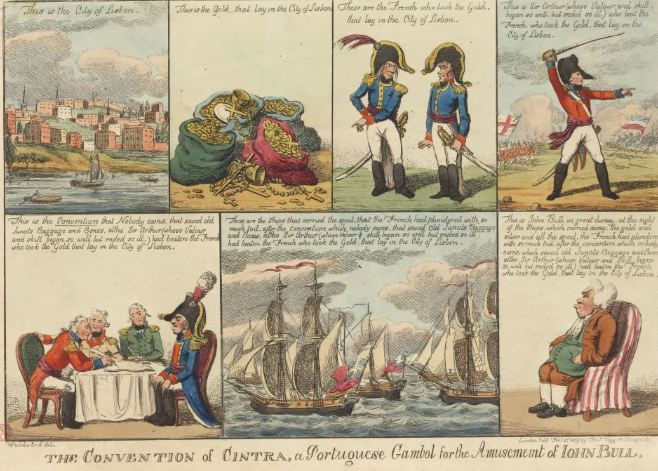
Yet this result would have been much more decisive but for the fact that two more senior British Generals arrived on the scene in the heat of battle, relieving Arthur Wellesley of his command. They prevented Arthur’s pursuit of the vanquished French armies and subsequently agreed an overly generous truce. The Convention of Cintra signed on August 30th allowed the entire French army free passage out of Portugal, and more importantly fit to fight another day. To add insult to injury the Royal Navy laid on ships to carry other French troops and munitions back home. This news was received with outrage in England, and Arthur blamed despite the fact he had not been a party to the agreement other than to sign it when ordered to do so by his superiors. Being demoted when in the throes of routing the opposition must have been a shattering blow for Arthur. He wrote to Wellesley-Pole on 26th August regarding his senior officers:

These people are really more stupid and incapable than any I have met with; & if things go on in this disgraceful manner I must quit them.

Naturally in the depths of such despair, Arthur was not to be trifled with. Into the firing line came William, whose bravery in the field had been reported in despatches, and whom Arthur had just a few days earlier remarked upon favourably. But with Arthur’s patience exhausted and his heckles up William was to become the fall-guy. This letter from the Raglan MS (dated Sept 6th) holds nothing back – as Arthur tells Wellesley-Pole exactly what he thinks of young William.

He is the most extraordinary person altogether I have ever seen. There is a mixture of steadiness and extreme levity, of sense & folly in his composition such as I have never met with… the nature of our relative situations, & the constant crowd with which I am surrounded prevents all intercourse between us… He is lamentably ignorant and idle… he talks incessantly and I hear of his topics from the others which sometimes do not appear to have been judiciously chosen… I have an opportunity of talking to him seriously of his situation; for he is gone off without Leave, which I must notice… In short I don’t know what to say about him. To educate him would be a desideratum… he will never be on a upon a par with the rest of society till he shall have educated himself

Historians regularly cite the above as a testament to Arthur’s black mood during this period. It is certainly true that Arthur’s anger made him excessively harsh towards his nephew. But given what we know about William’s subsequent behaviour at Wanstead – it is hard to disagree with this assessment.

maryborough

Wellesley-Pole received the news that William was ignorant without comment

What Wellesley-Pole must have made of Arthur’s character assassination of William we shall never know because the subject is not mentioned in subsequent correspondence. But, thanks to surviving archives, we do have the benefit of a right of reply from ‘Wicked’ William himself. We learn that William also wrote a letter home (on 27th August) in which he castigates uncle Arthur’s behaviour. The original has not survived – all we have is the reply from older sister Mary Bagot, which reveals that William actually expected more favourable treatment. To him being a relative transcended rules of rank and order within the army hierarchy. William’s vanity meant he could not grasp how such demands threatened to undermine Arthur’s authority.

My Dearest William – depend upon it, if it gets wind that you have differences with Arthur, you are ruined and undone… You must I seriously think have been drunk when you wrote to me. But I will answer every part of your complaints simply__

In the first place, you say Arthur “treats you distantly and never speaks to you”. I know, and have always heard, that when upon Service, he is notoriously distant with all his officers. Besides this, would a man of common sense be particularly free with his own nephew to disquiet every other person, make you hated, & an object of jealousy, & himself abused for favouring his nephew.

 You next say “he never employs you” – The general opinion here is that you were the person most employed & sent about with most messages in the actions. You say “you gain no credit” – To this I answer: The Times, The Oracle, & Courier have all had various eulogisms in them of you, for your activity and gallant behaviour… Everyone speaks the same language & all write in asking me, & hoping you intend following up the profession, as it is one you appear to shine in. So this is gaining no credit!

My dear William, you must recollect you are just 20. For many of those you are with, not only have a right to take the piss out of you & not only from superiority of years, but from rank, length of service & a thousand other things & can you expect to be employed & a preference given to you above them all. I cannot conceive how the idea of being employed conspicuously ever came into your head… Many work hard for years without gaining the credit you have gained in one month.

My love, your complaints are ungrateful to providence, & to Arthur… Give yourself common pains to gain an insight into the art of the profession you are now in. You began your career with one whose name & character stands unrivalled, & on with whom if you quarrel God help you is all I can say.

Above all this letter shows that William was by now a fully-fledged attention seeker. The mere fortnight that the British army rested following Vimeiro was clearly too dull– for William craved constant excitement and attention. He was obviously unprepared for the many months of inactivity and hardship facing most soldiers over the course of a campaign.

However, it must be said that William has identified traits in Arthur’s character which became the subject of debate and conjecture throughout his military career. This is perhaps best summed up by Arthur’s famous description of his troops as ‘scum of the earth’, which many observers then and since have considered insulting and unfeeling towards the many men who loyally served him & whose bravery was beyond reproach. As historian Christopher Duffy succinctly puts it

Wellington I think had this fundamental coldness in his heart. He would weep when he met casualties, but basically he was a cold-hearted bastard.

To sum up then, we can see that William’s immaturity was the root cause of his spat with Arthur. For all this though – he was unlucky to incur Arthur’s wrath at the very time when Arthur was considering his own future in the army. Had Arthur not been beset with such heavy troubles, this matter may have been resolved.

But such is the story of ‘Wicked’ William that another golden opportunity came to be wasted. Thus by the time Mary’s sensible advice reached William it was too late – he was already dismissed and heading home. To cap it all off  – ‘Wicked’ William’s chance to be mentored by Britain’s greatest general was taken by another rookie aide-de-camp named Fitzroy Somerset (later Lord Raglan) who not only went on to become Wellington’s closest military aide, but also to marry ‘Wicked’ William’s sister Emily.

emily        raglan

William’s Loss? Emily Wellesley-Pole & Wellington’s ‘chosen one’ –  Fitzroy Somerset


For more information on the Peninsular War (1808-1814), I would recommend http://peninsularwar200.org/

Rory Muir has recently written a very good biography of Wellington, which I would recommend not least because my own work is footnoted therein

For all things Wellington, and to partake in a tour why not visit Number One London

Finally, if you have enjoyed reading about ‘Wicked’ William acting the fool – please check out this earlier post entitled ‘Wicked’ William’s Hunt


Tally Ho! – A Brief History of The Epping Hunt Part 5 – A Fond Farewell

Tally Ho! A Brief History of the Epping Hunt

Introduction | Origins | The Cockney Hunt | Wicked William’s Hunt | A Fond Farewell

A Fond Farewell – (Courtesy of Thomas Hood)

 eppinghunt-4

Epping, for butter justly famed, And Pork in sausage popp’d;

Where winter time, or summer time, A Pig’s flesh is always chopp’d

 But famous more, as annals tell, Because of Easter Chase,

There ev’ry year ‘twixt dog and deer, There is a gallant race

Extract from ‘The Epping Hunt’ (1829)


As we have seen the Epping Hunt had long-since lost its reputation by the turn of the nineteenth century. By that time it was a regular victim of satire, described as a farce, worthy of scorn and derision. Whilst a lot of what was written about the Easter Monday Common Hunt was true, it should be noted that a sizeable element of snobbery motivated these attacks. It became de rigeur to pigeon-hole hard-working Londoners enjoying a day out as uncouth ‘cockney clowns’ unaware of their own ineptness and stupidity. This could be linked with a wider censorship of popular sports such as football and boxing, which were prevented from developing alongside acceptable aristocratic pastimes like horseracing and cricket. Organisations such as the Society for the Suppression of Vice openly advocated banning of working-class sports on Sundays, which was the only day available to most working-class people. Hence mass-participation events naturally suffered on the altar of religious zeal. Because of this the rules of football were not formally written down until the 1860s – a half century after cricket and horseracing.

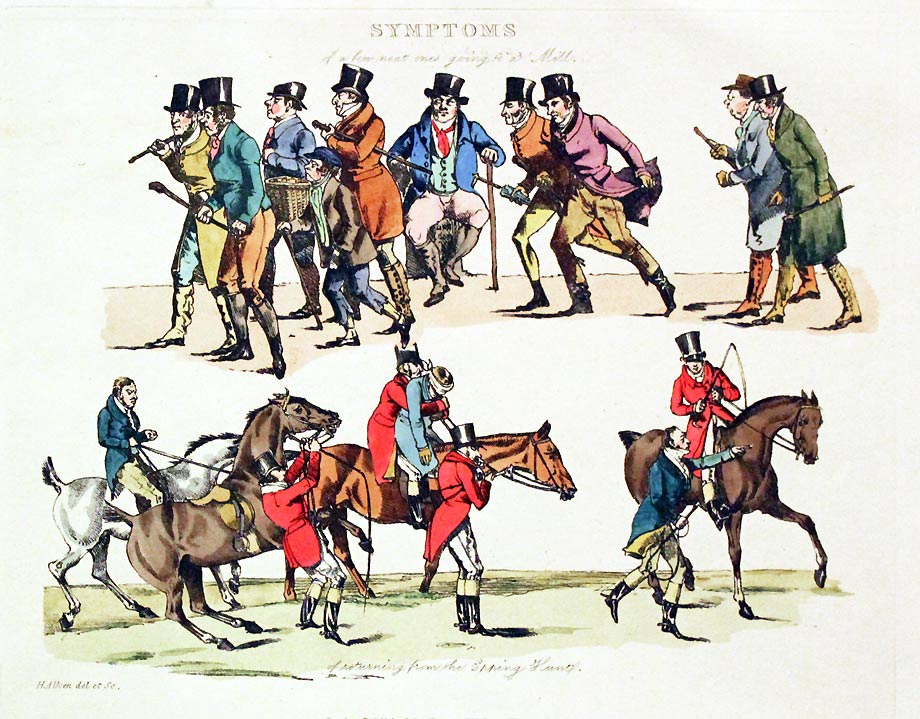
returning from the epping hunt 1822

Returning from the Epping Hunt (1822) – Yet more ‘cockney’ stereotyping


The so-called ‘march of morality’ began to kick in as the 1820s progressed , with even the middle and lower orders beginning to shift away from the frolicsome bawdiness of public sports, such as described in Pierce Egan’s popular classic Life In London (1820). In this thrust for greater decorum and respectability, Epping Hunt’s occasional reappearance was increasingly considered an embarrassing throwback. It lingered on sporadically until 1853 after which the landlord of the Roebuck – said to have become so ashamed of the company turning up at his establishment – put an end to the Epping Hunt forever.

Why then, does the Epping Hunt merit a fond farewell? And how has it passed into Essex folklore cleansed of the ill-will and disgust that followed it to the grave? Quite simply, I believe it has recovered in reputation thanks to the brilliance of poet Thomas Hood (1799-1845).

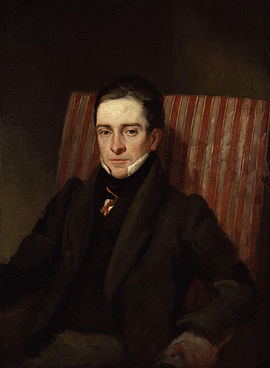
thomas hood

The Epping Hunt’s Facesaver? – Thomas Hood (1799-1845)

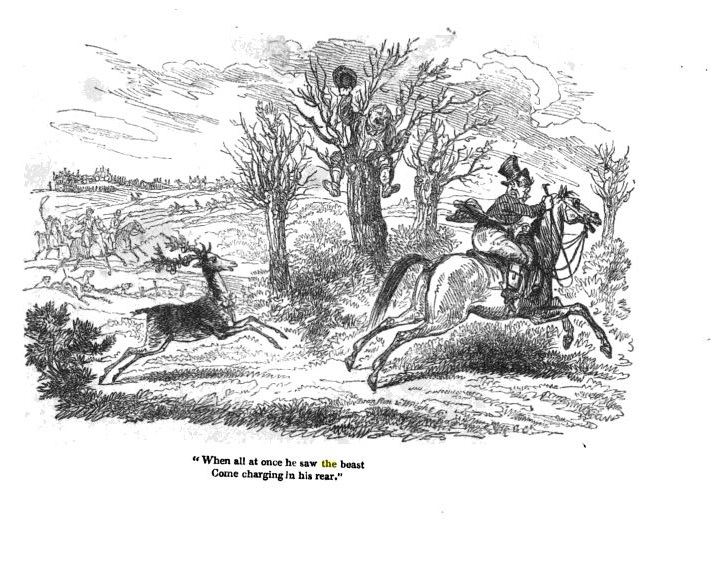
In his poem The Epping Hunt published in 1829 (and reproduced in full here) Hood makes no attempt to deny the charges brought against the Hunt. Like generations of critics before him, Hood lays bare the ridiculousness of town-dwellers coming into the countryside in pursuit of the stag. But Hood has changed the emphasis from hostility to whimsy, and his descriptions are not only gentle but also affectionate. With the help of 6 sketches from Thomas Rowlandson, The Epping Hunt was a national sensation, cementing Hood’s reputation as a comic poet, and repositioning the Epping Hunt as a tradition to be cherished. Hood’s style of writing represented a movement away from the savageness of Georgian satirical caricature, whereupon kinder representations of life such as nostalgia began to enter the nation’s conscience. So, thanks to Hood, the Epping Hunt achieved a decent eulogy for future generations.

eppinghunt-2

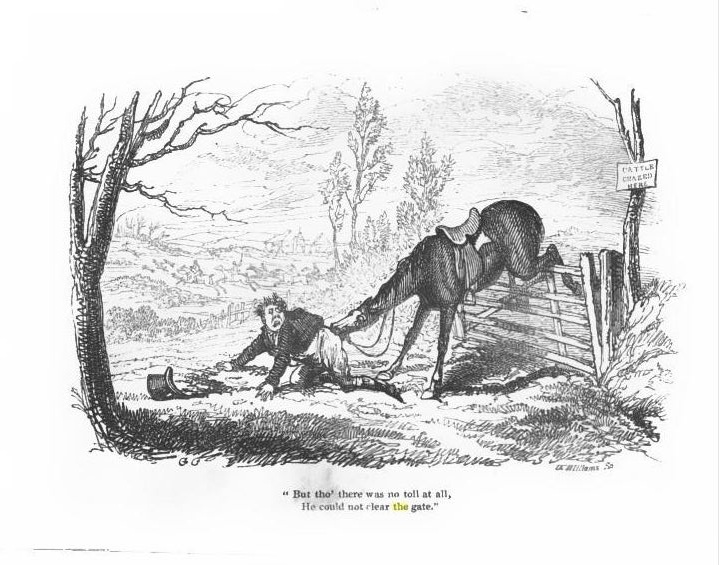
Hood’s comic verse is perfectly represented here by Rowlandson, as we see the hapless John Huggins being hunted by the deer


But how did Thomas Hood come to write about Epping Forest? We can only surmise that he was a visitor in the late 1820s following his marriage to Jane Reynolds. The newlyweds lived in Islington between 1826 and 1832, so it would not have been difficult for Hood to have made the annual pilgrimage to Buckhurst Hill to see what the fuss was about. In fact the 1826 Hunt was quite widely reported – though not in a positive way. The Everyday Book recorded that the event failed to start until 2-30pm because the stag was sent on a tour of all the local pubs, where it was shown to 3000 or so hunt-followers at 3 pence a view, presumably so they could get first-hand knowledge of what a stag looked like. It didn’t do much good for the stag was lost almost immediately after being set loose. The report summed up by saying if you are looking for a hunt…

For want of a better, this must do

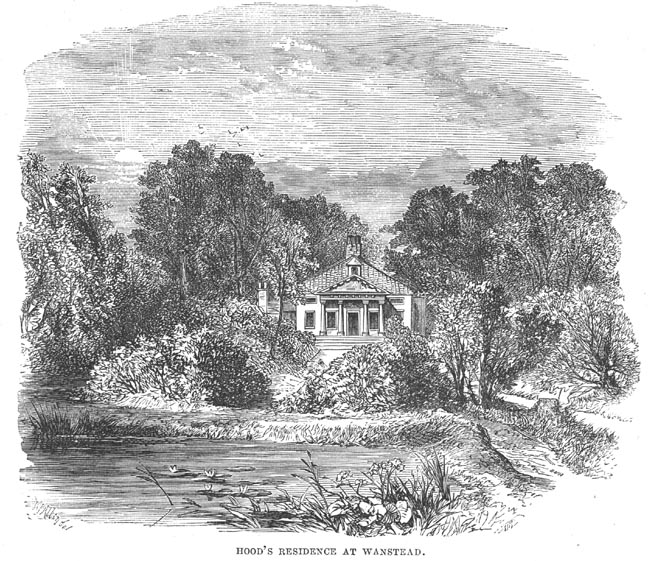
Perhaps Thomas Hood’s love for Wanstead began with his poem about the Epping Hunt. For in 1832 Hood took up residence at Lake House in Wanstead Park – where he lived for three years. Hood rented the property from none other than ‘Wicked’ William Long-Wellesley – and despite regularly defaulting on his rent managed to enjoy cordial relations with his notorious landlord. Hood’s only novel Tylney Hall (1834) is a thinly veiled homage to Wanstead House and Park. But attempting to cash in on Wicked William’s story was an unwise move because it raised expectations that Tylney Hall would reveal the truth about Wanstead House, and satisfy public curiosity as to why it was demolished. – This lead to criticism and affected sales, forcing Hood to add a note in the preface explaining that ‘Tylney Hall’  alluded to the topography of Wanstead Park, but not its disreputable owner.

Incidentally Tylney Hall is a very important early Victorian novel, well worth reading not least for its descriptions of Wanstead Park. Rather surprisingly several characters in the book are West Indian, their presence revealing that this part of London was already multicultural in the 1830s. I have covered this in a separate blog.

lakehouse wanstead hood

Thomas Hood lived at Lake House in Wanstead Park (1832-35)


As we draw a close to this brief history of the Epping Hunt, it is important to remember the role played by the ‘Common Hunt’ in the lives of Londoners and the people of Essex for over 600 years. Though it lingered on for far too long as a spectacle, Epping’s Hunt must be remembered as one of the earliest and enduring events available to the people on perhaps their most important public holiday. Therefore the festive spirit generated by celebrating the Epping Hunt can be seen to have moved on to other leisure activities, such as cycling and day-trips to Epping Forest, which became increasingly popular as the Victorian age of steam took hold.

deerhunt-1899

As this 1899 print shows, deer hunting in Epping Forest carried on regardless – for the privileged few.
Tally Ho!

I recommend the Gerald Massey website for an excellent biography of Thomas Hood.

For information about the history of Wanstead Park there is a very good ongoing series of articles written by Richard Arnopp available via Wanstead Village Directory

Thank you for joining me on this brief excursion into Epping Forest’s past. You can find out a lot more about this ancient forest by visiting the following sites:

The City of London’s informative guide to what’s on in Epping Forest : cityoflondon.gov.uk/epping

Essex Record Office is a tremendous resource for researching all aspects of Essex history: essex.gov.uk/ero

The Friends of Wanstead Park – wansteadpark.org.uk

Finally, the best place for Wanstead related news is Wansteadium


Tally Ho! – A Brief History of The Epping Hunt Part 4 – Wicked William’s Hunt

Tally Ho! A Brief History of the Epping Hunt

Introduction | Origins | The Cockney Hunt | Wicked William’s Hunt | A Fond Farewell

Chav-Man Cometh – Wicked William’s Hunt, 1813

wansteadcolour

Wanstead House – Catherine Tylney-Long’s pièce de résistance

Wanstead House first came under ‘Wicked’ William Long-Wellesley’s control upon his marriage to Catherine Tylney-Long in March 1812. Miss Tylney-Long, of Draycot House in Wiltshire, was universally recognised as richest heiress in the realm. Wanstead House – a magnificent Palladian Mansion on the edge of Epping Forest, just 10 miles from London – was the crown jewel of her vast landed estate. Catherine’s intention to reside at Wanstead was clear from the outset, for she served notice on her French Royal tenants within weeks of coming of age. Thereafter Catherine presided over a programme of refurbishment to revitalise the mansion, and she used it extensively throughout 1811 – hosting a series of showpiece events attended by a myriad of suitors eager to win her hand, (and more importantly her purse).

wickedwilliam

1st prize went to ‘Wicked’ William Wellesley-Pole (1788-1857) Booo!!!

After a chase worthy of the Epping Hunt, William emerged victorious from the pack when Catherine accepted his proposal in the autumn of 1811. Shortly before their marriage William added his wife’s name to his own and some – to form the ludicrously quadruple-barrelled new surname ‘Pole-Tylney-Long-Wellesley’. Not surprisingly this was soon abbreviated to Long-Wellesley by his friends, but rather pointedly to ‘Long’ by his Wanstead neighbours who rightly emphasised the surname he ought to have adopted when marrying into Catherine’s estate. An extract this contemporary ditty shows that William’s accession to Wanstead House was less than enthusiastically received.

LONG a tyrant, his neighbours presumed to annoy,

Their vexation and grief were his comfort and joy,

His greatest delight was to do others wrong

Till the people at length cried, “We won’t stand this LONG!”


From the outset the newlyweds craved acceptance from London’s fashionable elite. William believed Wanstead House could ignite his political career, enabling him to join his renowned Wellesley family relatives, whose power and influence was widely recognised. [See footnote below]

A few weeks after his marriage, and quite by chance, William discovered his hereditary entitlement to the role of Lord Warden of Epping Forest. This was an unlucky day for Essex because William’s assertion of the long-dormant Wardenship had a profound long-term affect on Epping Forest, for it shrank in size by over 5000 acres under his watch. But those years of destruction and land-grab came much later in William’s wreckless saga.

Because William believed he could never possibly spend the vast pile of cash he now possessed, his initially used the Wardenship for egotistical purposes. When he closed Wanstead Park to the public in the summer of 1812 there was a huge public outcry. Instead of negotiating with his neighbours, William reminded them that Lord Wardenship gave him powers to ‘appoint or sack forest officials’ thus sending an intimidating message to farmers and tradesmen alike – and anyone else dependent on his patronage. Despite this tangible threat to their livelihoods the people of Wanstead refused to be cowed, winning a landmark case in March 1813 – whereby the ancient rights of way were restored and William forced to reopen Wanstead Park. William lost the case because he did not appreciate the long-standing ties between Wanstead House, Epping Forest and its people, instead resorting to a crude attempt to bulldoze tradition purely for his own gain.

Easter Monday 1817 by Henry Thomas Aitken

 The Epping Hunt in ‘Wicked’ William’s day

The Lord Wardenship provided William with a second opportunity to flex his muscles, this time via spectacular gesture– a publicity stunt to convince rich and poor alike that he was worthy of admiration and respect. Yes, he decided to revive the Epping Hunt!  After all, what better way could there be to promote his equestrian prowess, style and up-to-the-minute fashion sense? This was a golden chance to be admired and envied, winning over his doubters in one fell swoop.

The problem was that William once again failed to do his homework, not realising the extent which the Epping Hunt had declined as a spectacle. William may have known the City of London abandoned the Common Hunt in 1807. In fact the Lord Mayor’s appearance at Buckhurst Hill had long-since been superseded by a new Easter Monday ‘tradition’ whereby the Lord Mayor and his retinue proceeded from Mansion House to Christchurch (Newgate) & heard the Spital sermon. But aldermen and stuffy City dignitaries held no interest for William. He wanted members of the beau monde, dandies, playboys and gadabouts – and intended to spend lavishly to ensure their attendance.

dandy club

William’s target audience was the fashionable London elite

Realising that a pack of hounds was an essential requisite of the Epping Hunt, William ordered the construction of new kennels on his land near the Eagle in Snaresbrook (then known as the Spread Eagle, now as the Toby Carvery). Instead of relying on foxhounds, William purchased a pack of stag-hounds especially bred for deer-hunting. At that time only the Prince Regent kept stag-hounds, and he only had a couple because of the enormous expense in acquiring them. William’s investment in a whole pack of hounds necessitated his appointment of Tommy Rounding, a widely respected local man fondly described as ‘father of the Hunt’. As far as adherence to tradition and quality of event, this was a promising start.

snaresbrook house

Modern-day Snaresbrook House stands on the site of William’s kennels

For the day in question William’s men were decked out in coats of Lincoln green with high-top boots. As for William, he was described in Bailey’s Magazine as

faultless alike in dress and symmetry, and style…With his spotless white waistcoat… and the ample tie of dark silk, perfectly adjusted and in true keeping with his dark coat.. [William] was the embodied perfection of a man of fashion, and carried his dress with that easy determination of style which is peculiar to high birth and high breeding.

One newspaper reported the sequence of events:

An uncommonly numerous assemblage of genteel company attended the Epping Easter Hunt this year. Those in carriages were chiefly of the first classes of Nobility and Gentry, and the horsemen in general capitally mounted. Mr. Pole Wellesley, of Wanstead House, having his stag-hunting establishment in this district, he is become patron of the Easter Hunt, and sent a deer to be turned out before the company. He was present on his famous chestnut horse. His Lady, Mrs. Long- Wellesley, was there also –she came in an open carriage, drawn by four greys, and two postillions with out-riders &c.; and with her company, took her station in an apartment for her at the Rein Deer, before the stag was turned out. It ran for about two hours, and was afterwards lost.


Elsewhere it was reported that while out with the hounds William scattered money freely among the village folk. He was said to have flung dozens of gold sovereigns into the throngs of spectators waiting outside the kennels upon his return. He then footed the bill for an enormous feast for participating huntsmen at the Eagle, and brought his more select guests back to Wanstead House for further hospitality and entertainment.

sovereigns

Sovereigns were thrown to bystanders at the kennels and the surrounding fields


As an event William Long-Wellesley’s Epping Hunt lived long in the memory and did a great deal to restore his reputation locally. But such wild and reckless flinging of sovereigns around the distressed community was more the act of a show-off than of somebody genuinely concerned for his tenants or the attending peasantry. Also his decision to begin the Hunt from the Rein Deer in complement to Mrs Long-Wellesley was reported to have caused ‘great mortification amongst numerous ladies and others in carriages arranged on the brow of the hill near the Roebuck, the customary place of turning out.’ This may have been a faux pas too far for William as it showed that spending prodigiously does not guarantee guest satisfaction.

the eagle

The Eagle at Snaresbrook – where being treated to a meal once really meant something


Perhaps the most telling thing about the whole event is that within a few weeks after the Epping Hunt it was announced that William Long-Wellesley intended ‘to give up his hunting establishment entirely’ and place the hunters, stag-hounds &c up for sale. This more than anything proves that Wicked William had no long-term intentions regarding the Epping Hunt. He just wanted to make a gesture, & boy did he waste a colossal sum in doing so.

I’d like to say that lessons were learnt, but I’m afraid we all know that the spending continued and that this crazy hedonistic occasion was merely the first warning that Wanstead House’s days were numbered. It is important to clarify that William continued to hunt regularly in Epping Forest during his tenure of Wanstead House, but this was by invitation only and nothing to do with the ‘Common Hunt’ which he turned his back on..

Wicked William was powerless to stop a few feeble re-runs of the Epping Hunt in the years to 1820, though perhaps his only permanent contribution to Hunt tradition was to make the Eagle pub at Snaresbrook the primary meeting place for a strange new breed of cockney visitors on Easter Monday for many years to come

hobbies in an uproar


It is hard to believe that the famous cycle meet at the Eagle, which was still going strong in the 1940s, could be traced back to ‘Wicked’ William’s days at Wanstead House, and that it evolved to replace the Epping Hunt as a regular feature of the annual calendar. As London became more urbanised, the ‘cockney’ desire to master horsemanship declined, and the age of machines accelerated their separation from country-dwellers

So by the 1820s with Wicked William in exile, Wanstead house torn down and the onset of the steam age – the Epping Hunt was not only dead, but there were no mourners in attendance. Or were there? Enter one Thomas Hood…


Footnotes:

[1]

At the time of his marriage, Marquess Wellesley (an uncle) had just resigned as Foreign Secretary in order to challenge Spencer Perceval’s for Prime Minister, Wellesley-Pole (his father) was Secretary of State for Ireland, and Lord Wellington (an uncle) was in the Peninsular leading the British forces against Napoleon.