Could this be the face of ‘Wicked William’ Long-Wellesley?

        A few weeks ago I was asked to pass an opinion upon the subject of a painting acquired by Plymouth-based art dealers Parade Antiques. It was the portrait of a man in his mid-twenties which was recently discovered in the attic of a house at St Ives (Cornwall). The canvas itself was in poor condition; minus frame, artist’s signature or any other distinguishing mark to shed light on his identity.

Could this be William Long-Wellesley?

        It was only after John Cabello (Parade Antiques) had this portrait restored that he noticed a striking resemblance between his mystery man and Arthur Wellesley (Duke of Wellington,1769-1852), who was Britain’s hero at the Battle of Waterloo. Mr Cabello immediately suspected he was looking at an image of ‘Wicked William’ Long-Wellesley, the Duke’s wastrel nephew, best recalled for the destruction of Wanstead House. In Cabello’s opinion this painting is highly reminiscent of Sir Thomas Lawrence (1769-1830), who was a leading English portrait painter of the Regency period and the fourth president of the Royal Academy. 

       But what would a portrait of the black sheep of the Wellesley family be doing in a Cornish attic? And if it can be attributed to Lawrence (or one of his associates) why was it left to fester in such a decrepit state for nigh on two centuries? Most importantly, can we find any visual evidence to connect the cocky-looking man displayed in this picture to the illustrious Wellesley family?

 1. What would Long-Wellesley have been doing in St Ives?

      Strangely enough the obscure location where this painting was found may prove to be the strongest pointer to Long-Wellesley. Following his marriage in 1812, ‘Wicked William’ decided to enter Parliament, and purchased a seat for £500 in the rotten borough of St Ives. He was duly elected in November 1812, serving as the town’s MP until 1818. Long-Wellesley continued to live at Wanstead House, only visiting St Ives around the time of their assizes. Given that Long-Wellesley had civic as well as parliamentary responsibilities in Cornwall it is entirely possible that a painting was commissioned for the purpose of familiarising constituents with Long-Wellesley’s likeness in the days before photographic media. This painting may have been taken down after Long-Wellesley resigned his seat; its frame perhaps re-used for his replacement MP. Maybe the portrait remained in situ until after Long-Wellesley’s scandalous behaviour became public knowledge. Alternatively it could have adorned Long-Wellesley’s residence at St Ives, and he never bothered to retrieve it after he left the area.


2. Could Sir Thomas Lawrence really have have painted Long-Wellesley?

      Sir Thomas Lawrence is best remembered for his flattering style of portraiture, emphasising the positive physical attributes of his subjects. The man in this painting is in his mid-twenties, staring back at us unabashed, almost arrogantly, in the mode of a man of fashion. His style of clothing is very typical of the dandy, but the controlled wildness of his hair exudes masculinity with more than a hint of Romanticism. In 1814 Lawrence was commissioned by members of the Wellesley family to paint a series of portraits, including this iconic image of the Duke of Wellington.

Wellington by Sir Thomas Lawrence (1814)

        Another of Lawrence’s most notable works at this time was an ensemble entitled ‘The Three Graces’ : being Mary Bagot, Priscilla Burghersh and Emily Fitzroy Somerset – These women are Long-Wellesley’s sisters.
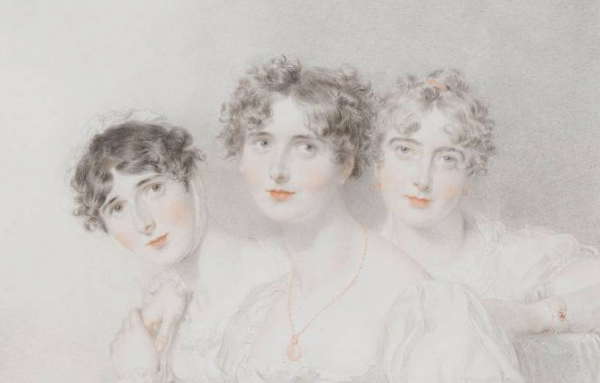
Wicked William’s three sisters as sketched by Sir Thomas Lawrence (1814)

        In the summer of 1814 William held an enormous fete at Wanstead House to honour his uncle the Duke of Wellington, which was attended by the crowned heads of Europe, in celebration of Napoleon’s defeat and exile. Given that Lawrence was at this time busily employed by the Wellesleys it seems plausible that ‘Wicked William’ could have asked Lawrence to do his portrait too. This was when Long-Wellesley was at the height of his pomp, having just turned 24 years old and thought to be so good-looking that even Lord Byron was envious. The St Ives painting has an element of swagger that would have typified Long-Wellesley. 

        It is important to acknowledge that the age of this portrait is as yet unproven. However the way this man is presented and what he is wearing does provide some hints. The sitter’s clothes are consistent with contemporary descriptions of Long-Wellesley, and the execution of the portrait is so close to the style of Lawrence that it is reasonable to assume it originates from (or relates to) the Regency period.


3. Are we looking at a member of the Wellesley family?

        The best way to determine a familial likeness is to set the mystery portrait against other members of the Wellesley family to look for common traits
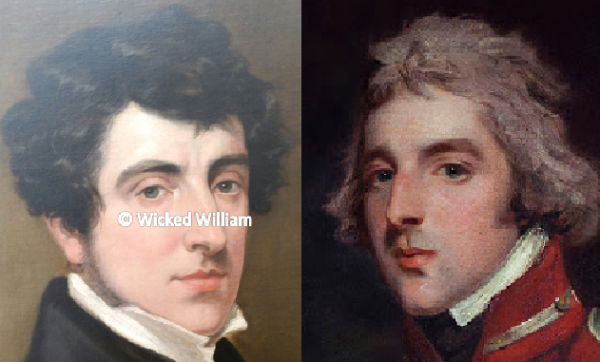
The restored painting (left) and a portrait of Arthur Wellesley by John Hoppner (right)

       In this comparison we capture Arthur Wellesley in 1808 (aged 39). Both men have thick-set eyebrows and blue eyes, their mouths and chins seem to follow the same lines.

When we place the picture alongside contemporary images of William’s sisters the evidence seems even more compelling.
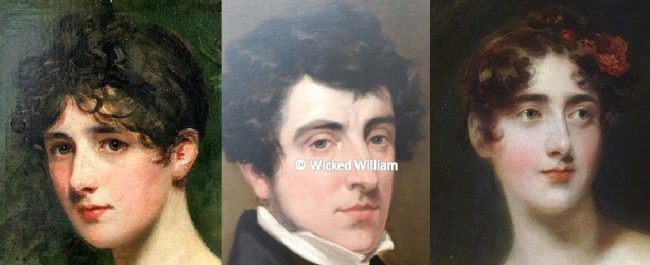
         On the left is a portrait of Mary Bagot by John Hoppner c.1807. On the right is Emily Fitzroy Somerset by Sir Thomas Lawrence c.1815. Although their portraits were painted by different artists the sisters’ features are identical. Of the two, Emily seems to be uncannily like the man in this portrait, suggesting not only that he is a close family relation, but also that this man has been painted by the same artist (Sir Thomas Lawrence).

4. Is this portrait ‘Wicked William’ Long-Wellesley?

     The story of William’s marriage to the richest heiress in Regency Britain, Catherine Tylney-Long, has become internationally famous since the publication of Angel and the Cad by Geraldine Roberts (2015). Long-Wellesley went on to wreck Catherine’s ancestral home at Wanstead House, leading to the fire sale of its priceless art and treasures; even her cherished family portraits were lost. Although William retained some of Catherine’s heirlooms, they had to be auctioned off in 1852 because he never paid the storage fees, and their current whereabouts are unknown.

       Apart from a few satires at the British Museum, there are no surviving images of William or Catherine Long-Wellesley for the duration of their marriage. All we can use for comparative purposes are a miniature of Long-Wellesley aged 16 (in the collection of the Duke of Wellington at Stratfield Saye) and etching of him in profile aged about 38 (the original of which is in my possession).

The unknown man replicates 16-year-old William in both appearance and dress

        Looking at youthful William (right), we see distinct features such as eyebrows, nose and the line of his jaw – which seem to be present in the later image. Their fashionable clothes seem to conform to the same dandy regulation of wearing a drab overcoat with high-necked collar. The curls of hair may not be so pronounced in the left-hand image, but this may have been deliberate – reined in to give the man an air of authority commensurate with his standing on public life.
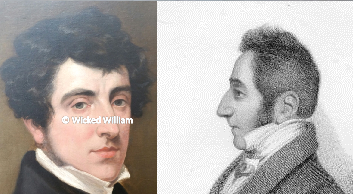
         The portrait of Long-Wellesley in his late thirties (shown on right) depicts a more care-worn man with a receding hairline and a much bigger nose. His chin looks less prominent, but the eyes and eyebrows and his mode of dress are consistent in both images. We all know that the nose never stops growing as one gets older, and Wicked William certainly seems well on the way to a full-blown proboscis akin to the Duke of Wellington. As he got older William looked increasingly more like Wellington. Even the Duke gasped at the likeness when the pair met up in 1845.

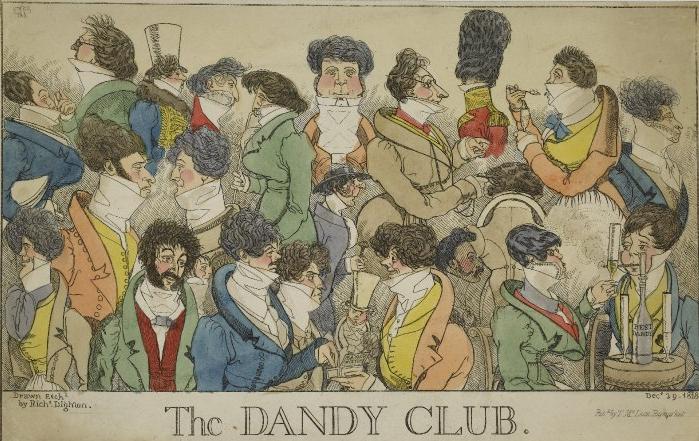
         Georgian satires ridiculed celebrities of their day by exaggerating physical appearance to create an image fit for public consumption. Their primary function was commercial; providing a cheap, popular and in-the-moment source of entertainment. Satirical representations were parodies rather than true likenesses. But it was vital to capture the essence of those featured, to make them instantly recognisable. In Long-Wellesley’s case he was often depicted carrying a rake to sow his wild oats; and presented as a womanising fool bereft of common sense. Despite this, when we compare Long-Wellesley’s satires with the St Ives portrait we again find common ground. These examples from 1811 and 1812 could easily be caricatures of the man we see in this portrait.


Conclusion

     It is clear that the St Ives painting needs further examination by art experts to fully establish its age and provenance. I have considered it purely in the context of Long-Wellesley’s life. Long-Wellesley did spend time in St Ives; he also would have been closely associated with Sir Thomas Lawrence at this time. The sitter in this portrait is almost certainly a member of the Wellesley family. Having compared this new painting with existing images and satires of Long-Wellesley, I feel certain that Parade Antiques have unearthed the genuine article, and that this really is an extremely important find.

      I am not yet sure what will become of the painting, but it would be wonderful to see it back in Wanstead. Imagine the irony of forcing Wicked William to gaze upon the wreck of his once proud estate from his position on the wall of the Temple at Wanstead Park – This would be a small yet symbolic act of penance for the misery and cruelty he wrought upon Wanstead House and its ancestral owners.

——–

Images of the St Ives portrait are produced with the kind permission of Parade Antiques, and have been watermarked to preserve their copyright.

If you would like to learn a bit more about Wicked William Long-Wellesley, you might like to find out how he got on when he served under Wellington’s command in Portugal. To learn about William’s over the top entertainments at Wanstead you could join Wicked William’s Hunt – or witness his heartless treatment of Catherine in her final days

For Wanstead related history you might like to learn about Anne Rushout, Wanstead’s Forgotten Artist – or discover multicultural Wanstead in Thomas Hood’s Tylney Hall

I am currently in the midst of writing up my thesis, which is about ‘Long-Wellesley and Publicity during the Regency period’. I hope to publish more new posts as this year goes on. As usual I would appreciate any feedback, comments, or suggestions.

Tally Ho! – A Brief History of The Epping Hunt Part 4 – Wicked William’s Hunt

Tally Ho! A Brief History of the Epping Hunt

Introduction | Origins | The Cockney Hunt | Wicked William’s Hunt | A Fond Farewell

Chav-Man Cometh – Wicked William’s Hunt, 1813

wansteadcolour

Wanstead House – Catherine Tylney-Long’s pièce de résistance

Wanstead House first came under ‘Wicked’ William Long-Wellesley’s control upon his marriage to Catherine Tylney-Long in March 1812. Miss Tylney-Long, of Draycot House in Wiltshire, was universally recognised as richest heiress in the realm. Wanstead House – a magnificent Palladian Mansion on the edge of Epping Forest, just 10 miles from London – was the crown jewel of her vast landed estate. Catherine’s intention to reside at Wanstead was clear from the outset, for she served notice on her French Royal tenants within weeks of coming of age. Thereafter Catherine presided over a programme of refurbishment to revitalise the mansion, and she used it extensively throughout 1811 – hosting a series of showpiece events attended by a myriad of suitors eager to win her hand, (and more importantly her purse).

wickedwilliam

1st prize went to ‘Wicked’ William Wellesley-Pole (1788-1857) Booo!!!

After a chase worthy of the Epping Hunt, William emerged victorious from the pack when Catherine accepted his proposal in the autumn of 1811. Shortly before their marriage William added his wife’s name to his own and some – to form the ludicrously quadruple-barrelled new surname ‘Pole-Tylney-Long-Wellesley’. Not surprisingly this was soon abbreviated to Long-Wellesley by his friends, but rather pointedly to ‘Long’ by his Wanstead neighbours who rightly emphasised the surname he ought to have adopted when marrying into Catherine’s estate. An extract this contemporary ditty shows that William’s accession to Wanstead House was less than enthusiastically received.

LONG a tyrant, his neighbours presumed to annoy,

Their vexation and grief were his comfort and joy,

His greatest delight was to do others wrong

Till the people at length cried, “We won’t stand this LONG!”


From the outset the newlyweds craved acceptance from London’s fashionable elite. William believed Wanstead House could ignite his political career, enabling him to join his renowned Wellesley family relatives, whose power and influence was widely recognised. [See footnote below]

A few weeks after his marriage, and quite by chance, William discovered his hereditary entitlement to the role of Lord Warden of Epping Forest. This was an unlucky day for Essex because William’s assertion of the long-dormant Wardenship had a profound long-term affect on Epping Forest, for it shrank in size by over 5000 acres under his watch. But those years of destruction and land-grab came much later in William’s wreckless saga.

Because William believed he could never possibly spend the vast pile of cash he now possessed, his initially used the Wardenship for egotistical purposes. When he closed Wanstead Park to the public in the summer of 1812 there was a huge public outcry. Instead of negotiating with his neighbours, William reminded them that Lord Wardenship gave him powers to ‘appoint or sack forest officials’ thus sending an intimidating message to farmers and tradesmen alike – and anyone else dependent on his patronage. Despite this tangible threat to their livelihoods the people of Wanstead refused to be cowed, winning a landmark case in March 1813 – whereby the ancient rights of way were restored and William forced to reopen Wanstead Park. William lost the case because he did not appreciate the long-standing ties between Wanstead House, Epping Forest and its people, instead resorting to a crude attempt to bulldoze tradition purely for his own gain.

Easter Monday 1817 by Henry Thomas Aitken

 The Epping Hunt in ‘Wicked’ William’s day

The Lord Wardenship provided William with a second opportunity to flex his muscles, this time via spectacular gesture– a publicity stunt to convince rich and poor alike that he was worthy of admiration and respect. Yes, he decided to revive the Epping Hunt!  After all, what better way could there be to promote his equestrian prowess, style and up-to-the-minute fashion sense? This was a golden chance to be admired and envied, winning over his doubters in one fell swoop.

The problem was that William once again failed to do his homework, not realising the extent which the Epping Hunt had declined as a spectacle. William may have known the City of London abandoned the Common Hunt in 1807. In fact the Lord Mayor’s appearance at Buckhurst Hill had long-since been superseded by a new Easter Monday ‘tradition’ whereby the Lord Mayor and his retinue proceeded from Mansion House to Christchurch (Newgate) & heard the Spital sermon. But aldermen and stuffy City dignitaries held no interest for William. He wanted members of the beau monde, dandies, playboys and gadabouts – and intended to spend lavishly to ensure their attendance.

dandy club

William’s target audience was the fashionable London elite

Realising that a pack of hounds was an essential requisite of the Epping Hunt, William ordered the construction of new kennels on his land near the Eagle in Snaresbrook (then known as the Spread Eagle, now as the Toby Carvery). Instead of relying on foxhounds, William purchased a pack of stag-hounds especially bred for deer-hunting. At that time only the Prince Regent kept stag-hounds, and he only had a couple because of the enormous expense in acquiring them. William’s investment in a whole pack of hounds necessitated his appointment of Tommy Rounding, a widely respected local man fondly described as ‘father of the Hunt’. As far as adherence to tradition and quality of event, this was a promising start.

snaresbrook house

Modern-day Snaresbrook House stands on the site of William’s kennels

For the day in question William’s men were decked out in coats of Lincoln green with high-top boots. As for William, he was described in Bailey’s Magazine as

faultless alike in dress and symmetry, and style…With his spotless white waistcoat… and the ample tie of dark silk, perfectly adjusted and in true keeping with his dark coat.. [William] was the embodied perfection of a man of fashion, and carried his dress with that easy determination of style which is peculiar to high birth and high breeding.

One newspaper reported the sequence of events:

An uncommonly numerous assemblage of genteel company attended the Epping Easter Hunt this year. Those in carriages were chiefly of the first classes of Nobility and Gentry, and the horsemen in general capitally mounted. Mr. Pole Wellesley, of Wanstead House, having his stag-hunting establishment in this district, he is become patron of the Easter Hunt, and sent a deer to be turned out before the company. He was present on his famous chestnut horse. His Lady, Mrs. Long- Wellesley, was there also –she came in an open carriage, drawn by four greys, and two postillions with out-riders &c.; and with her company, took her station in an apartment for her at the Rein Deer, before the stag was turned out. It ran for about two hours, and was afterwards lost.


Elsewhere it was reported that while out with the hounds William scattered money freely among the village folk. He was said to have flung dozens of gold sovereigns into the throngs of spectators waiting outside the kennels upon his return. He then footed the bill for an enormous feast for participating huntsmen at the Eagle, and brought his more select guests back to Wanstead House for further hospitality and entertainment.

sovereigns

Sovereigns were thrown to bystanders at the kennels and the surrounding fields


As an event William Long-Wellesley’s Epping Hunt lived long in the memory and did a great deal to restore his reputation locally. But such wild and reckless flinging of sovereigns around the distressed community was more the act of a show-off than of somebody genuinely concerned for his tenants or the attending peasantry. Also his decision to begin the Hunt from the Rein Deer in complement to Mrs Long-Wellesley was reported to have caused ‘great mortification amongst numerous ladies and others in carriages arranged on the brow of the hill near the Roebuck, the customary place of turning out.’ This may have been a faux pas too far for William as it showed that spending prodigiously does not guarantee guest satisfaction.

the eagle

The Eagle at Snaresbrook – where being treated to a meal once really meant something


Perhaps the most telling thing about the whole event is that within a few weeks after the Epping Hunt it was announced that William Long-Wellesley intended ‘to give up his hunting establishment entirely’ and place the hunters, stag-hounds &c up for sale. This more than anything proves that Wicked William had no long-term intentions regarding the Epping Hunt. He just wanted to make a gesture, & boy did he waste a colossal sum in doing so.

I’d like to say that lessons were learnt, but I’m afraid we all know that the spending continued and that this crazy hedonistic occasion was merely the first warning that Wanstead House’s days were numbered. It is important to clarify that William continued to hunt regularly in Epping Forest during his tenure of Wanstead House, but this was by invitation only and nothing to do with the ‘Common Hunt’ which he turned his back on..

Wicked William was powerless to stop a few feeble re-runs of the Epping Hunt in the years to 1820, though perhaps his only permanent contribution to Hunt tradition was to make the Eagle pub at Snaresbrook the primary meeting place for a strange new breed of cockney visitors on Easter Monday for many years to come

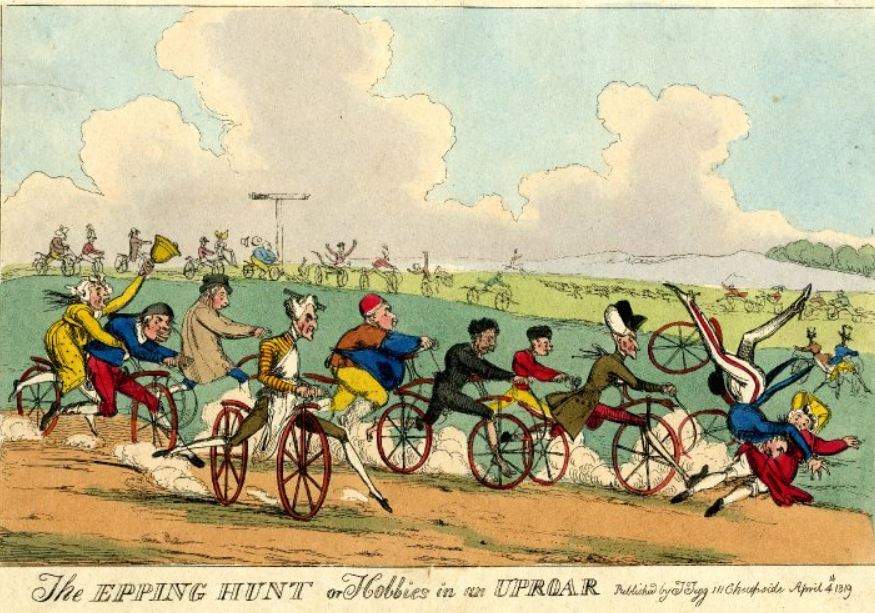
hobbies in an uproar


It is hard to believe that the famous cycle meet at the Eagle, which was still going strong in the 1940s, could be traced back to ‘Wicked’ William’s days at Wanstead House, and that it evolved to replace the Epping Hunt as a regular feature of the annual calendar. As London became more urbanised, the ‘cockney’ desire to master horsemanship declined, and the age of machines accelerated their separation from country-dwellers

So by the 1820s with Wicked William in exile, Wanstead house torn down and the onset of the steam age – the Epping Hunt was not only dead, but there were no mourners in attendance. Or were there? Enter one Thomas Hood…


Footnotes:

[1]

At the time of his marriage, Marquess Wellesley (an uncle) had just resigned as Foreign Secretary in order to challenge Spencer Perceval’s for Prime Minister, Wellesley-Pole (his father) was Secretary of State for Ireland, and Lord Wellington (an uncle) was in the Peninsular leading the British forces against Napoleon.