Thomas Hosmer Shepherd – A Recorder of London

T H Shepherd – painted the good, the bad & the ugly of London’s streets

In my previous post I wrote about the tremendous debt Londoners owe to Frederick Crace, whose collection of some 5000 prints, maps and paintings of London and its environs was purchased by the British Museum in 1880. Actively collecting between 1815 and his death in 1859, Crace amassed an cornucopia of scenes encompassing and embracing times of great change in the topography of the city. He particularly excelled in ensuring that soon-to-be demolished buildings were recorded for posterity. Sometimes the doomed structures were depicted in their final dismal state, but others were carefully illustrated as they were in their heydey.

Self-Portrait of Shepherd and his muse: London

This post is about perhaps the most important artist associated with Frederick Crace’s collection, certainly in terms of output, if not by reputation. Crace’s collection contains individual works by legendary artists, such as Paul Sandby or Wenceslaus Hollar, but it is dominated by Thomas Hosmer Shepherd, whose 720+ works constitute about 15% of the entire portfolio. Additionally, the British Museum holds almost 300 Shepherd artworks not associated with Frederick Crace. So here we have in just one location over 1000 examples of his works of art:-  the fruits of a very industrious and important artist principally engaged in recording London as it was undergoing huge changes towards modernity.

Tumbledown buildings in Grub Street complete with broken windows c.1840

A quick search on google returns some 192,000 pages linked to Thomas Hosmer Shepherd. But this is entirely down to the wide dissemination of his drawings and watercolours. Very little is recorded about his life and times – and practically no images of the artist himself. When I searched the British Library newspaper archive I found that Shepherd’s death on July 4th 1864 was not reported in the press – indicating that his final years were spent in obscurity. However, I was pleased to discover that Shepherd does have a blue plaque at No 26 Batchelor Street in Islington, so at least he is being commemorated today.

T.H Shepherd’s old stomping ground at Islington Green (1850)

The story of Thomas Hosmer Shepherd in many ways mirrors the life of any struggling painter in the early modern period: i.e. one of dependency upon a patron in order to facilitate one’s career. In the age before consumerism it was common for artist to find favour with a wealthy or influential connoisseur through which they were enabled to thrive. Artists such as Hogarth and Nollekins forged their career in this way. However by the late 1700s a new genre of independently successful artists emerged – most particularly Sir Joshua Reynolds – who were sufficiently renowned to stand on their own merit, and benefitted from a surge in purchasing power from the mercantile and middling classes as Britain underwent rapid industrial change. However, when we look at Thomas Hosmer Shepherd we can see that even by the mid 1800s it was only the very elite artists that were capable of choosing their own commissions and setting their own prices.  For everyone else it was a question of finding favour with clients, meeting their needs, and striving for regular and constant output – without which the spectre of poverty always beckoned. Shepherd’s story of boom and bust parallel’s that of Thomas Hood, of whom I have previously written.

Landmark or no mark: Shepherd always had bystanders

Thomas Hosmer Shepherd was born in France on 16 January 1793, the son of a watchcase maker. At this time France was in the throes of revolution, and war was about to break out against a coalition of her neighbouring countries including Britain. So the family hastened home settling in a house near the City Road, in what was then the village of Islington, and Thomas was baptised at St Luke Old Street, on 24 February.

St Luke’s Church, Old Street (Magnoliabox.com)

Perhaps Thomas’s most important influence in his early years was older brother George, an artist working in both pencil and watercolours – who began working for Frederick Crace around 1810. By this time young Thomas had already obtained commissions from Rudolph Ackermann, for whom he regularly supplied prints and etchings right up until Ackermann’s magazine The Repository of Arts folded in 1827. The two brothers often worked together on projects as their skills complemented each other – George was very fast with the pencil outline, and Thomas a better finisher. Thomas did very little work for Frederick Crace before 1820 (certainly not that he was credited for) and looked more likely to establish himself independently, as he undertook a series of sketching tours and earned his living in that way. However, it seems that once Thomas settled down and became a father, it became vitally important for him to have a regular workflow – so he gravitated back to employment by others.

George Shepherd was more adept with a pencil than brother Thomas

Thomas married in 1818, spending his honeymoon in France. Somewhat tellingly his first-born son was named Frederick Napoleon Shepherd, perhaps in homage to his nationality and political leanings (in terms of Napoleon) but also crediting his benefactor (Frederick Crace). By 1820, the family lived at 26 Chapman Street (now Batchelor Street), Islington, just west side of Liverpool Road. He used his home address when advertising as a drawing master.

Shepherd’s seemingly mundane images are fascinating for historians

Throughout the 1820s Shepherd worked hard to establish himself as a popular artist, both by touring and contributing to numerous topographical publications. He undertook a series of paintings of Edinburgh, and also worked at Bath and Bristol. But after 1830 his output as an illustrator of books rapidly declined  – possibly due to a change in public demand for such books, as a couple of planned commissions that year never came to fruition – one of which had necessitated a wasted trip to Ireland.

Edinburgh Castle (1829) with obligatory dog and kilts

Shepherd then took a change of direction by exhibiting four watercolours of Scotland at the Society of British Artists, in 1831 and 1832, but as the years passed by he increasingly relied upon Frederick Crace for employment. Luckily for Shepherd, Crace seems to have accelerated his demand for pictures – and work was plentiful right up until Crace died in 1859. In the early 1840s Shepherd moved to 2 Bird’s Buildings (now part of Colebrooke Row), north of Camden Passage, Islington – and he also began contributing images for The Illustrated London News. Shepherd’s final years were spent in poverty, possibly through ill health as old age set in, but more likely as a result of lack of work after Crace passed away. It is sad to think that somebody capable of creating thousands of historically important images of nineteenth century Britain should die unnoticed and unwanted, just as new photographic technology usurped his genuine talent for recording life as it was back then.
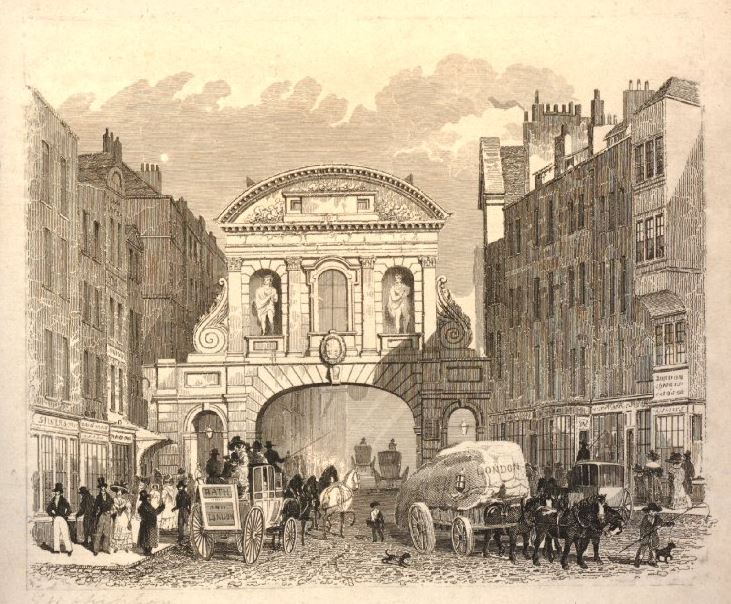
Temple Bar (1844) – Streetscene as interesting as the edifice

Shepherd’s style of painting was characterized by an attention to detail towards to subject building or street being depicted, but his scenes often contained people, carriages, horses, or dogs. Thus his collection of paintings gives us an excellent by-product of olde London via the fashions and activities of the people. For example we often see children playing in the streets, and the enduring British love for dogs is more than abundantly represented via a variety of pooches of differing sizes and shapes adorning his works. Whilst it is true that Shepherd’s paintings tend to avoid the filth, smoke, and grinding poverty of London – he doesn’t shy away from decay or of realistic portrayal of slum areas and prisons, which he was commissioned to accurately record. We must remember that his brief was to concentrate upon the buildings  as subjects, and that his only individual artistic outlet was the ability to add by-standers for context and adornment purposes. In his world too, it seldom rains and plants are always in bloom – So we get Dickensian buildings in abundance – without the depressing realism of London as it really must have been.

I hope you will join me on this progressing journey through olde London courtesy of Crace and Shepherd. I have already extensively used their images for my series of postings on Regency Stagecoach Travel and also when relating the story of Wellesley Pole at the Mint

As my series of posts relating to the Crace Collection unfolds, Thomas Hosmer Shepherd will feature heavily. All images used will come directly from the British Museum images database. However, Shepherd’s prints are abundantly held by numerous other public bodies – most notably Kensington and Chelsea Library -which has done a series of excellent posts regarding their own collection, the V&A Museum, the Science Museum, the Government Art Collection, and a small number at the Royal Academy.

Shepherd as a recorder of change: Blackfriars Bridge and Steamship (1848)

Please note that my use of British Museum images in on a non-commercial basis –  my primary intention being to promote the British Museum as a source of reference for all historians. Several times in the past I have paid initial photographic fees to digitise their images for my own use, knowing that once this fee is paid such imagery becomes available to all. I could not recommend use of the British Museum strongly enough, especially if you are looking to source illustrations for publication. In return for obtaining pricelessly detailed high resolution images, you in return get the satisfaction of knowing that you are contributing to the continued development and protection of this vital resource.

For more information on Thomas Hosmer Shepherd I recommend

  • Brian Reginald Curle and Patricia Meara, Thomas Hosmer Shepherd, 1793-1864, (London: Kensington and Chelsea Public Libraries, 1973)
  • J F C Phillips, Shepherd’s London, (London: Cassell, 1976)
  • Chris Beetles Gallery has a range of original Thomas Hosmer Paintings for sale as well as an excellently detailed biography
  • On 6th April 2015 Bonhams sold an exquisite collection of Thomas Hosmer Shepherd views of Edinburgh, pencil on paper – with 5 in watercolour for £5625.00

Frederick Crace – London’s Forgotten Benefactor

frederick_crace_oil_on_canvas_on_diplay_at_the_royal_pavilion_large

This is Frederick Crace (1779-1859) – a man who deserves to be remembered for his cultural contribution to the history of London. Between 1820 and 1860 Crace collected and collated a visual record of London every bit as vital as that which has been described by Charles Dickens in the pages of his iconic novels – i.e an aura of ‘Olde’ London at a time when it was quickly (and quietly) vanishing beneath the relentless march of Victorian ‘modernisation’. The era when Crace operated saw stagecoach transportation gave way to steam locomotion, clearance of slums and construction of elegant new town squares – extending London’s boundaries far beyond their traditional limits. Ports, churches, thoroughfares and dockyards were rebuilt as industrialisation changed the face and spread of London almost beyond recognition even for those who witnessed it.

bedford-sq-c1850

Bedford Square c.1850 (Crace Collection)

For all his efforts, it is particularly sad that Frederick Crace doesn’t seem to have a permanent London memorial. He doesn’t have a blue plaque, and even his graveyard memorial in West Norwood Cemetery has long since been destroyed. For a man who did so much to record London in the era before photography, we really ought to celebrate and commemorate him better. So I am going to begin here by giving a brief outline of Crace’s professional career, and then follow up with a series of posts examining the the many London scenes he commissioned for his unique collection. If you want a taster why not start with my recent blog about London’s coaching inns – which uses images entirely drawn from Crace’s collection.

Crace’s appointment as Commissioner of Sewers in 1818 may have literally been ‘a crap job’, but it did stimulate his interest in the history of the streets of London because he began to collect maps and views of the city from that point right up until his death in 1859. What Crace was unable to procure from collectors, he commissioned via renowned artists, in particular Thomas Hosmer Shepherd. A very large collection of maps and pictures was assembled under his care. Crace had some of Shepherd’s paintings collated and published as ‘Views of London’. But many of the scenes recorded were ordered by Crace upon a whim, or at the drop of a hat, whenever he saw anything important to record for posterity.

http://www.chrisbeetles.com/gallery/early-english-18th-early-19th-century/st-marys-aldermanbury.html

Courtesy www.chrisbeetles.com

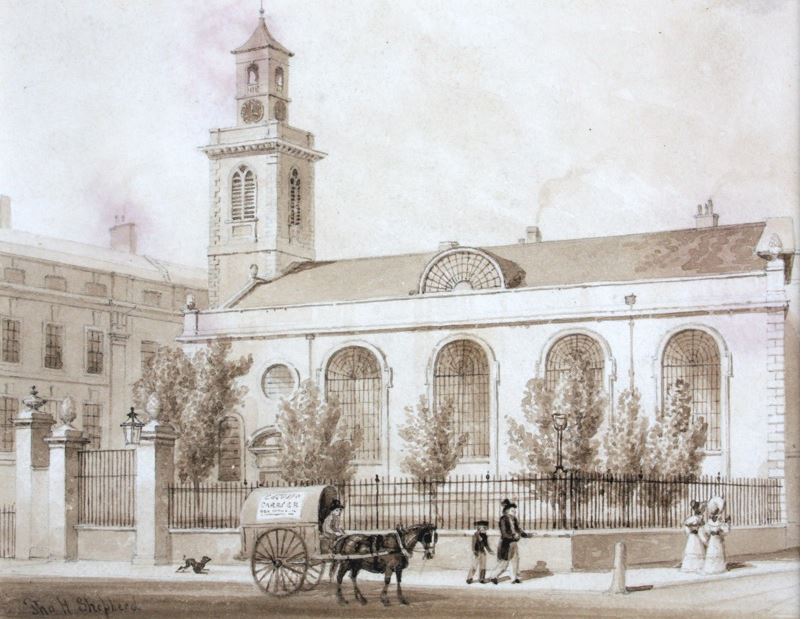
St Mary’s Aldermanbury by T.H. Shepherd c.1850

Thanks to Crace we have a significant record of early Victorian transformation of the old Georgian landscape – because his vast collection now resides to the British Museum, having been purchased from Crace’s son in 1879. More joyously still, we now have access to hundreds of beautiful London street scenes (such as the one above) via their excellent online search engine. The true beauty of Crace’s collection is that the traditional tourist panoramas, such as St Paul’s Cathedral or the Tower of London, play a very minor role in the whole ensemble – because Crace concentrated on what was leaving the landscape, rather then what endured. We therefore have a wonderful myriad of London back-streets, shops, inns, churches and housing – perhaps too idyllically depicted – nonetheless vital to grasping an essence of life in London almost two centuries ago.

fishing-templeThe Fishing Temple at Virginia Water, by Frederick Crace c.1825

Frederick Crace, was one of a dynasty of interior designers that graced British homes and palaces between 1750 and 1899. Originally founded as a decorating company by Edward Crace (1725-99), 4 subsequent generations of Craces, in various partnerships and guises,  transformed the business into what the Victoria and Albert Museum have described as ‘the most important family of interior decorations in 19th Century Britain’.

Courtesy Smithsonian Museum

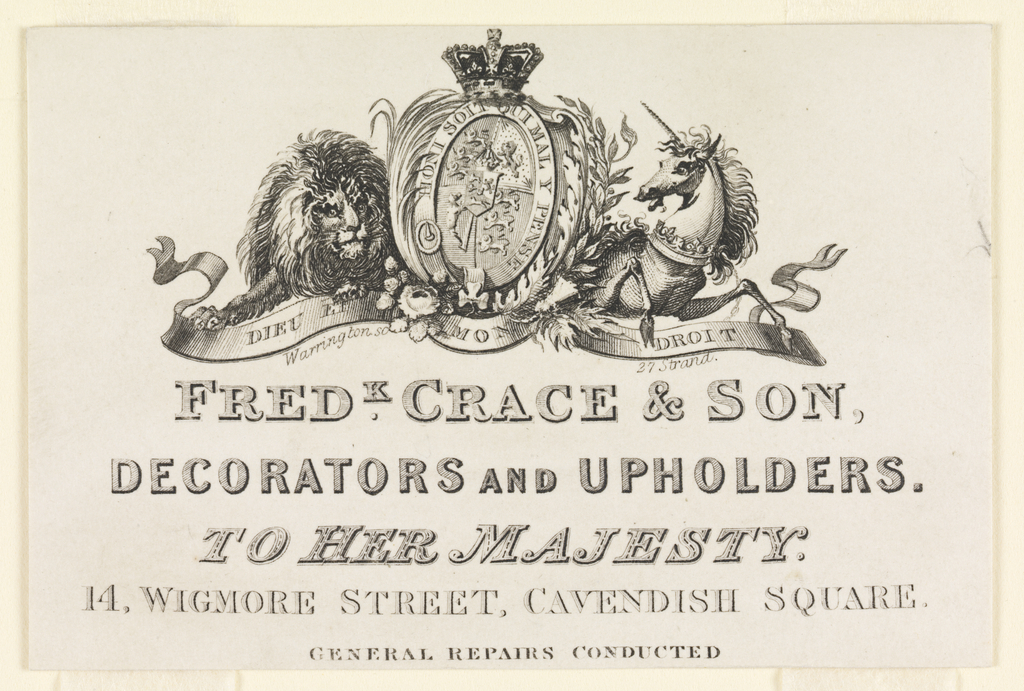
A lot has been written about the Crace family, not least Frederick who is chiefly remembered for the chinoiserie interiors of the Brighton Pavilion. Just recently London Street Views have written a very informative blog about their business base at 14 Wigmore Street. The family firm was created around 1750 by Edward Crace (1725-99) and quickly established themselves as favoured contractors to George III. Edward was not just a paint-splosher, and his services were more akin to interior design, earning him extensive commissions both at Buckingham House and Windsor. Edward’s talents were far-reaching, for in 1770 he authored an influential book upon designs for coach panels (his own father had been a coach-maker), and not long afterwards he became Keeper of the Royal Collection of Paintings, which involved both cataloguing and maintaining the King’s art collection. This was a job Edward kept right up until his death.

Royal Pavilion by Frederick Crace

The Music Room, Brighton Pavilion – Frederick Crace c.1820

Edward’s eldest son John was equally proficient and renowned for his decorating skills, though he set up in practice separately from his father due to a dispute about his choice of bride. John Crace (1754 – 1819) set up on his own in 1776 and by the end of the century was employing his very highly-rated son Frederick. Their clients included leading architects such as Henry Holland and many of the late Georgian housebuilders. John was as favoured in Royal circles as his estranged father – and he was used extensively by the Prince of Wales (later Prince Regent) – working at Carlton House and the Royal Pavilion in Brighton. When in 1788 John was commissioned to source and supply a collection of Chinese art to the Royal Pavilion, he could not have known that this was to lay the groundwork for his own son’s most famous and enduring project.

brighton-pavilion

Brighton Pavilion – the Prince Regent’s playground

It is said that young Frederick first came to the attention of the Prince of Wales whilst he was at work gilding a staircase at Windsor Castle. The Prince was so enamoured with the artistry on show that he asked Frederick to decorate the Royal Pavilion in a style to match the Chinese art housed therein – hence Frederick designed and installed the exotic Chinese-inspired décor of the Music Room and later, when the Prince Regent became George IV, he decorated the King’s private apartments at Windsor Castle. Other significant projects attributable to Frederick included designing the St James’s Theatre (1835)

st-james-theatre-exterior

St James’ Theatre (1835) designed by Frederick Crace & Son

Frederick died peacefully at his home in Hammersmith on 18th September 1859. The Morning Post eulogised upon his professional talents and achievements but went on to add

Mr Crace has always taken a great interest in the history and topography of London, but for the last 30 years of his life he has devoted himself with untiring energy and industry in perfecting a very valuable and extensive collection of maps, plans, and views of every part of the metropolis from a very early period to the present time

Frederick’s collection was left to his son John, who further added to it, catalogued it and eventually put it in a free exhibition at South Kensington Museum in December 1878. The Morning Post enthused called ‘a most honourable monument’ to Frederick’s patriarchal and archaeological skills:

To historians and antiquarians it will prove of great value as describing the marvellous changes enacted by the lapse of time, not alone in the architecture of London, but also in the manners, fashions, and social usages of its inhabitants.

Within two years (around 1880) John Crace sold the entire collection to the British Museum, where it remains today every bit as important as the Morning Post described it 140 years ago. I am not sure what the Museum paid for the privilege of owning this collection, but I hope and suspect that the Crace family would have been more anxious to preserve the collection than to maximise profit by this transaction.

craces-home-by-shepherd

In my next post I will introduce Thomas Hosmer Shepherd and talk about his life, and in subsequent posts will collate some of Shepherd’s images into themed headings and try to provide more background upon each London scene. I hope you will be able to join me as I try to add historical notes to the images selected, to help breath life back into Crace’s London.

In conclusion, I am irresistibly drawn to make a comparison between Frederick Crace and the modern-day work of Mr Paul Talling, who I believe is undertaking an equally commendable and worthy task of recording derelict and forgotten London before it too disappears from our consciousness. Whereas Frederick relied upon artists such as Shepherd, Paul is able to utilise his own camera to capture equally historic scenes which are already being acknowledged as culturally vital – Its good to know that the feelings which motivated Frederick Crace remain alive today with modern historians of London life.

For further information on the Crace family, may I recommend and cite as sources of reference

  1. London Street Views – page on the Crace business premises
  2. Victoria and Albert Museum Archive of Art and Design catalogue of items relating to Frederick Crace
  3. Carlton Hobbs’ excellent images and details about the Crace family
  4. Cooper Hewitt’s list of Crace items at the Smithsonian Museum
  5. A visit to the Brighton Pavilion to see Frederick’s Crace’s masterpiece of the Music Room as well as his portrait

If you are interested in the lost history and traditions of London, you make like my series of blogs on the Epping Hunt, or the history of Royal Ascot. Or for another forgotten and under-appreciated genius why not check out William Wellesley-Pole – the man who gave us the splendid shilling – which is fast approaching its bicentenary of creation.


Black representation in ‘Tylney Hall’ (1834)


Overview of Thomas Hood & Wanstead

Review of Tylney Hall | Finding Wanstead in Tylney Hall  | Black representation in Tylney Hall

black opera

High status black Georgians, fact or fiction?

Thomas Hood’s Tylney Hall would make a great film because it offers historical drama which doesn’t merely include black roles, but positively revolves around them. To think that Britain in 1834 could (and did) celebrate black culture is something we should all be proud of, and Tylney Hall may well be regarded as a by-product of public opinion in the year that slavery was finally abolished. Whilst it was a rarity, the occurrence of high status black people in Georgian society was not beyond the bounds of probability, hence Hood was not stretching credibility beyond its limits.

This final post examines three characters from Tylney Hall – each of whom provide a valuable insight into the presence and status of black people in late Georgian England. By 1800 black people were a relatively common sight throughout Britain. Historian Grechen Gerzina (who has written a number of excellent books and articles upon this subject) calculates that by 1800 up to 3% of Londoners were black. So let’s meet those created by Hood

Pompey (A servant)

kitchen stuff - black servants

Black servants were highly sought after

The character of Pompey is engaged as a black footman by Mr Twigg, a Londoner who has recently bought a house near Tylney Hall. Hood does use racial stereotyping by having Pompey utter phrases such as ‘Nebber mind’  and ‘me berry glad to see him face’ but this should not be taken out of context. Throughout Tylney Hall Hood relies on accents for comic effect; not just for national but also class differences, and perhaps the most ridiculed of all is the Scottish dialect. So what impression do we get of Pompey?

From the first moment Pompey appears he is impeccably dressed in ‘a new suit of sables’ provided for him by pretentious boss Mr Twigg. We learn that Pompey had formerly served as a soldier under Herbert Tyrell, Sir Mark’s recently deceased brother – who is lying in state at Tylney Hall, and had followed him back to England. Pompey causes a bit of stir by sneaking into the room where his former commander lay, and Hood shows us the loyalty and respect of this ‘affectionate African’. We soon learn that the real target of Hood’s satire is in fact Mr Twigg, a city-dwelling ‘cockney’ whose chav-like behaviour grates upon all and sundry. We get the measure of Twigg’s snobbery when he declares:

It is a strange thing that a man like me can’t have a black footman as well as other people of property

We see how highly regarded for black servants were amongst the upper classes in late Georgian England, and though Pompey is firmly a comic character – his positive attributes are always foregrounded.

Marguerite (A mysterious woman living in the forest)

fortune teller

Marguerite – Scary lady from the forest

Marguerite is without doubt the best character in Tylney Hall. Early in the book the local magistrate Justice Rivers warns Sir Mark Tyrell of a strange woman living in the forest outside Tylney Hall. ‘She possesses, at least, the remains of beauty… as for age she may be 50 or 30.’ Though Marguerite’ as she is known is harmless, her exotic ways and palm-reading skills have made her appear very frightening to the superstitious locals, most of whom live in dread of encountering her.

When Sir Mark finally meets Marguerite upon the road, Mr Twigg decries her as ‘a witch’ but he sees a woman ‘dressed in faded mourning [that] could not conceal the symmetry of a shape that had belonged to that fine order of forms, which is peculiar in the half-caste families of the West Indies. She had the taper waist, the full round limbs, and the graceful easy carriage.’ Immediately we see beyond Twigg’s prejudice, the real person standing before them, and Hood drives the point home exquisitely: When the Squire offers Marguerite sixpence she replies with contempt  ‘Give it to your slaves’.

The dignity with which Marguerite is presented more than makes up for her eccentric behaviour, and of all the characters in Tylney Hall she is bestowed with the best lines. When Marguerite finally meets young Walter she reveals her former role as nursemaid to him back in the West Indies, and is able to give him some personal possessions entrusted to her by Walter’s long-dead mother. ‘I was your mother’s dearest friend – her sworn sister, your nurse.’ We can only applaud her for adding

As for my poverty I feel it not; so put up your purse. Should I want money… your hand Walter Tyrrel is the only one on earth that would not revolt my pride… the world is a worthless weedy place to me, but its prejudices are of importance to the young and hopeful. My acquaintance can do you no credit. You must neither name me, nor recognise me, before others… Seek me not, heed me not, mention me not; but if I should summon you at any time… be sure…to come to me.

Perhaps her most emotive scene occurs when Marguerite is finally hauled up before the magistrate for vagrancy and she walks free after declaring

I will tell you I have the same natural privileges as yourself; the same right to live where I will, or how I will, to starve on wild herbs and berries in preference to the menial’s pittance, and to sleep under the bare cape of heaven rather than the roof of a poor house… The Liberty that God gave me, man shall not wrest from me.

We see the depth of Marguerite’s devotion to Walter in that she is prepared to accept any hardship on earth in order to help and protect him when she tells him he is ‘the last link of a chain of love, the whole tie that attaches me to a weary world’.When she hands Walter a copy of his parents’ marriage certificate, Marguerite relieves the boy of his greatest pain, that of being labelled a bastard – and she coalesces in his plot for revenge but urges him to wait for the right opportunity

the time is not yet come. But remember every wrong, record every insult; add word to word, and deed to deed, till the whole heap of injury be worthy of a stern and deep revenge, a full and final atonement.

Marguerite plays a crucial role when the time does come, helping Walter persuade Raby to flee after his accidental shooting of older brother Ringwood.  There is one important twist to the story in regard to her, which I feel ought to withhold in case you may wish to read the book. Suffice to say that this poverty-stricken (yet noble woman) plays a significant part in the denouement. Her final scene is perhaps the most unsatisfactory aspect of Tylney Hall as it is seems not only hurried but also unworthy of her character.

Nevertheless Marguerite brings a strong presence to Tylney Hall and I find it refreshing that whilst being black is a device Hood uses to emphasise her outsider status, he paints a very positive picture of her as a strong woman of principle.

Walter Tyrell (member of the Tyrell family of Tylney Hall)

black 2

Walter is depicted as a noble but resentful character

Walter is not only the central character of Tylney Hall but for the most part of the book we observe events from his standpoint – we feel the prejudice against him, we understand the pain he endures and what leads him to exact his revenge. Any reader of Tylney Hall might argue that Walter’s ultimately awful actions negate his positive foregrounding as a black person. But I think this would be unfair since Hood has ample opportunity of making Walter a savage (as was perhaps expected at that time), but he instead consciously invites us to sympathise with Walter’s ordeal and to hope he came come through it unscathed.

My review of Tylney Hall goes into more detail about Walter’s rivalry with his cousins Ringwood and Raby Tyrell, so all I want to stress here is the status and placement of Walter as a black noble in the pages of this novel. If Tylney Hall tells us anything it reveals the rigidity of class-lines within Georgian society. For, as soon as Sir Mark takes Walter into his care and up to his social position, there is no sign of any racial prejudice. Walter is enabled to go to Oxford, where he gets a degree – and enjoys exactly the same privileges as cousins Ringwood and Raby. The primary issue is not race but the question of Walter’s legitimacy – because being a bastard was perhaps the greatest barrier of all to social advancement. It is on this head that Walter’s enmity with Ringwood originates. Walter’s determination for equality with his cousins leads onto the second conflict – his plain old-fashioned jealousy of Raby’s love affair with Grace Rivers. Though we are made a party to Walter’s evil machinations, these are ALWAYS stirred following some kind of unfair slight has come his way. An example of this occurs at Mr Twigg’s garden party after Ringwood is splashed by a water hose operated by Twigg’s naughty son, when Ringwood instantly blames Walter (who happens to be nearby) and humiliates him in front of the assembled guests.

When there IS racial prejudice against Walter it is conveyed in a way that shocks reader and fellow characters alike. Sir Mark is perhaps the most representative of this push against racism because he steadfastly protects Walter and treats him as one of his own. Other characters, for the most part, treat him with due deference as an aristocratic person – meaning that when Walter finally does turn evil he has not already accumulated any bias because of the colour of his skin. In the end Walter’s actions alone define him, as they should any character in a well-written novel.

Conclusion

black street traders

Street scene c.1840s reveals multicultural London

I hope you have enjoyed my series of blogs on Tylney Hall and will share with me the hope that this far from perfect, yet still important and interesting, novel really ought to be revived. Its insight into the lives of black people in Georgian England may be unique. Also the date of publication (1834) plus the very recognisable representation of Wanstead and Epping Forest provides a prototype of early multicultural suburban life.

For more information on Thomas Hood and Epping Forest you might like ‘A Fond Farewell’ or why not find out how one London home can contain so much history

The best websites for Epping Forest are The Corporation of London (for activities) or the Essex Record Office (for historical research). For modern-day Wanstead news and views look no further than Wansteadium

I always welcome comments and suggestions, and will be blogging again soon on the subject of Wanstead Park


A Review of ‘Tylney Hall’ by Thomas Hood

Overview of Thomas Hood & Wanstead

Review of Tylney Hall | Finding Wanstead in Tylney Hall  | Black representation in Tylney Hall

tylney hall cover

The fact that Tylney Hall (1834) is Thomas Hood’s only published novel implies that he was not really suited to this discipline of writing – especially as his reputation for humorous articles and sublime poetry was already established. This may be true given the mixed reviews Hood received for this three volume story. But the parlous state of Hood’s finances and his desperately poor health would also have compelled him to focus on shorter more intense creative output – just to make ends meet. Furthermore, Hood was actually working on a second novel entitled ‘Our Family’ at the time of his death – so we must assume he was not too bruised by the experience of writing Tylney Hall.

This post provides an overview and critique of the plot – and it does contain some spoilers!

Plot Synopsis

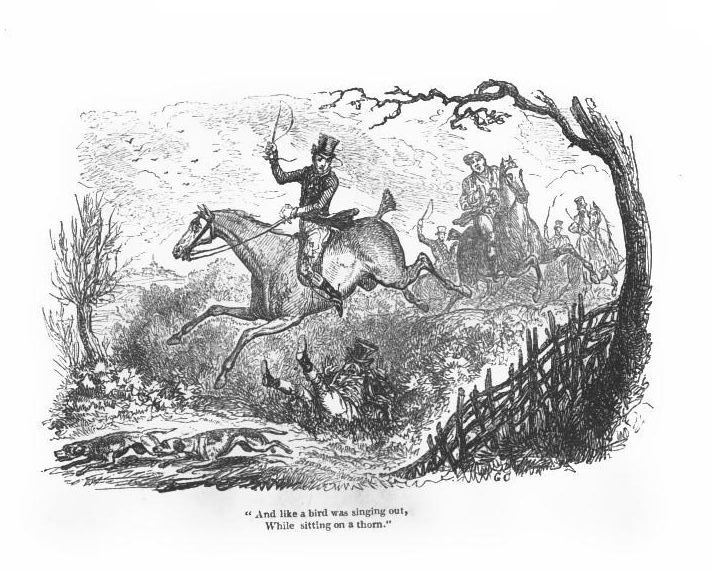
eppinghunt-3

This novel is set in the 1700s in a location in the environs of London. The eponymous mansion of Tylney Hall is owned by Sir Mark Tyrrel, a widower with two young sons. Sir Mark is a keen sportsman enjoying warm relations with his friends, relations and employees. His sons are as different as brothers can be. Older boy and heir-apparent Ringwood is the outdoor type, whereas Raby is a bookish, more sensitive lad who prefers poetry to the hunt. Their lives change when Sir Mark’s younger brother returns from the West Indies, barely clinging to life – bringing with him a scared and frightened boy who he identifies as his son. There is an awkward moment in which Sir Mark exclaims ‘He’s of a cross breed, he’s as brown as Gypsy Jack’. But when he sees how upset he has made the boy he quickly makes amends

‘Come, come’, said Sir Mark, laying his broad hand with an encouraging slap… ‘what I said about the skin was only for the sake of giving tongue – a good horse can’t be of a bad colour.’

As his brother lies dying, Sir Mark pledges ‘to back him through this world, and while I live I’ll ride with him round the course.’ This is an important scene because it instantly shows us that the most powerful character (Sir Mark) takes the boy to his heart – and supports him unequivocally thereafter.

black 2

Sir Mark nicknames his nephew ‘St Kitts’, alluding to his island of origin, and the narrator Hood (for the most part) refers to him as ‘the Creole’. In fact we have to wait until page 43 before the boy’s Christian name is revealed; ‘Walter’ – but I think this is a plot device emphasising Walter’s status as an outsider, rather than an outright bias against him.

The main storyline of Tylney Hall revolves around Walter’s relationship with his cousins, Ringwood and Raby. Walter is often innocently caught up in the cross-fire when the brothers fall out (as siblings do) – because whichever side he takes – both brothers end up resenting him. Ringwood in particular can be nasty and continually questions Walter’s legitimacy, suggesting that he was born out of wedlock. Perhaps the most shocking attack comes when Ringwood names his new horse ‘Brown Bastard’ – in retaliation for a betrayal he wrongly believes Walter has committed. Surprisingly the accusation of bastardy is most hurtful to Walter because he feels unable to stand on an equal footing with the brothers because of it.

fortune teller

Walter befriends a mysterious fortune-teller in the forest

Sir Mark keeps the peace at home and always supports his nephew when arguments arise, but Walter’s resentment continues to grow as a series of misunderstandings (on either side) increase his antipathy to Ringwood. Just when it seems Walter will flip, he meets a mysterious black woman in the forest who claims to have been his nursemaid in the West Indies. She counsel’s Walter to bide his time and crucially provides him with documentary evidence proving his legitimacy – the marriage certificate for his parents:

the reproach of my birth is removed; that sting will still be aimed at me, but it has lost its venom… I am now Ringwood’s equal in all but expectations

All three boys are educated at Oxford, returning to Tylney Hall during the holidays. One summer Raby meets and falls in love with Grace Rivers, the daughter of a local magistrate. But the lovers are thwarted after Sir Mark announces he has long-since agreed that oldest son Ringwood shall wed the magistrate’s daughter. Walter ought to have been pleased to see this serious rift between the brothers, but instead the news awakens the depth of his own feelings for Grace, inciting a jealous hatred towards Raby too.

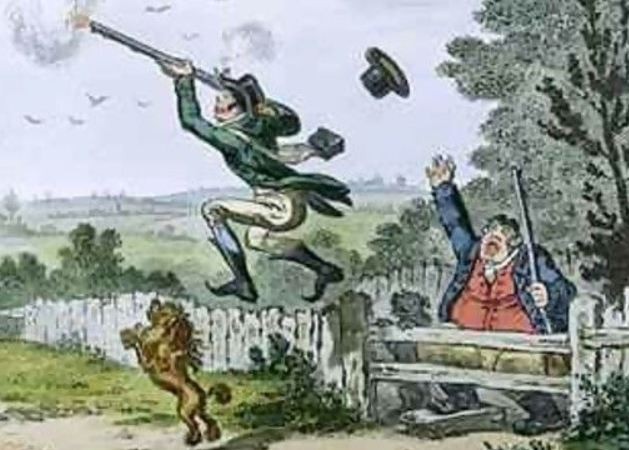
cockney sportsman

Raby is no sharp-shooter, preferring poetry to potshots

Walter knows that Sir Mark intends to buy him a commission into the army when he graduates from Oxford  – but he now decides he wants more. Observing Sir Mark’s disappointment at Raby’s complete inability to use a gun, Walter offers to give Raby shooting lessons, and takes him to a secluded part of the Flats ostensibly to shoot hares. Raby fires the gun when he sees movement in a copse and to his utter shock finds that he has shot his brother Ringwood dead. We are not told whether Walter engineered the shooting – but he does take advantage by urging Raby to flee as he will surely be found guilty of murder, given the well-known fact of the breach between the brothers.  That night a thunderstorm floods the area  – and a few days later a body is plucked from the river wearing Raby’s clothes – indicating that he has died attempting his escape.

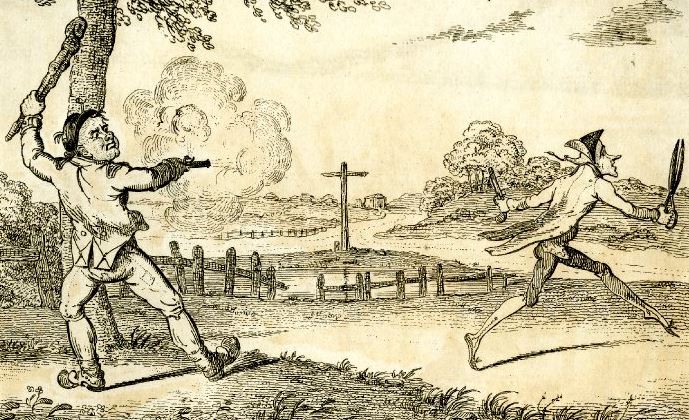
Sir Mark is devastated by this double tragedy and dies less than a month afterwards. Walter inherits the estate but he cannot rest easy as the first the local squire then the old woman in the forest threaten to expose him. As the months pass by, Sir Walter (as his is now known) begins to relax – and looks to complete his final conquest – that of Grace’s heart. This proves a bridge too far as Grace rejects his advances, and accuses him of skulduggery. Returning home from this devastating setback Sir Walter meets the squire who produces a letter confirming Walter’s hand in Ringwood’s death, and challenges him to a duel. Walter sinks to new depths of dishonour by attempting to shoot his adversary in the back while he is still taking the 10 paces – The bullet misses its mark and the squire fatally wounds Walter by return of fire.

duel
Bad-boy Walter shoots (but misses) the squire while his back is turned

All this is witnessed by a passing stranger – who happens to be Raby on his way home, after deciding to face the music. The younger brother is not after all – having swapped his clothes with a tramp before he made his escape. Walter has the decency to make a dying confession fully exonerating Raby, enabling him to marry Grace and reclaim Tylney Hall as its rightful owner.

There are a lot of deaths in the final part of the book, but these are not entirely unexpected as we have seen the resentment build inside Walter. Some of the comic set-pieces, such as an elaborately described fete champetre – held at the home of social-climbing snob Mr Twigg (and turns out disastrously bad) – contain serious events which help turn the screw of Walter’s hatred. It is hard not to empathise with Walter after the treatment he receives from Ringwood & though Walter does turn out to be a thoroughly bad apple in the end, Hood succeeds in showing that this is in some part down to the ordeal he has endured.

Style of Writing

When Thomas Hood wrote Tylney Hall he considered himself ‘young in the path in which he was treading’ and readily acknowledged that characterisation failed to an extent because ‘he could not write love scenes’. It is certainly true that the largely comic style of narration makes it difficult for Hood to switch emphasis to the darker side without jarring the flow. When looking for the absurd, such as portrayed by the character ‘Unlucky Joe’, Hood’s style of writing resembles the early works of Thackeray, who published The Yellowplush Papers around the same time. Both men earned their living contributing to popular magazines such as Punch, and both were fans of the ribald sense of humour promoted by artists such as Rowlandson. The fete scene is particularly reminiscent of Pierce Egan’s Life in London (1822) – a very influential but largely discarded masterpiece of Regency satire.

Hood’s reputation as ‘king of the punsters’ is certainly well lived up to, but perhaps too much to sustain what is a genuinely interesting and sometimes gripping plot. The whole piece comes across as a kind of bridging point between late Georgian bawdiness and the mawkish sentimentality that was about to dominate Victorian literature. It is nonetheless a worthy attempt to tackle the important and still relevant subject of privilege and prejudice.

Most of all I enjoyed its understated social commentary, in particular on the subject of ‘legitimacy’ defined by the arbitrary fate of being born on the ‘wrong side of the blanket’ – for which Walter laments

Tis no fault of mine. I had not the ordering of my birth…

Justice may award the shame to the parent, but the prejudice of man entails it on the child.

Rating 4 out of 5

Tylney Hall is more than just a curiosity, and is a very readable story.  The strength of Hood’s central black characters seems very innovative – perhaps ahead of its time. Transformed into a screenplay this could produce a powerful and unique insight into black culture in Georgian Britain.

Part Three of this series examines how accurately Tylney Hall represents Georgian Wanstead – the area upon which it is based

+++

There is a dearth of readily available information on Tylney Hall  – Gerald Massey’s website remains the best resource for Thomas Hood generally but I also recommend The Poetry Foundation

Finally, why not check out this collection of Hood’s memorable quotes

Elsewhere on my blog I have examined Hood’s relationship with the Epping Hunt. For other sporting related posts you might like the story of prize-fighter Tom Shelton or a brief history of Royal Ascot

Three to See at the First Georgians Exhibition, Queens Gallery

first georgians

The beauty of going to any exhibition is the fact that each and every item being shown has the power to strike a chord, providing every visitor both a unique and a personal experience.

This fact can be no better demonstrated by going to ‘The First Georgians’ which is on at the Queen’s Gallery, Buckingham Palace until October 12th. Organised to mark the 300th anniversary of the accession of George I, Britain’s first constitutional monarch – this exhibition focusses on works of art collected by the royal family (at various times) dating from 1714 until the death of George II in 1760, what we might describe as the early Georgian era.

 hogarths card

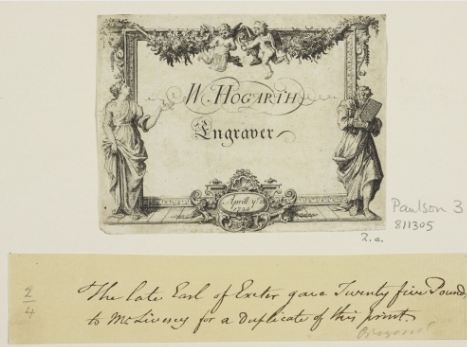
Hogarth’s business card as an engraver – but he was so much more

Fans of William Hogarth (1697-1764) will not be disappointed. His series of six paintings A Harlot’s Progress (1732) & Marriage A La Mode (1743-45) can be seen side-by-side in a section dedicated to perhaps the first exponent of British satirical art.

Seeing Johannes Kip’s incredibly detailed London maps and Canaletto’s overly idyllic views of the Thames from Somerset House was a great pleasure, but for me there are three stand-out exhibits worthy of the admission price alone.

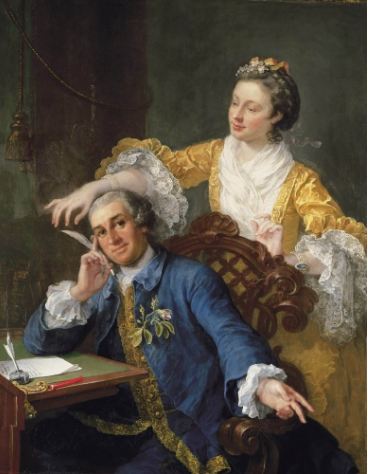
  1. David Garrick and his wife, Eva-Maria Veigel, by William Hogarth (c.1757)

garrick

I have always associated Hogarth with the representation of idleness and debauchery via engravings such as Gin Lane (1751) but here we find an almost seaside-postcard style of painting with truly vibrant colours and little nuances of humour encapsulating his subjects perfectly.

David Garrick (1717-79) was one of the most frequently painted subjects in eighteenth-century Britain. He befriended Hogarth after the artist painted Garrick as the King in William Shakespeare’s Richard III in 1745 (Liverpool, Walker Art Gallery). But it is thought that the pair fell out over this particular portrait. Garrick was displeased with his likeness and disliked the original domestic setting. Hogarth amended the scene by adding a hanging chord in the background reminiscent of the stage, but Garrick never collected the painting and it was still in Hogarth’s possession when he died in 1764.

What I especially like is the depiction of Veigel sneaking up behind her husband to snatch his pen away. This gives me a sense of the warmth of their relationship, with Garrick’s smile adding further to the playfulness of the scene.

This painting is hung in the main gallery well away from the other Hogarth exhibits, and for this I think it benefits greatly and the style in which it is painted makes it refreshingly timeless.

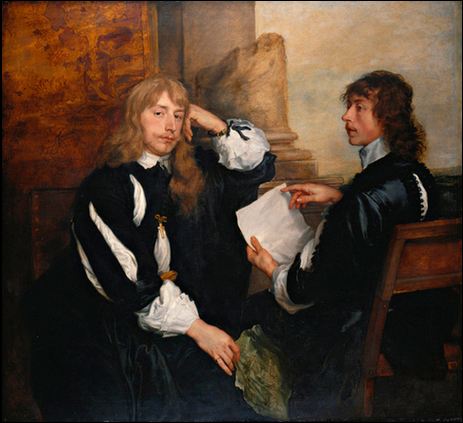
  1. Thomas Killigrew with an Unidentified Man, by Van Dyck (1638)

 killigrew

This painting really is mesmeric to see in the flesh. Painted by Sir Anthony van Dyck (1599-1641) it depicts two figures united by grief. On the left is Thomas Killigrew (1612-83), who is in mourning for his wife Cecelia Crofts, who died in 1638 just two years into the marriage. Killigrew wears his wife’s wedding ring attached to his left wrist by a black silk band. A silver cross inscribed with her intertwined initials is attached to his doublet and he wears a mourning ring next to his wedding band. In his hands is a piece of paper on which there are drawings, possibly made with a funerary monument in mind. Killigrew is being comforted by a friend, but is too distracted by grief to acknowledge what he is being shown.

Such is the incredible clarity of van Dyck’s brushwork that Killigrew really does come to life and his doleful eyes seem to draw you in from far away so you can come and pay your respects. Killigrew’s expression and his long hair would not look out of place on a 1960s hippie, but the sombre tone really does transmit his pain. There are some interesting theories about who the other gentleman may be, but I think the beauty of this painting renders knowing an irrelevance.

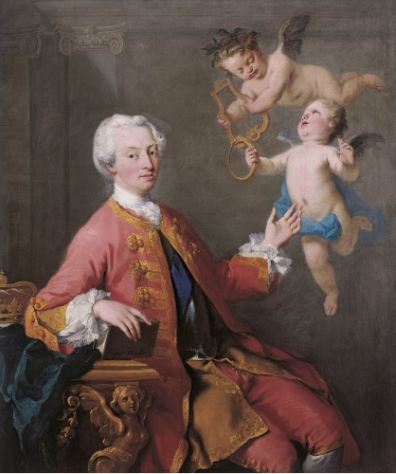
  1. Frederick, Prince of Wales, by Amigoni c.1736)

 frederick

This may seem like an odd choice for my top three, but I have selected it because one of the very knowledgeable curators at the Queen’s Gallery gave a very informative 10-minute talk about it during my visit. Unfortunately she had to compete with a completely ignorant guide who stood at the opposite end of the main gallery talking very loudly to a party of tourists. Given that the guide had ample other points of interest to show her enthusiastic troupe, it was incredibly bad manners for her to blather on whilst the curator bravely soldiered on.

Above all this painting has exposed my ignorance about the Georgian succession. Up until now I have been happily deluding myself that George III was the son of George II and followed him as naturally as princes follow kings. But the fact is that Frederick, Prince of Wales (1707-1751) was the man who ought to have succeeded George II, & whose death meant that it was a grandson who became George III in 1760.

Frederick seems to have had a very neglected childhood, having been left back in Hanover at the age of 7, and not seeing his parents for the next 14 years. Not surprisingly his relationship with George II was strained, and he spent his life trying to carve a separate identity. As Prince of Wales he fraternised with opposition politicians and became a patron of the arts. His knowledge and good taste led to the accumulation an outstanding cache of art, which now forms part of the Royal Collection.

Frederick was eventually banned from the King’s court in 1737 after he sneaked his heavily-pregnant wife out of Hampton Court Palace in the middle of the night, to ensure that the King and Queen could not be present at the birth. His poor spouse was forced to get into a carriage which raced over to St James’s Palace just in time for the birth. The King and Queen were furious at this perceived snub and never forgave Frederick for this act of independence.

This portrait by Amigoni was commissioned by the Prince’s friend, George Bubb Dodington (1691-1762), & given to Frederick as a peace-offering following a spat between them. As is appropriate for a friend’s portrait the Prince appears in an informal and affable guise, as patron of the arts. Frederick holds a book inscribed ‘Pope’s Homer’, alluding to Pope’s famous recently-published translations of The Iliad and The Odyssey. Cherubs fly above the Prince holding a lyre (the attribute of Poetry) and a snake biting its tail (the attribute of Eternity, the duration of a true poet’s fame).

Though his pose is relaxed, the Prince does have formal attributes: a crown on the table, and a riband of the Garter reminding us that this is not just any patron of the arts but a heroic and a royal one.

Frederick certainly seems a character worthy of greater investigation, not just for his contribution to the development of the arts, but also for his love of English culture. Whenever you next hear ‘Rule Britannia’ spare a thought for our lost King for it was Frederick, Prince of Wales whose patronage brought this song into creation.

Because I am really more of a Regency historian, I have shamelessly pillaged the Royal Collection website for background information on these great works of art. Any errors made are all mine though.

If you have been or are considering going to the First Georgians Exhibition I’d love to hear back regarding the works of art you found most compelling – As I have a free return voucher and it would be great to look from another perpective!!

Click Here for more info and facts on the First Georgians Exhibition:

The peerless Lucy Worsley has made a BBC4 TV show about the current exhibition

If you liked this you may like the following excellent Georgian era  Blogs:

Jacqueline Riding is a fountain of knowledge on Georgian art amongst other skills

Who could resist the legend that is Madame Gilflurt 

The British Society for Eighteenth Century Studies promotes all things Georgian

And finally, partly because Ireland is steeped in Georgian era culture, and partly because Frederick, Prince of Wales served as the tenth Chancellor of the University of Dublin (1728-51), I would recommend a visit to the Irish Georgian Society  – Me being Irish might have had a hand in this too.