Suffer Little Children

The Story of Wanstead's Lost Children

The tragic story of Wanstead House, and the dramatic relationship between Catherine and ‘Wicked’ William Long-Wellesley, is a vibrant part of Wanstead’s history. But lesser known is what exactly happened to their three children after the palatial mansion was demolished to pay off William’s colossal debts. This is a tale of yet further loss, betrayal and destruction – with a glimmer of hope thrown in to lighten the mood – a heady mixture which was to profoundly shape the Wanstead landscape we know and love so well today.

Please come along to my talk at Wanstead Cricket Club on Tuesday 16th September 2025 at 7.30pm to learn all.

Tickets Available Here

Could this be the face of ‘Wicked William’ Long-Wellesley?

        A few weeks ago I was asked to pass an opinion upon the subject of a painting acquired by Plymouth-based art dealers Parade Antiques. It was the portrait of a man in his mid-twenties which was recently discovered in the attic of a house at St Ives (Cornwall). The canvas itself was in poor condition; minus frame, artist’s signature or any other distinguishing mark to shed light on his identity.

Could this be William Long-Wellesley?

        It was only after John Cabello (Parade Antiques) had this portrait restored that he noticed a striking resemblance between his mystery man and Arthur Wellesley (Duke of Wellington,1769-1852), who was Britain’s hero at the Battle of Waterloo. Mr Cabello immediately suspected he was looking at an image of ‘Wicked William’ Long-Wellesley, the Duke’s wastrel nephew, best recalled for the destruction of Wanstead House. In Cabello’s opinion this painting is highly reminiscent of Sir Thomas Lawrence (1769-1830), who was a leading English portrait painter of the Regency period and the fourth president of the Royal Academy. 

       But what would a portrait of the black sheep of the Wellesley family be doing in a Cornish attic? And if it can be attributed to Lawrence (or one of his associates) why was it left to fester in such a decrepit state for nigh on two centuries? Most importantly, can we find any visual evidence to connect the cocky-looking man displayed in this picture to the illustrious Wellesley family?

 1. What would Long-Wellesley have been doing in St Ives?

      Strangely enough the obscure location where this painting was found may prove to be the strongest pointer to Long-Wellesley. Following his marriage in 1812, ‘Wicked William’ decided to enter Parliament, and purchased a seat for £500 in the rotten borough of St Ives. He was duly elected in November 1812, serving as the town’s MP until 1818. Long-Wellesley continued to live at Wanstead House, only visiting St Ives around the time of their assizes. Given that Long-Wellesley had civic as well as parliamentary responsibilities in Cornwall it is entirely possible that a painting was commissioned for the purpose of familiarising constituents with Long-Wellesley’s likeness in the days before photographic media. This painting may have been taken down after Long-Wellesley resigned his seat; its frame perhaps re-used for his replacement MP. Maybe the portrait remained in situ until after Long-Wellesley’s scandalous behaviour became public knowledge. Alternatively it could have adorned Long-Wellesley’s residence at St Ives, and he never bothered to retrieve it after he left the area.


2. Could Sir Thomas Lawrence really have have painted Long-Wellesley?

      Sir Thomas Lawrence is best remembered for his flattering style of portraiture, emphasising the positive physical attributes of his subjects. The man in this painting is in his mid-twenties, staring back at us unabashed, almost arrogantly, in the mode of a man of fashion. His style of clothing is very typical of the dandy, but the controlled wildness of his hair exudes masculinity with more than a hint of Romanticism. In 1814 Lawrence was commissioned by members of the Wellesley family to paint a series of portraits, including this iconic image of the Duke of Wellington.

Wellington by Sir Thomas Lawrence (1814)

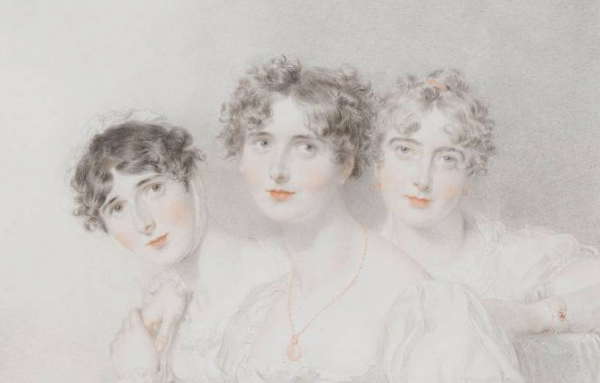
        Another of Lawrence’s most notable works at this time was an ensemble entitled ‘The Three Graces’ : being Mary Bagot, Priscilla Burghersh and Emily Fitzroy Somerset – These women are Long-Wellesley’s sisters.

Wicked William’s three sisters as sketched by Sir Thomas Lawrence (1814)

        In the summer of 1814 William held an enormous fete at Wanstead House to honour his uncle the Duke of Wellington, which was attended by the crowned heads of Europe, in celebration of Napoleon’s defeat and exile. Given that Lawrence was at this time busily employed by the Wellesleys it seems plausible that ‘Wicked William’ could have asked Lawrence to do his portrait too. This was when Long-Wellesley was at the height of his pomp, having just turned 24 years old and thought to be so good-looking that even Lord Byron was envious. The St Ives painting has an element of swagger that would have typified Long-Wellesley. 

        It is important to acknowledge that the age of this portrait is as yet unproven. However the way this man is presented and what he is wearing does provide some hints. The sitter’s clothes are consistent with contemporary descriptions of Long-Wellesley, and the execution of the portrait is so close to the style of Lawrence that it is reasonable to assume it originates from (or relates to) the Regency period.


3. Are we looking at a member of the Wellesley family?

        The best way to determine a familial likeness is to set the mystery portrait against other members of the Wellesley family to look for common traits

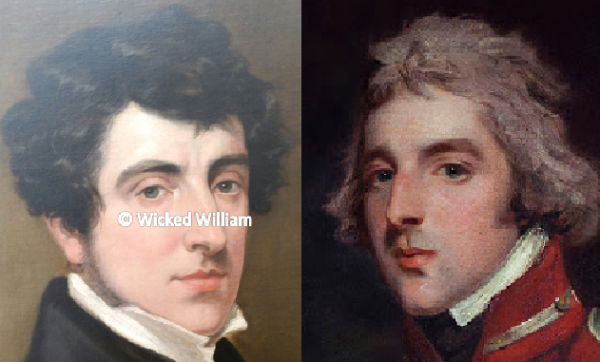
The restored painting (left) and a portrait of Arthur Wellesley by John Hoppner (right)

       In this comparison we capture Arthur Wellesley in 1808 (aged 39). Both men have thick-set eyebrows and blue eyes, their mouths and chins seem to follow the same lines.

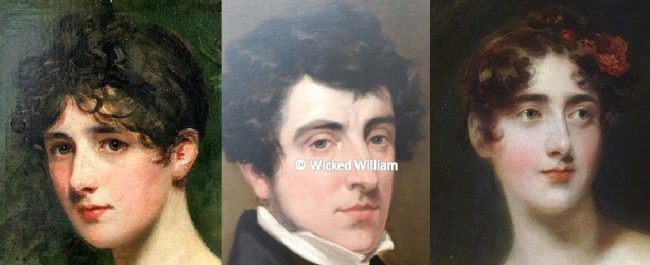
When we place the picture alongside contemporary images of William’s sisters the evidence seems even more compelling.

         On the left is a portrait of Mary Bagot by John Hoppner c.1807. On the right is Emily Fitzroy Somerset by Sir Thomas Lawrence c.1815. Although their portraits were painted by different artists the sisters’ features are identical. Of the two, Emily seems to be uncannily like the man in this portrait, suggesting not only that he is a close family relation, but also that this man has been painted by the same artist (Sir Thomas Lawrence).

4. Is this portrait ‘Wicked William’ Long-Wellesley?

     The story of William’s marriage to the richest heiress in Regency Britain, Catherine Tylney-Long, has become internationally famous since the publication of Angel and the Cad by Geraldine Roberts (2015). Long-Wellesley went on to wreck Catherine’s ancestral home at Wanstead House, leading to the fire sale of its priceless art and treasures; even her cherished family portraits were lost. Although William retained some of Catherine’s heirlooms, they had to be auctioned off in 1852 because he never paid the storage fees, and their current whereabouts are unknown.

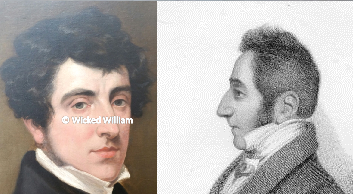
       Apart from a few satires at the British Museum, there are no surviving images of William or Catherine Long-Wellesley for the duration of their marriage. All we can use for comparative purposes are a miniature of Long-Wellesley aged 16 (in the collection of the Duke of Wellington at Stratfield Saye) and etching of him in profile aged about 38 (the original of which is in my possession).

The unknown man replicates 16-year-old William in both appearance and dress

        Looking at youthful William (right), we see distinct features such as eyebrows, nose and the line of his jaw – which seem to be present in the later image. Their fashionable clothes seem to conform to the same dandy regulation of wearing a drab overcoat with high-necked collar. The curls of hair may not be so pronounced in the left-hand image, but this may have been deliberate – reined in to give the man an air of authority commensurate with his standing on public life.

         The portrait of Long-Wellesley in his late thirties (shown on right) depicts a more care-worn man with a receding hairline and a much bigger nose. His chin looks less prominent, but the eyes and eyebrows and his mode of dress are consistent in both images. We all know that the nose never stops growing as one gets older, and Wicked William certainly seems well on the way to a full-blown proboscis akin to the Duke of Wellington. As he got older William looked increasingly more like Wellington. Even the Duke gasped at the likeness when the pair met up in 1845.

         Georgian satires ridiculed celebrities of their day by exaggerating physical appearance to create an image fit for public consumption. Their primary function was commercial; providing a cheap, popular and in-the-moment source of entertainment. Satirical representations were parodies rather than true likenesses. But it was vital to capture the essence of those featured, to make them instantly recognisable. In Long-Wellesley’s case he was often depicted carrying a rake to sow his wild oats; and presented as a womanising fool bereft of common sense. Despite this, when we compare Long-Wellesley’s satires with the St Ives portrait we again find common ground. These examples from 1811 and 1812 could easily be caricatures of the man we see in this portrait.


Conclusion

     It is clear that the St Ives painting needs further examination by art experts to fully establish its age and provenance. I have considered it purely in the context of Long-Wellesley’s life. Long-Wellesley did spend time in St Ives; he also would have been closely associated with Sir Thomas Lawrence at this time. The sitter in this portrait is almost certainly a member of the Wellesley family. Having compared this new painting with existing images and satires of Long-Wellesley, I feel certain that Parade Antiques have unearthed the genuine article, and that this really is an extremely important find.

      I am not yet sure what will become of the painting, but it would be wonderful to see it back in Wanstead. Imagine the irony of forcing Wicked William to gaze upon the wreck of his once proud estate from his position on the wall of the Temple at Wanstead Park – This would be a small yet symbolic act of penance for the misery and cruelty he wrought upon Wanstead House and its ancestral owners.

——–

Images of the St Ives portrait are produced with the kind permission of Parade Antiques, and have been watermarked to preserve their copyright.

If you would like to learn a bit more about Wicked William Long-Wellesley, you might like to find out how he got on when he served under Wellington’s command in Portugal. To learn about William’s over the top entertainments at Wanstead you could join Wicked William’s Hunt – or witness his heartless treatment of Catherine in her final days

For Wanstead related history you might like to learn about Anne Rushout, Wanstead’s Forgotten Artist – or discover multicultural Wanstead in Thomas Hood’s Tylney Hall

I am currently in the midst of writing up my thesis, which is about ‘Long-Wellesley and Publicity during the Regency period’. I hope to publish more new posts as this year goes on. As usual I would appreciate any feedback, comments, or suggestions.

Has Wanstead become a byword for neglect?

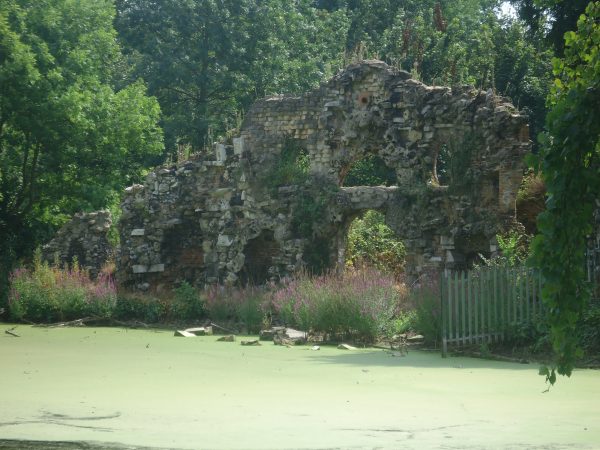
The grotto, Wanstead Park, a symbol of neglect stretching back two centuries

At the turn of the millennium Redbridge held the dubious honour of being the only borough not to feature any places of interest in the official Blue Guide to London. Despite the restoration of Valentines Mansion in Ilford between 2006-09, Redbridge remains missing from the Blue Guide for 2017; though at least it now shares this distinction with outlying boroughs of Bromley, Croydon, Havering, and Sutton.

Whereas other boroughs have majestic buildings of note, Redbridge just has a hole in the ground where Wanstead House once stood

This sense of neglect is no more epitomised than by Wanstead, an area of historical importance that is nonetheless too keenly associated with loss. Since the demolition of Wanstead House, Britain’s first and finest Palladian mansion (1824), it can sometimes feel that the circus has left town and that Wanstead has nothing left to offer but memories of a glorious past. Yet anyone who knows Wanstead and its environs would rightfully assert that today, even without its magnificent mansion, Wanstead Park remains a jewel in the crown not just of Redbridge, but of the whole of east London.

Wanstead Park – Loved yet unknown to most Londoners

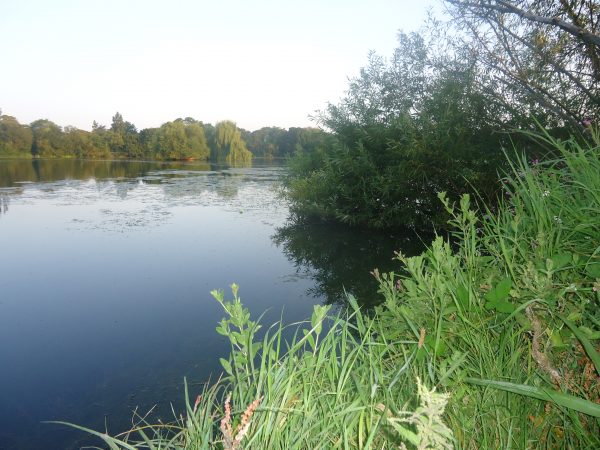
Despite a chronic lack of investment, during which time its ornamental waters have drained and dried up, Wanstead Park remains a doggedly popular leisure amenity. It is enthusiastically championed by a dedicated group of Friends, anxious to turn back the tide of decay which is allowing this enclave of London – once favoured by Tudor Kings and Queens, to slip away without ceremony before our very eyes. The Corporation of London, current custodians of Wanstead Park have long asked us to accept that their finances have limits, yet one can’t help feeling that Wanstead is well down their list of priorities, and certainly easier to ignore than more high profile assets such as Hampstead Heath, with its richer and more powerful supporters.

News today however, that the future of St Mary the Virgin Church in Overton Drive is now under threat because its owner the Church of England are finding it too expensive to upkeep, may just be the tipping point at which we must all stand up and demand change. A church has stood on this site for 800 years, and the present version (c.1790) is the only Grade I listed building in the borough of Redbridge. A by-product of Britain’s East India Company and slave trading past, St Mary’s is both architecturally and socially significant; well worth a visit for anyone interested in London’s cultural history.

I had the good fortune to visit St Mary’s recently whilst a choir practice was in progress and it was a truly memorable experience not only for the delightful interiors but the wonderful acoustic provided by its galleried aisles – leaving me chuffed to know that we have this gem of a building in our midst

Of course buildings like St Mary’s Church are costly to maintain, and reports that the congregation has dwindled to a few dozen mass attendees, clearly contribute to the Anglican Church’s decision to review its future. But isn’t this so typically Wanstead, so typically Redbridge? Here we have the Church of England, sitting on landholdings conservatively valued at £8bn, pleading poverty and implying disinterest as a means to disengage. One must ask the obvious question – why hasn’t the Church invited proposals to increase the use of St Mary’s? Is it because they don’t want help to keep the church open – and are simply looking for excuses to bail out?

The M11 Link protest of early 1990s proves that Wanstead does not always have to take decisions lying down

In the long run listed status will conserve St Mary’s for future generations but doesn’t this whole episode smack of yet more neglect, and a rather patronising assumption that the people of Wanstead will accept another loss in their usual stoic manner? One can only hope that this news will be greeted with a call to arms (like to M11 link protest days) rather than a collective sigh passively confirming that Redbridge, and especially Wanstead, really do deserve to be overlooked by the London guidebooks.

For news and other information about Wanstead why not visit

‘Wicked’ William & Catherine: Society Wedding of the Regency Era

Wicked William takes the hand (and purse) of his bride

On 14th March 1812, ‘Wicked’ William Wellesley-Pole married his fabulously rich bride Catherine Tylney-Long at St James’ Church, Piccadilly. The tragic outcome of their marriage has been thoroughly described in Geraldine Roberts‘ best-selling book The Angel and The Cad (Macmillan, 2015) – including the fascinating account of how such a penniless wastrel could have succeed in winning the heart of Britain’s richest woman.

This blog takes us back to March 1812,  shedding a bit more light on the wedding itself, and how it was reported in the press.

William’s courtship of Catherine Tylney-Long began in the summer of 1810, and it took almost 18 months for him to fend off a plethora of rivals including the Duke of Clarence (future King William IV), before the chase was won. The above satire from January 1812 likens William and Catherine’s courtship to that of Romeo and Juliet – a kind of ‘against the odds’ love affair – which it certainly was. Though at this stage they were already betrothed, the battle was still raging – Not only was Catherine under attack from stalkers, such as John Scott (pictured being chased away above) but there were also hundreds of legal documents to wade through as Catherine’s alarmed and concerned family sought to devise a marriage agreement that would keep as much control as possible away from the Wellesley bridegroom.

William could now be called ‘Long Pole’ and not without reason

Over the next two months a sometimes tense and occasionally hostile negotiation continued – meaning that the wedding arrangements were continually postponed. William did not waste time, however, to cement his destiny. On January 14th 1812 – even before he was married – William changed his name by Royal Licence and added his wife’s ancestral surnames – to become fabulously quadruple-barreled William Pole-Tylney-Long-Wellesley. If you were looking for an omen here – then William certainly gave one by placing ‘Wellesley’ at the end of his newly acquired monicker. It was always traditional for men marrying into money to adopt their wife’s title or surname upon marriage. William instead chose to foreground his politically well-connected Wellesley family name – one which had up to this point been merely a middle name for him – but now, thanks to the endeavours of his famous uncles (including the Duke of Wellington) – William was suddenly making a claim to be Pretender to their legacy. A marvellous piece of self-marketing that really ought to have been pulled up by Catherine and her family. As for the combination of Long and Pole – this gave endless opportunities for punsters to allude to his renowned masculinity – which certainly would have flattered William still further.

St James, Piccadilly – The ultimate fashionable wedding venue

Another knock-on effect of the delay with legalities meant that Catherine’s original intention to ‘get married without ostentation’ was completely over-ridden as William chose THE most fashionable church in London, St James, Piccadilly – in the heart of his stomping grounds amidst the dandies and beau monde of Piccadilly. This beautiful Wren church is still the same, lying just north of St James Square, and its interiors are exactly as they would have been on the day when William and Catherine walked the aisle

Eventually, in early March, Catherine’s legal advisor sent over his final draft of the marriage agreement, but cautioned her as to the amount of property being placed under William’s control

I can only say that if I saw anything improper or that was inconsistent with your honourable character, I should lake the liberty of pressing it to your notice. Nothing of that kind will, I dare say, occur; and as to the general case of the arrangements, they must be entirely governed by your own feelings & judgement as they concern the dispensation of the property which must be entirely subject to your ideas of what is best to be done relatively to all other claims upon it

Once the news was out that the wedding date was finally fixed for Saturday 14th, the Morning Chronicle recorded

The rolls of parchment employed in preparing the marriage articles, conveyances, and other deeds, in preparation for the expected union of Miss Tilney Long and Mr. Wellesley Pole, are sufficiently numerous and bulky to load a cart. The settlement for the separate use of the lady is said to be £11,000, for pin money, with additions of £6000 in case of a separation

Anticipation for the big event was a fever-point by this stage. It was widely reported that huge numbers of ladies queued for hours on end for the change to view Miss Tylney-Longs nuptial garments, which were on display at her robe-makers – ‘it excites much female curiosity to learn why each snow-white chemise should be decorated with the finest Brussels lace all down the back’. Indeed Catherine’s choice of white for her wedding gown is nowadays attributed with establishing that tradition – one that was copied by Queen Victoria at her own wedding, to great acclaim.

The Newspapers describes events of the wedding day – including William’s appalling failure to provide a wedding ring – another omen perhaps, and that led to a lengthy delay whilst a local jeweller was sent for.

The ceremonial of the Wellesley marriage was as private as possible. Marquis Wellesley acted as Master of the Ceremonies, and conducted the bride through Dr. Andrews house to the altar. Miss Diana and Miss Emma Long followed as bridesmaids. During the service, tears were plentifully shed by Lady Catherine, who was present, and all the daughters; it is to be hoped that they may prove the last on this trying occasion! The ceremony over, a new equipage was at the church door in Jermyn Street to receive the happy pair; it was a singularly elegant chariot, painted a bright yellow, and highly emblazoned drawn by four beautiful Arabian grey horses, attended by two postillons in brown jackets, with superbly embroidered jackets in gold, emblematic of the united arms of the Wellesley and Tylney families. The new married pair drove off at great speed for Blackheath, intending to pass the night at the tasteful chateau, belonging to the bridegroom’s father, and thence proceed to Wanstead, in Essex, on the following day to pass the honeymoon.

The dress of the present bride consisted of a robe of real Brussels point lace; the device a sigle sprig; it was placed over white satin. The head was ornamented with a cottage bonnet, of the same material; viz. Brussels lace, with two ostrich feathers. She likewise wore a deep lace veil, and a white satin pelisse, trimmed with Swansdown. The dress cost 700 guineas, the bonnet 150, and the veil 200. Mr Pole wore a plain blue coat, with yellow buttons, a white waistcoat, and buff breeches, and white silk stockings. The Lady looked very pretty and interesting.

It was to elude the eager curiosity of the crowd that they returned from the church at the door opposite to the one at which they entered.

On Sunday the wedding favours were distributed among their numerous friends; the number exceeded eight hundred, composed wholly of silver, and unique in form – those for Ladies having an acorn in the centre, and the Gentleman’s a star; each cost a guinea and a half. The inferior ones, for their domestics and others, were made of white satin ribbon, with silver stars and silver balls and fringe. The Lady’s jewels consisted principally of a brilliant necklace and ear-rings; the former cost twenty five thousand guineas. Every domestic in the family of Lady Catherine Long  has been liberally provided for; they all have had annuities settled upon them for life; and Mrs Pole Tylney Long Wellesley’s own waiting woman, who was nurse to her in her infancy, has been liberally considered. The fortune remaining to Mrs Pole Tylney Long Wellesley (after allowing for considerable sums given as an additional portion to each of the Misses Long, and an annuity to Lady Catherine Long), may be raised to eighty thousand pounds per annum.

A singular circumstance is said to have attended the wedding on the arrival of the happy pair at the Hymeneal altar, the bridegroom was applied to by Dr. Glasse for the ring; but he had forgotten to procure the necessary testimonial. A messenger was in consequence dispatched to Mr. Brown, a jeweller, in Piccadilly, opposite the Church, who immediately attended with an assortment, and then the ceremony proceeded without further interruption.

Not all of the press were enamoured with this incredibly splendid occasion. Several papers intimated that William’s decision to leave the church via the back route owed as much to the need to avoid writs from creditors as the desire to avoid the crowds outside. The Liverpool Mercury acknowledged the ‘admiration and envy excited by the costly bridal dress and jewels’ but questioned the extravagance of spending ‘a sum of money equal to a year’s maintenance of at least 500 poor families’.

So the deed was done and the Long-Wellesleys were off to spend their married life at Wanstead House. Perthaps for this day then, I will wish them well – and hope that, despite the signs, William Long-Wellesley will prove to be a dutiful husband, who will take his Wanstead estate to new heights of brilliance. Fat chance though….

Wanstead House and Gardens, the 'English Versailles,' - England's finest Palladian mansion

Catherine’s marriage was to prove beginning of the end for Wanstead House

The story of William and Catherine’s marriage, and their ups and (mainly) downs at Wanstead House can be fully appreciated by reading The Angel and The Cad – but there is so much more besides to ‘Wicked William’ Long-Wellesley – which has been researched but was not needed for that project. I will return to other episodes from William’s life in future posts

If you want to learn about William’s shambolic military career why not follow him to war, or you might like to see an example of his expensive lifestyle by attending Wicked William’s Hunt. A black sheep indeed, but to appreciate the achievements of his father and brothers, you might like to celebrate 200 years of the splendid shilling, or to see why the Duke of Wellington ought to be celebrated more by the French nation.

My blogs tend to be Londoncentric, and if you are of a similar persuasion why not read the sad tale of a Walthamstow Murderess, the death of a prizefighter, or learn about the days when vagrancy meant prison

Finally, I would like to reiterate that my blog is entirely my own work, but that I do rely heavily upon the fantastic image resources of the British Museum  without which I couldn’t hope to properly illuminate my subjects. I am always happy to answer questions and receive feedback on any of these postings, and would like to thank the 25000+ unique visitors that I have welcomed to my blog site since I first started to post.

Wanstead’s Heiress: The Last Days of Catherine Tylney-Long

If you wish to avoid spoiling your enjoyment of Geraldine Roberts‘ excellent book The Angel and the Cad, look away now! Because this post examines the final tragic days of Catherine Tylney-Long, whose life ended on 12th September 1825. As we shall see her death is not just about Wanstead House – it is in fact an important marker on the long road to women’s equality. Less than 15 years after turning down the chance to marry the Duke of Clarence (later King William IV) Catherine’s final days were spent in a turmoil of pain and anxiety – thrust upon her by the man she did chose to marry: William Long- Wellesley.

wansteadcolour

Wanstead House lamented, but not its tragic owner

Prior to The Angel and The Cad, Catherine Tylney-Long has been a barely remembered footnote in the sad story of the loss of Wanstead House, Britain’s first and finest Palladian Mansion. She had long been blamed for getting mixed up with ‘Wicked William’ Long-Wellesley in the first place:- Catherine’s early death has somehow been viewed as a punishment befitting her negligence in marrying ‘Wicked William’ Long-Wellesley, whose reckless extravagance brought her so much pain and sorrow. Years of research have now overturned this viewpoint, and Catherine has finally been liberated from obloquy. Thus we can now mourn her loss because she did not survive to witness the astonishing victory she delivered for womankind in relation to maternal rights, rather than because Wanstead House is no more.

catherine-tylney-long

Catherine

Here are some details of Catherine’s final days as compiled via eyewitness reports and private letters. To set the scene, Catherine has fled to Richmond with her sisters and children, because she knows that her husband William intends to seize her children and regain control of their remaining funds.

August 28th 1825

Catherine makes William aware that he will no longer receive an allowance from her pin-money. As part of her marriage settlement Catherine had sole control over pin-money of £11000 per annum (roughly £900K in today’s terms) – She had been giving half of this to William since their separation, and he had been living a high life in Paris with his mistress in tow. As from 30th October 1825 William’s funds would be cut, thus his reaction was a desperate one. Catherine was informed that ‘if he could not obtain custody of the children by legal measures, he would resort to stratagem.’ For this reason she now went into hiding.

the-paragon-1The Paragon, at Richmond – Catherine’s final home

September 7th 1825

In the words of Catherine’s sister Emma:

On Wednesday the 7th of September we arrived with Mrs Long Wellesley and her children into a house, in the Paragon, Richmond. She had previously been much indisposed with a stomach complaint. On the evening of that day she was seized with spasms, which occasioned so much alarm that she called my sister Dora into another room & told her that, as spasms in the stomach have proved fatal, she considered it her duty to revoke without delay a will she had signed some years before, which had been made under Mr Long Wellesley’s direction, & probably, she added, to the disadvantage of her children. She then wrote a short revocation of that will & signed it in the presence of two witnesses. She then saw the apothecary who provided a medicine & the spasms subsided.

tylney-long-sisters

Emma and Dora Tylney-Long

September 8th 1825

Thursday the 8th, Mrs Long Wellesley received a letter from her uncle Mr H Windsor, containing one from William The instant she saw Mr Long Wellesley’s handwriting, she closed the letter, and sending for my sister Dora & myself, she informed us that she had received a letter written by Mr Long Wellesley, that concluding it contained some distressing threats of removing her children from her care; and feeling too ill to encounter any distressing intelligence, she was resolved not to open it, & directed us to take charge of it, she said, “if it contains, as I have reason to suspect, any threats regarding the children, I authorise you both to communicate with my solicitor, Mr Hutchinson, & in his absence from Town,… to send for Planch, the Police Officer, to resist to the utmost every attempt to remove the children, which you are well aware I should have done had I been in good health. – Only avoid mentioning this distressing subject to me at present, as I feel persuaded that, if I were to attempt reading that letter, my spasms would return, and I might be dead in a few hours.” My sister Dora and myself then assured her that we would faithfully respect her wishes and we never mentioned the subject to her again.

September 9th 1825

Having been treated by Dr Julius, Catherine was well enough to walk out. However, word had been sent to relatives regarding her precarious state, and the Duke of Wellington dispatched Sir Henry Halford a top physician to attend her.

September 10th 1825

Cousin and long-time guardian Bartholemew Bouverie wrote to Dora Tylney Long from London on hearing of Catherine’s illness

I am very much concerned indeed to learn that your sister Mrs Long Wellesley is so alarmingly ill… I fear your sister’s illness must be increased by reflecting into what wretched hands her poor children must fall, should it please providence to remove her from hence; but I will not even for a moment anticipate an event so calamitous to them & to yourself & Miss Emma, but trust that ere long I shall have the satisfaction of hearing that she can be pronounced convalescent.

September 11th 1825

Catherine suffered a relapse and despite the attention of three doctors experienced ‘agonies of the heart’ and screamed hysterically. She was, however, able to have final words with her children – and to relate instructions to her sisters as to their future care.

September 12th 1825

Catherine passed away quite suddenly at 11am in the presence of her sisters and doctors. She was just 36 years old. Halford wrote directly to the Duke of Wellington, ascribing her death to a fever. The day was spent trying to work out into whose charge the children should be placed. William was in Paris and legally entitled to take them, but those present at Catherine’s deathbed knew that she wanted anything but that to occur. So Dr Gladstone placed the children with their aunts as next-of-kin present to take charge of their welfare. This act was to enrage William, who saw it as an act of treachery denying him his legal rights as a father – leading to the famous custody case fought on Catherine’s behalf to protect her children.

September 13th 1825

News breaks about Catherine’s death, and her sufferings are blamed upon William. Batholemew Bouverie angrily writes

I had a fearful foreboding of the melancholy event, which your letter I received this morning has announced to me. The symptoms you had mentioned were of too alarming a character to afford us any sanguine hopes of your poor sister’s recovery. Oh! What remorse must that wretch feel, or rather ought to feel when he learns about what his perfidy & cruelty have effected! Alas! I fear, his heart is so hardened, & his mind so completely depraved as to be alive only to a very different impression… I hope the proceedings in Chancery were so far advanced that [the oldest boy] is now actually a Ward in Chancery, & therefore all that property will be kept completely out of that monster’s hands. If the boy is not already a Ward in Chancery, you and Miss Emma, as the next heirs, can make all the three children so.

Amidst the outrage though, there is genuine sorrow as expressed by Catherine’s close friend Sir George Dallas

Is it possible, that one so loved, so honoured, so deservedly mourned, is snatched thus suddenly from her weeping children… in the flower of her days, to that Heaven she had early earned by her virtues? O, God, it is impossible that a Soul so pure, so acceptable in thy sight, could be summoned to thy presence but to receive that Crown of righteousness which her spotless life, and admirable qualities, had fitted her to wear, and to experience an appropriate shelter from that earthly storm which had already wrecked her happiness, and threatened her future days, (had she been spared to see them), with increasing misery… A finer heart never bowed to earthly sufferings, and great we know her sufferings to have been, how she bore them we equally know; and these, while they embalm her memory in the hearts of her friends, will also enshrine it in the memory of a husband who now, that she is lost to him for ever, cannot forget how tenderly she loved him, and whose heart, touched by her sad, and unmerited fate, may, when brooding over the recollection of her virtues, and the remembrance of her misfortunes, awaken, perhaps, to penitence, and seek to atone for the misery he heaped upon her by a life of future devotion, and kindness to her children. So may he soothe her Shade, by a renewed, and tender, discharge of that parental duty to them it was the pride of her life, and the dearest object of her own heart to perform… What a blank she will create in our affections, and how she deserves to be mourned! Her sensible mind, her sprightly disposition, her graceful elegant manners, her generous heart, her happy temper, her devotion to her family, a breast wherein all the virtues dwelled, these were the adoring qualities of her character; and it is over these you must both muse when seeking for consolation under your affliction, for it is in the consciousness of these that you must reach the consolatory assurance that she is finally and imperishably happy.

Over the coming days there were a great many eulogies to Catherine in the newspapers. Out of a sense of decorum her loss was mourned without any blame being attached to William. However, the Evening Herald, was unable to resist using her story as a metaphor for contemporary life

It is seldom that we allude to domestic circumstances, under a strong conviction of the privacy of domestic life is what the Press can, generally speaking, have nothing to do with. But premature death of an amiable and accomplished lady, born to large possessions, and against who the voice of calumny never so much breathed a whisper, calls, we think, for one passing comment, in illustrating, and furnishing, we trust, a lasting and a useful lesson to the heartlessness of too many of the men of the present age. With a fortune that made her an object and a prize to Princes, this amiable woman gave her hand and heart to a man of her choice, and with them all that unbounded faith could bestow. What her fate has been, all the world knows: what it ought to have been the world is equally aware. To her, riches have been worse than poverty; and her life seems to have been sacrificed, and her heart ultimately broken, through the very means that should have cherished and maintained her in the happiness and splendour which her name and disposition were alike qualified to produce. Let her fate be a warning to all of her sex, who, blessed with affluence, think the buzzing throng which surround them have hearts, when, in fact, they have none: and if there be such a feeling as remorse, accessible in the quarter where it is most called for, let the world witness, by a future life of contrition, something like atonement for the past.

I hope that the above has given a flavour of Catherine’s final days, and shone some light into how much her loss was felt by family, friends and the wider general public. Just a week later thousands of mourners lined the roads to Draycot Church to witness Catherine’s burial and to pay their respects to a woman of virtue, who had been the victim of a morally corrupt husband. Thankfully, during the remainder of William Long-Wellesley’s lifetime, he was vilified for this act of cruelty above all others.

children

Thanks to Catherine – Children were hereafter protected from bad fathers

Whilst there can be no doubt that Catherine Tylney-Long lost her life due to William’s shameful behaviour – she was equally a high-profile victim of an antiquated legal system, which denied women even the most basic rights in terms of property, and no say in the control of their own children. Such were Catherine’s sufferings that Lord Chancellor Eldon was unwilling to uphold the status quo, and instead ruled that William Long-Wellesely should be the first man ever to be denied custody of his children on the grounds of moral conduct. This Cruickshank satire depicts Catherine’s children safely in the control of legal guardians, whilst their errant father takes yet another fall from grace.

I am glad to say that ‘Wicked’ William’s attempts to silence his wife and place her in permanent ignominy have failed – Despite the destruction of her private papers, and Long-Wellesley’s assertion that she was an uneducated dullard, Catherine left enough scraps of information to allow a fresh examination of her life, and to overturn the conventional viewpoint. Geraldine Roberts’ book The Angel and the Cad reveals Catherine’s real nature – and liberates her from almost two centuries of misrepresentation. Her ‘guilt’, if you can even call it that, only extends to following her heart and falling in love with the wrong person – and then standing by him through thin and thinner. Ultimately, she was a brave woman risking all in the defence of her children, by instigating legal action that is nowadays acknowledged as a landmark in British legal history. Therefore, all that remains to be said is

catherines-tomb

R. I. P. Catherine Tylney Long (1789-1825)

If you want to learn more about the Long-Wellesley family please bookmark this site. Wicked William’s long and notorious life contains many interesting chapters as yet unwritten. You can learn more about Wanstead House on Geraldine Roberts Website and the best resource for Wanstead Park is here.

You may also enjoy Wicked William and The Epping Hunt or see what a completely useless soldier he was when Wicked William went to War. Finally, to prove that bonkers behaviour can and does run in families, read the interesting tale of Wellesley-Pole’s Anger Management


A Guide to Commuting In Regency London

Rules of the Road | Wanstead | UK Destinations | Porters, Goods & Luggage
stagecoach perils

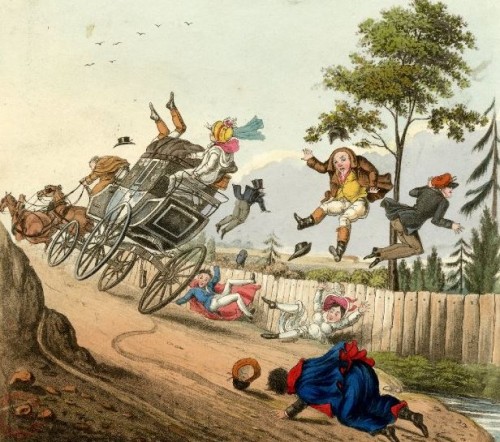
Finding a stagecoach might be the start of your troubles

Should you ever find yourself transported back to Regency London (1819), here is an essential guide to making your way home. Remember that this was an age before trains, or motorised public transport could whisk you home in time for tea. Your destination will undoubtedly be unrecognisable from how it looks today, yet I hope my advice will remove you from the streets of the Metropolis before darkness sets in, and the Regency Underworld takes over.

Having explained the rules and regulations of coach fares, this second post focusses on my own locality, namely Wanstead and its environs. But part three now provides information upon travelling to other destinations throughout Britain. Special priority will be given to requests submitted by anyone overly anxious about the dangers of slipping through a time portal.
book reference

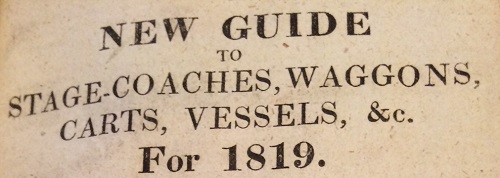
Information drawn from this hand-book

So if one day you do happen to wake up in 1819, please DON’T PANIC because London already has a highly organised and efficient transport system, relying on horse power [and Old Father Thames] to move people from A to B. You will discover a network of coaching inns and wharves, acting as proto ‘station terminals’ taking you to all manner of destinations.  Each can offer a choice of departure times, mode of carriage, and hospitality to suit the weary traveller should they decide to bide a while longer in the City before departure.

Before you book your journey, it is necessary to draw your attention to the terms and conditions prevailing in 1819.  After all you don’t want to end up in darkest Snaresbrook being bludgeoned by an irate coach driver because you have failed to read the small print governing Regency period transportation.

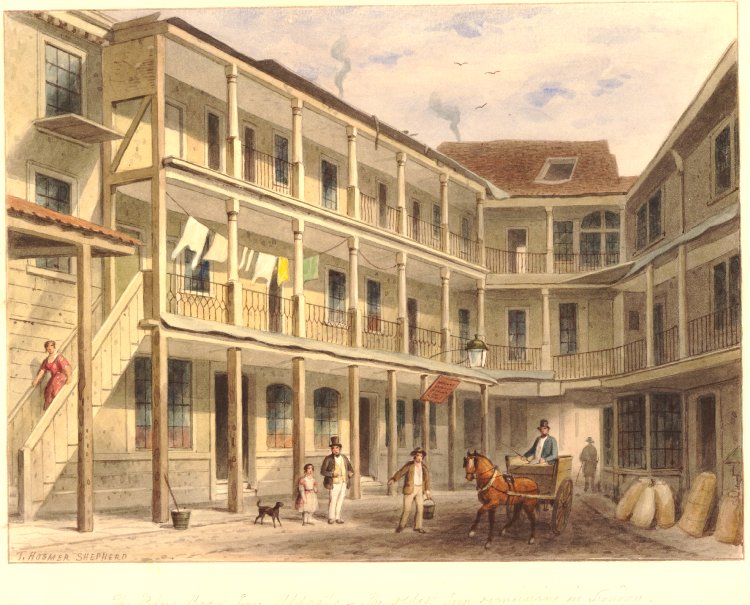
Most coaching inns provide stagecoaches, with some offering luxury Chariots to their richest clients. However, to reach your destination safely you may be compelled to board a Waggon alongside farm animals – or worse still, endure the ignominy of sharing a Cart with anything from perishable goods through to dead bodies (perished goods heading back to their parish for burial). So please study the timetable carefully to ensure you make the right choice!!


Wanstead [Essex, 8 miles from London] – Approximate cost 11 shillings

Magpie and Stump3
The Magpie & Stump – With prime views of Newgate Prison executions from the upstairs windows

As late as 1821 Wanstead was a very sparsely populated, with most local employment engaged at Wanstead House. In fact the only means of hired travel to Wanstead was by Cart:-

Kings Arms, Leadenhall Street, and Spotted Dog, Strand 4pm daily; Blue Boar Cellar, Aldgate, Kings Arms & Flower Pot, Bishopsgate; Three Nuns, Whitechapel, and White Hart, Strand, 2pm daily; Cheshire Cheese, Crutched Friars, and Magpie & Stump, Newgate Street, daily (on demand)

Given that the Wanstead Estate produced a great deal of fresh fruit and vegetables as well as timber, it is likely that Carts travelled to London laden with goods early each day and then in the afternoon served as carriages for their return journey.


Leytonstone [Essex, 6 miles] – Approximate cost 8 shillings
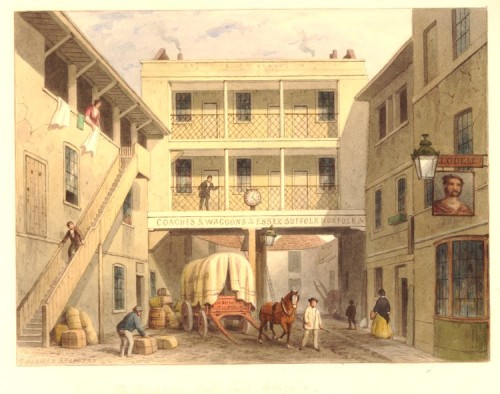
saracens head aldgate 1855

The Saracen’s Head, Aldgate – Regular trips to Leytonstone

Given the surprising difference in mileage from that of nearby Wanstead, I assume that ‘Laytonstone’ (as it was then termed) must have had a drop off point nearer the parish boundary with Stratford. There are far more options available to Leytonstone dwellers:

By Coach daily: – The Bull, Aldgate, 11am and 3pm; Kings Arms, Leadenhall Street, 10am, 3pm, 4pm and 7pm; Saracen’s Head Aldgate, and Three Nuns, Whitechapel, 10am and 7pm; Blue Boar Cellar, Aldgate, 4pm during summer, 3pm in winter.

By Cart daily:- White Hart, Strand, Flower Pot and King’s Arms, Bishopsgate, and The Bull, Whitechapel at 3pm, Cheshire Cheese, Crutched Friars, The Bull and Blackboy & Camel, Leadenhall Street, and Magpie and Stump Newgate, (on demand)


Snaresbrook [Essex, 8 miles] – Approximate cost 11 shillings
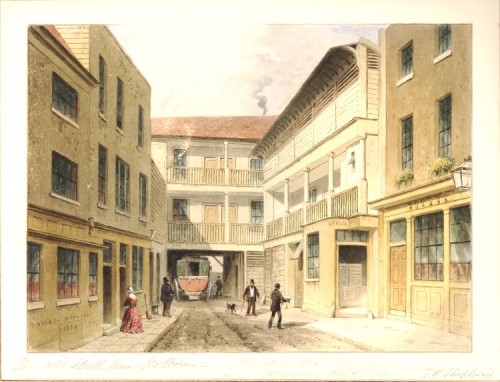
the bell gracechurch st

The Bell, Bell Yard, Holborn – served Snaresbrook

During my research into Wanstead House I discovered that Snaresbrook was an important stage post for carriages travelling in the direction of Norfolk. This may explain why there are a reasonable amount of options available in London for what was (at this time) mainly open country.

By Coach daily:- Flower Pot and Four Swans, Bishopsgate, 10am, 4pm and 7pm

By Waggon daily:- The Bull, Aldgate, 3pm

By Cart daily:-   The Bell, Bell Yard, Gracechurch Street and Flower Pot, Bishopsgate Street 3pm and Kings Arms, Bishopsgate, at 2pm


Woodford [Essex, 9 miles] – Approximate cost 12 shillings
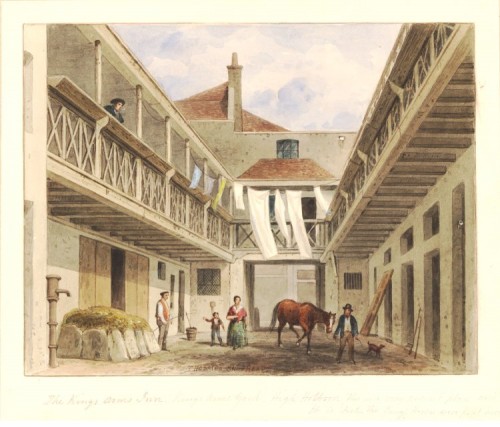
the kings arms holborn

The Kings Arms – good for Woodford

By 1819 Woodford had a number of fine mansions, farms and estates, so this may explain the range of options available for travel to that destination

By Coach daily:- King’s Arms, Leadenhall Street, 10am, 3pm, 4pm and 7pm; Saracen’s Head, Aldgate, and Blackboy & Camel, Leadenhall Street 3pm and outside No 93 Bishopsgate Street 4-30pm. The Bull, Leadenhall Street has a service 3pm daily apart from Sunday which leaves at 10-30am; and Three Nuns, Whitechapel, does 10-30am and 7pm daily, apart from Sunday when it departs at 9am and 7pm

By Cart daily:- Three Nuns, Whitechapel, 4pm; Flower Pot, Bishopsgate, 2pm; The Bull, Aldgate,  3pm and Magpie & Stump, Newgate Street, 2pm daily. Kings Arms, Bishopsgate, offers a service Wednesdays & Saturdays only at 2pm


Woodford Bridge [Essex, 10 miles] – Approximate cost 13 shillings

blue boar aldgate

The Blue Boar Cellar, Aldgate – try here for Woodford Bridge

Given that Woodford Bridge is close to Woodford, I am surprised to note the lack of overlap in service between these two destinations. The Bull, Aldgate for example offers a Coach to Woodford Bridge but only a cart to Woodford – and none of the regular coach services to Woodford have the option to stay on until Woodford Bridge. Perhaps folk were happy to walk the mile or two between destinations rather than looking upon coach services as a series of stops – which they clearly weren’t given the limited passenger capacity of each carriage.

By Coach daily:- The Bull, Aldgate, 3pm and Blue Boar Cellar, Aldgate,  4pm winter and 3pm summer, daily, save for Sunday which is at 8am

By Cart daily:-  Blue Boar Cellar, Aldgate,  4pm winter and 3pm summer, daily, save for Sunday which is at 8am, and The Bull, Aldgate, and Talbot, Whitechapel, Tuesdays, Thursdays and Saturdays  only at 3pm

♦   ♦   ♦

I hope you have found this an interesting guide as to how our ancestors found their way home from London. All information is drawn from a book in my possession, published by Critchett & Woods at the end of 1818. Meticulous work seems to have gone into the production of their guide – and I will be dipping into it again to examine other destinations served by the once great coaching inns of old London town.

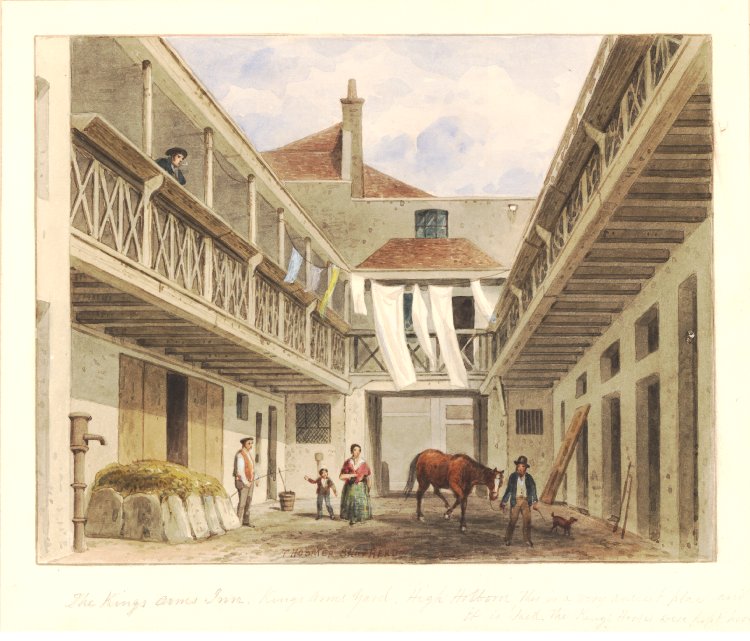
These beautiful water colour paintings of London’s lost inns are all by Thomas Hosmer Shepherd (1792-1864). If he was around today I would gladly buy him a pint for his dedicated attention to detail.

If you like to know about old London pubs and coaching inns, I recommend Pubs History – an excellent resource for any local historian
Finding Wanstead in Thomas Hood’s Tylney Hall

Overview of Thomas Hood & Wanstead

Review of Tylney Hall | Finding Wanstead in Tylney Hall  | Black representation in Tylney Hall

Up the slope Wanstead Park

Hood conjured a vision of Wanstead Flats – not Wanstead House

The overview to this blog looks at Thomas Hood’s impact as a poet and wry observer of the joy and hardships of life in the early decades of the nineteenth century. As explained, his only novel Tylney Hall (1834), gave readers false hope of discovering what actually happened at Wanstead House, nearby ancestral home of the Earls of Tylney –  which had been suddenly and brutally demolished less than a decade earlier. Such a glaringly obvious deceit within the novel’s title undoubtedly upset readers. The Literary Gazette echoed this widespread disappointment

It was inferred that the private histories of the Wellesley and Long families had furnished matter for the novel…. Accordingly, not a few copies travelled eastward, through Stratford-le-Bow, but, of course, to the signal discomfiture of the speculators [because] the figures were not drawn from living models

I am fascinated by the fact that the central character – from whose perspective we follow events – is a black man – Not a stereotypically menial representation found in the background of much Georgian art, but a wealthy, educated and well-connected black man, with a profound understanding of the prejudice he encounters. What’s more he is not the only black character in the book. I thought this plot-device would have set alarm bells ringing as to Tylney Hall ‘s credibility. But having examined several contemporary reviews of Hood’s novel – both good and bad – I find no evidence to suggest that the presence of black people of worth was anything out of the ordinary to late Georgian readers.

middling heat in the west indies 1817

Tylney Hall avoids traditional black stereotypes

So how much, if anything, does Tylney Hall represent the geography and social fabric of eighteenth century Wanstead? I will answer this question in two sections, firstly looking for physical evidence of Wanstead’s presence – and secondly questioning whether the presence of black (or Asian) people in that part of the world was as commonplace as Tylney Hall implies

1. Finding Wanstead in Tylney Hall

It is important to remember that Hood was often unwell during his years at the Lake House. Thus the writer had to rely heavily upon his surrounding neighbourhood to create the backdrop for Tylney Hall. From the outset Hood makes no effort to disguise the fact that Wanstead is the setting.

Rabbits1900

The Three Rabbits was within walking distance of Hood’s home

The opening chapter of Tylney Hall  takes us to the Rabbits public house ‘set in a bleak wasteland called the Flats…On the other side stretched an immense park, behind an angle of which lay perdue a small village.’ Straight away the geography of Wanstead is laid before us – from Manor Park’s Three Rabbits pub in the south up to the village beyond Wanstead Park. Hood gives a lovely description of the pub and its characters, including their regular whist drives. We also learn that the local coaching inn, which stands outside the grounds of ‘Tylney Hall’ is called ‘The Green Man’  – not just the same name but the same proximity of Leytonstone’s Green Man pub to the gates of old Wanstead House.

green man

The Green Man Inn (Leytonstone) features in Hood’s Tylney Hall

Tylney Hall is less obviously a replica of the real Wanstead House. Perhaps Hood never visited Wicked William’s Palladian palace before it was demolished, for interior descriptions of Tylney Hall are scanty. However Tylney Hall does possess ‘a great many Gobelin Tapestries’ – copying one of the main treasures advertised for sale by George Robins in 1822, suggesting that Hood may have seen or possessed an auction catalogue. External features of Wanstead House – such as the stables (still standing today) and the octagonal Basin are replicated by Hood for the fictitious Tylney Hall

gobelin tapestry

Gobelin Tapestries prominently featured in Robins’ auction catalogue (1822)

Hood’s lovely descriptions of the park, lake and waterways around ‘Tylney Hall’ can only be picked up and appreciated by readers familiar with the landmarks in question. We can therefore conclude that Hood’s novel is definitely a homage to Wanstead Park.

2. Finding black people in Wanstead

cruickshank from the west indies

West Indian immigrants satirised by Cruickshank (1824)

Recent research has shown that black people were fairly commonly employed as servants in wealthy or titled households during the Georgian era. As such many were educated to a high-level commensurate with their status within the hierarchy of the home. In many cases these families contained mixed race children or servants – either of whom would have enjoyed the protection of their wider family group. Those who returned from service in the East India Company often settled in close knit ‘Anglo-Indian’ communities – The writer William Makepeace Thackeray  (1811-1863), who was born in Calcutta and returned to England in 1815 to complete his education – lived in one such community – sticking together to overcome local resentments. Another example may be found in the story of Dido Elizabeth Belle, which has recently been made into a film. But most importantly, there was a general influx of foreign settlers in Britain’s urban areas from the eighteenth century onwards. By the 1790s significant immigrant communities, arriving from Africa, the West Indies or Asia – either aboard merchant ships, or demobbed military/naval conscripts. In London, for example, the slums around St Giles were considered to be black ghettos.

During my research on ‘Wicked William’ of Wanstead House I discovered that during the 1790s the Wellesley-Pole family regularly opened a soup kitchen from their home in Savile Row – This weekly event was attended by such numbers of homeless black immigrants that they were eventually ordered to close it to keep the peace.

the rabbit salesman

For many,  black people were a regular feature of everyday life

So, let’s take these findings to the Wanstead area. First of all we can see that a great many estates in and around Epping Forest were bought up and subsequently developed by East India Company employees and merchants. Given its relatively close proximity to London and the docks – it is therefore perfectly reasonable to conclude that Hood’s Tylney Hall does reflect the reality of black people – rich and poor, entitled and subservient – who may have lived or worked around Wanstead at this time.

In my final part I will take a closer look at three black characters from Tylney Hall to get a better understanding of their place in society and the interaction they had – both good and bad – with those around them. I want to show that for Hood at least – there was a true respect for black people. Perhaps Hood was reflecting the prevalent public enthusiasm for black culture following the recent Abolition of Slavery Act (which gained Royal Assent just two months prior to publication). But I prefer to think his experience of living amidst the poor and under-privileged around Wanstead was the more fertile ground where his characterisations were formed

+++

Paul Edwards has written a great article in History Today looking at black personalities in Georgian England

For more information on the subject of black history try this select bibliography:

Reconstructing the Black Past: Blacks in Britain 1780-1830 by Dr Norma Myers

The Fortunes of Francis Barber: The True Story of the Jamaican Slave Who Became Samuel Johnson’s Heir by Michael Bundock

Untold Histories: Black People in England and Wales During the Period of the British Slave Trade, C. 1660-1807by Kathleen Chater

Black England: Life Before Emancipation, and  Black Victorians/Black Victoriana – both by Gretchen Gerzina

London In The Eighteenth Century: A Great and Monstrous Thing  by Jerry White

Finally you may like to read more about the Wellesley-Pole’s charitable work, as they attempt to rescue a tramp. If only their son Wicked William of Wanstead House had the same attitude when he went amongst the needy

A Review of ‘Tylney Hall’ by Thomas Hood

Overview of Thomas Hood & Wanstead

Review of Tylney Hall | Finding Wanstead in Tylney Hall  | Black representation in Tylney Hall

tylney hall cover

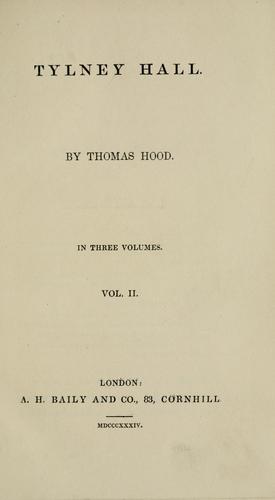
The fact that Tylney Hall (1834) is Thomas Hood’s only published novel implies that he was not really suited to this discipline of writing – especially as his reputation for humorous articles and sublime poetry was already established. This may be true given the mixed reviews Hood received for this three volume story. But the parlous state of Hood’s finances and his desperately poor health would also have compelled him to focus on shorter more intense creative output – just to make ends meet. Furthermore, Hood was actually working on a second novel entitled ‘Our Family’ at the time of his death – so we must assume he was not too bruised by the experience of writing Tylney Hall.

This post provides an overview and critique of the plot – and it does contain some spoilers!

Plot Synopsis

eppinghunt-3

This novel is set in the 1700s in a location in the environs of London. The eponymous mansion of Tylney Hall is owned by Sir Mark Tyrrel, a widower with two young sons. Sir Mark is a keen sportsman enjoying warm relations with his friends, relations and employees. His sons are as different as brothers can be. Older boy and heir-apparent Ringwood is the outdoor type, whereas Raby is a bookish, more sensitive lad who prefers poetry to the hunt. Their lives change when Sir Mark’s younger brother returns from the West Indies, barely clinging to life – bringing with him a scared and frightened boy who he identifies as his son. There is an awkward moment in which Sir Mark exclaims ‘He’s of a cross breed, he’s as brown as Gypsy Jack’. But when he sees how upset he has made the boy he quickly makes amends

‘Come, come’, said Sir Mark, laying his broad hand with an encouraging slap… ‘what I said about the skin was only for the sake of giving tongue – a good horse can’t be of a bad colour.’

As his brother lies dying, Sir Mark pledges ‘to back him through this world, and while I live I’ll ride with him round the course.’ This is an important scene because it instantly shows us that the most powerful character (Sir Mark) takes the boy to his heart – and supports him unequivocally thereafter.

black 2

Sir Mark nicknames his nephew ‘St Kitts’, alluding to his island of origin, and the narrator Hood (for the most part) refers to him as ‘the Creole’. In fact we have to wait until page 43 before the boy’s Christian name is revealed; ‘Walter’ – but I think this is a plot device emphasising Walter’s status as an outsider, rather than an outright bias against him.

The main storyline of Tylney Hall revolves around Walter’s relationship with his cousins, Ringwood and Raby. Walter is often innocently caught up in the cross-fire when the brothers fall out (as siblings do) – because whichever side he takes – both brothers end up resenting him. Ringwood in particular can be nasty and continually questions Walter’s legitimacy, suggesting that he was born out of wedlock. Perhaps the most shocking attack comes when Ringwood names his new horse ‘Brown Bastard’ – in retaliation for a betrayal he wrongly believes Walter has committed. Surprisingly the accusation of bastardy is most hurtful to Walter because he feels unable to stand on an equal footing with the brothers because of it.

fortune teller

Walter befriends a mysterious fortune-teller in the forest

Sir Mark keeps the peace at home and always supports his nephew when arguments arise, but Walter’s resentment continues to grow as a series of misunderstandings (on either side) increase his antipathy to Ringwood. Just when it seems Walter will flip, he meets a mysterious black woman in the forest who claims to have been his nursemaid in the West Indies. She counsel’s Walter to bide his time and crucially provides him with documentary evidence proving his legitimacy – the marriage certificate for his parents:

the reproach of my birth is removed; that sting will still be aimed at me, but it has lost its venom… I am now Ringwood’s equal in all but expectations

All three boys are educated at Oxford, returning to Tylney Hall during the holidays. One summer Raby meets and falls in love with Grace Rivers, the daughter of a local magistrate. But the lovers are thwarted after Sir Mark announces he has long-since agreed that oldest son Ringwood shall wed the magistrate’s daughter. Walter ought to have been pleased to see this serious rift between the brothers, but instead the news awakens the depth of his own feelings for Grace, inciting a jealous hatred towards Raby too.

cockney sportsman

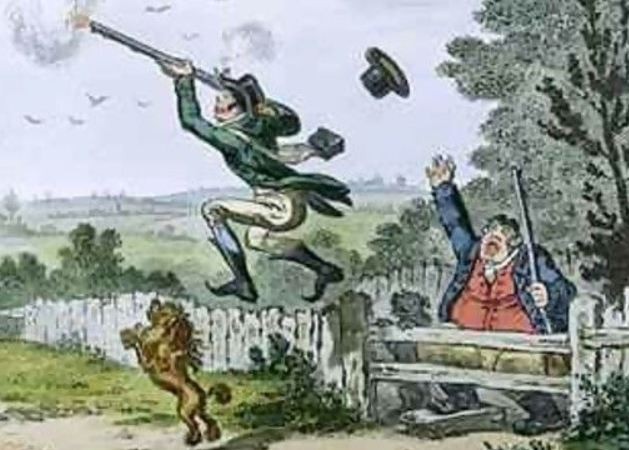
Raby is no sharp-shooter, preferring poetry to potshots

Walter knows that Sir Mark intends to buy him a commission into the army when he graduates from Oxford  – but he now decides he wants more. Observing Sir Mark’s disappointment at Raby’s complete inability to use a gun, Walter offers to give Raby shooting lessons, and takes him to a secluded part of the Flats ostensibly to shoot hares. Raby fires the gun when he sees movement in a copse and to his utter shock finds that he has shot his brother Ringwood dead. We are not told whether Walter engineered the shooting – but he does take advantage by urging Raby to flee as he will surely be found guilty of murder, given the well-known fact of the breach between the brothers.  That night a thunderstorm floods the area  – and a few days later a body is plucked from the river wearing Raby’s clothes – indicating that he has died attempting his escape.

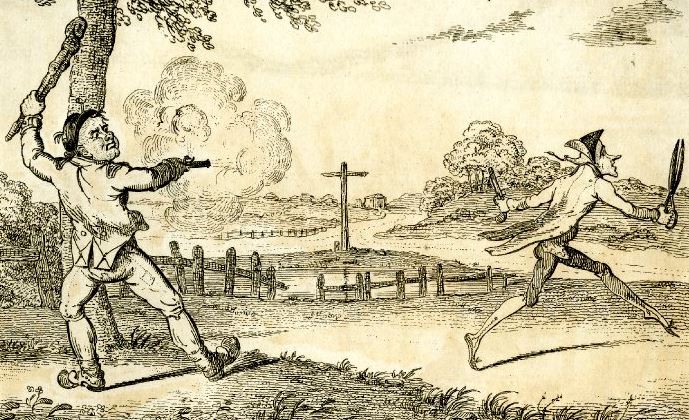
Sir Mark is devastated by this double tragedy and dies less than a month afterwards. Walter inherits the estate but he cannot rest easy as the first the local squire then the old woman in the forest threaten to expose him. As the months pass by, Sir Walter (as his is now known) begins to relax – and looks to complete his final conquest – that of Grace’s heart. This proves a bridge too far as Grace rejects his advances, and accuses him of skulduggery. Returning home from this devastating setback Sir Walter meets the squire who produces a letter confirming Walter’s hand in Ringwood’s death, and challenges him to a duel. Walter sinks to new depths of dishonour by attempting to shoot his adversary in the back while he is still taking the 10 paces – The bullet misses its mark and the squire fatally wounds Walter by return of fire.

duel
Bad-boy Walter shoots (but misses) the squire while his back is turned

All this is witnessed by a passing stranger – who happens to be Raby on his way home, after deciding to face the music. The younger brother is not after all – having swapped his clothes with a tramp before he made his escape. Walter has the decency to make a dying confession fully exonerating Raby, enabling him to marry Grace and reclaim Tylney Hall as its rightful owner.

There are a lot of deaths in the final part of the book, but these are not entirely unexpected as we have seen the resentment build inside Walter. Some of the comic set-pieces, such as an elaborately described fete champetre – held at the home of social-climbing snob Mr Twigg (and turns out disastrously bad) – contain serious events which help turn the screw of Walter’s hatred. It is hard not to empathise with Walter after the treatment he receives from Ringwood & though Walter does turn out to be a thoroughly bad apple in the end, Hood succeeds in showing that this is in some part down to the ordeal he has endured.

Style of Writing

When Thomas Hood wrote Tylney Hall he considered himself ‘young in the path in which he was treading’ and readily acknowledged that characterisation failed to an extent because ‘he could not write love scenes’. It is certainly true that the largely comic style of narration makes it difficult for Hood to switch emphasis to the darker side without jarring the flow. When looking for the absurd, such as portrayed by the character ‘Unlucky Joe’, Hood’s style of writing resembles the early works of Thackeray, who published The Yellowplush Papers around the same time. Both men earned their living contributing to popular magazines such as Punch, and both were fans of the ribald sense of humour promoted by artists such as Rowlandson. The fete scene is particularly reminiscent of Pierce Egan’s Life in London (1822) – a very influential but largely discarded masterpiece of Regency satire.

Hood’s reputation as ‘king of the punsters’ is certainly well lived up to, but perhaps too much to sustain what is a genuinely interesting and sometimes gripping plot. The whole piece comes across as a kind of bridging point between late Georgian bawdiness and the mawkish sentimentality that was about to dominate Victorian literature. It is nonetheless a worthy attempt to tackle the important and still relevant subject of privilege and prejudice.

Most of all I enjoyed its understated social commentary, in particular on the subject of ‘legitimacy’ defined by the arbitrary fate of being born on the ‘wrong side of the blanket’ – for which Walter laments

Tis no fault of mine. I had not the ordering of my birth…

Justice may award the shame to the parent, but the prejudice of man entails it on the child.

Rating 4 out of 5

Tylney Hall is more than just a curiosity, and is a very readable story.  The strength of Hood’s central black characters seems very innovative – perhaps ahead of its time. Transformed into a screenplay this could produce a powerful and unique insight into black culture in Georgian Britain.

Part Three of this series examines how accurately Tylney Hall represents Georgian Wanstead – the area upon which it is based

+++

There is a dearth of readily available information on Tylney Hall  – Gerald Massey’s website remains the best resource for Thomas Hood generally but I also recommend The Poetry Foundation

Finally, why not check out this collection of Hood’s memorable quotes

Elsewhere on my blog I have examined Hood’s relationship with the Epping Hunt. For other sporting related posts you might like the story of prize-fighter Tom Shelton or a brief history of Royal Ascot

Thomas Hood, Tylney Hall & Multicultural Wanstead

Overview of Thomas Hood & Wanstead

Review of Tylney Hall | Finding Wanstead in Tylney Hall  | Black representation in Tylney Hall

 thomas-hood-5

Thomas Hood (1799-1845) is a shamefully overlooked 19th century literary great – for whom a renaissance must surely beckon. His obscurity is all the more surprising when we consider how immensely popular he was throughout the Victorian era. Try Googling him and you will find scant reward. During his own short lifetime Hood overcame debilitating illness and grinding poverty to become a national treasure. He contributed humorous articles to popular magazines such as Athenaeum and Punch & also single-handedly ran his own magazine The Comic Annual (1830-42). He wrote just one novel – Tylney Hall (1834) – which I will be discussing in this blog, but poetry was his real forte.

sonnet to vauxhall

Hood’s Sonnet to Vauxhall – illustrated by Rowlandson

Hood’s output was created at great cost to his health. In his early days he was a talented engraver working alongside artists such as Thomas Rowlandson (a man with whom he later often collaborated), but was compelled to abandon this profession and seek an outdoor life to recover his strength. It was a tough existence for by 1841 when Hood became an invalid he was only saved from financial ruin thanks to the intervention of Prime Minister Sir Robert Peel, who was a great fan of his works. When Hood eventually died his family were granted a state pension – and the public continued to adore him. A memorial was later built by public subscription in Kensal Green cemetery. As the century progressed Hood’s poetry and witticisms remained familiar enough to be often quoted in ordinary conversation. As late as 1903 William Rossetti (of Pre-Raphaelite brotherhood fame) described Hood as ‘the finest English poet between the generations of Shelley and Tennyson’. However, since these heady heights of appreciation Hood has quietly slipped into obscurity, and has long-since vanished from the modern-day English literature curriculum.

 lakehouse

Hood wrote Tylney Hall whilst living in Wanstead Park

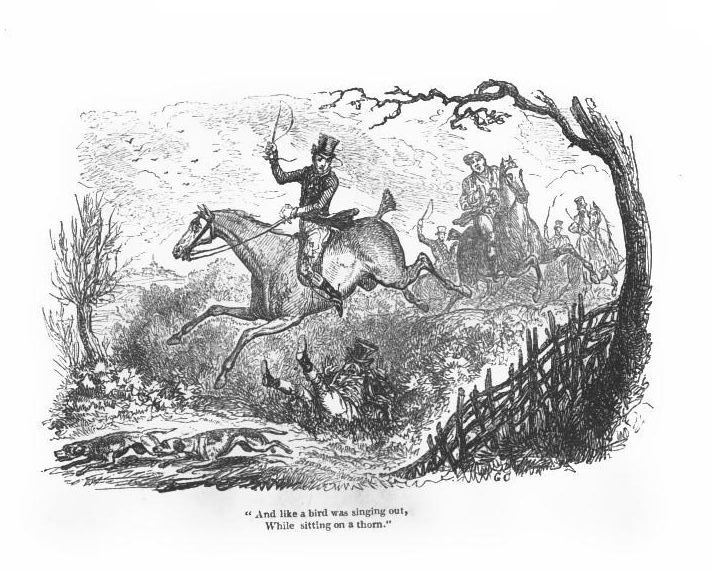
Yet one bastion of recognition for Thomas Hood still remains intact, and it can be located in the environs of Epping Forest, and most particularly Wanstead. After his marriage in 1824 Hood lived in Islington but made frequent visits to the countryside beyond London,  especially to Epping Forest, and he formed a deep affinity with the area. I have already described how Hood encapsulated the rough and tumble tradition of the Epping Hunt (1829), recording for posterity the rituals of that annual cockney jamboree. He was also fully cognisant of the scandalous loss of Wanstead House, ironically benefitting from its destruction by renting the Lake House in Wanstead Park from ‘Wicked’ William Long-Wellesley.

wickedwilliam


Wicked William – Hood’s shady landlord (1832-35)

Hood’s arrival in Wanstead in 1832 coincided with Wicked William’s enforced exile – so it is unlikely that landlord and tenant spent much time together. Though he was always a feckless waster, William was notoriously generous and probably offered Hood terms well below the market rate. Perhaps Long-Wellesley’s vanity was sated by Hood’s eulogy to the Epping Hunt – because the men were already acquainted. This unlikely friendship endured, for it is recorded that William regularly visited Hood’s sickbed in 1837, when both men were living in Belgium.

eppinghunt-1

This scene from The Epping Hunt  shows Hood preferred whimsy to satire

Hood was active during a time of great social and technological change – as the long 18th century drew to a close and young Queen Victoria assumed the throne. From the outset of his career Hood purposefully rejected the brutality of late Georgian satire which sought to undermine its subject, preferring to adopt a kinder and more affectionate style. His whimsical humour presaged the rising sense of decency and respectability throughout society, foreshadowing the sentimentality and mawkishness which defined popular Victorian literature. Hood’s style is very like Thackeray’s early writing, light-hearted and amusing – never over-analytical.

Despite his comic reputation, Hood was capable of portraying the biting hardship of contemporary poverty. For example, Song of the Shirt (1843) highlighted appalling working conditions of the era – where Hood showed remarkable foresight in writing from a female perspective – describing a needleworker’s daily struggle for existence and the cruelty of her employer

song of the shirt

Despite being penned by a man, Song of the Shirt ought to be considered one of the most important proto-feminist works of literature ever written. It was based on a contemporary court case involving a woman who was forced to sell her employer’s equipment simply to put food upon the table – a decision that led to prosecution. The case is long forgotten but this poem became a standard-bearer for highlighting the effect of inequality upon humanity, inspiring a generation of mid-Victorian artists

bridge of sighs

Opening stanzas of Bridge of Sighs 

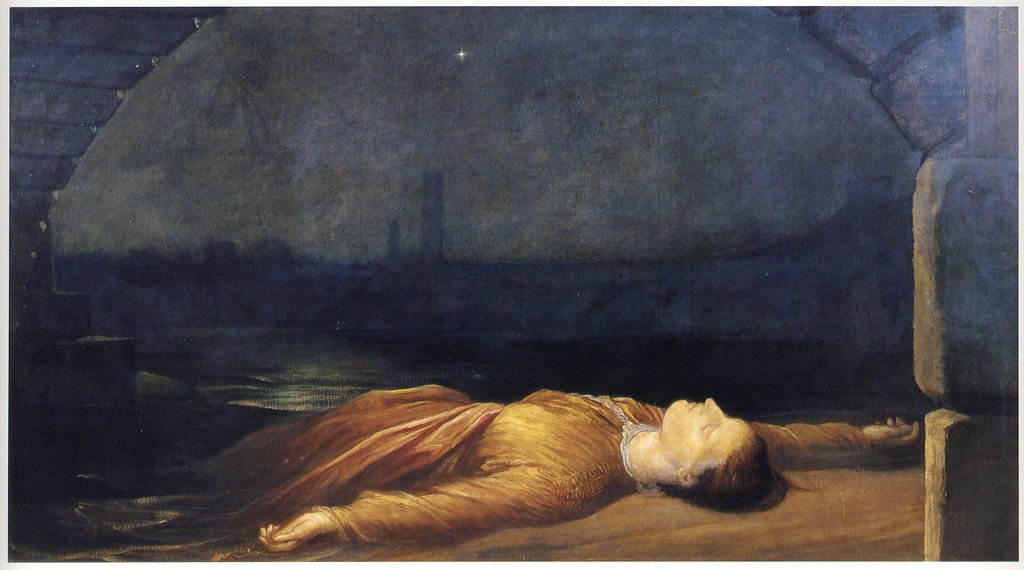
Another poem Bridge of Sighs (1844) again draws on real life by recounting the tale of a homeless young woman who committed suicide by throwing herself from Waterloo Bridge in London – At a time when suicide was frowned upon Hood declares that whatever sins she may have committed are cleansed by the sadness of her death
 found drowned

Hood’s poem inspired Found Drowned by Frederick Watts (1852)

Were it not for Hood’s own untimely demise he may have further developed his talent for social commentary. But in death as in life Hood has been unlucky, for the gentle observational humour of his earlier years has become his posthumous trademark.

grave

I will be turning to Hood’s only novel Tylney Hall in the second part of this blog. Written in 1834, whilst he was living in Wanstead, the title is a very thinly veiled reference to Long-Wellesley’s once great mansion, Wanstead House. But attempting to cash in on Wicked William’s story was an unwise move because it raised expectations that Tylney Hall would reveal the truth about Wanstead House, and satisfy public curiosity as to why it was demolished. – This led to criticism and affected sales, forcing Hood to add a note in the preface explaining that ‘Tylney Hall’ alluded to the topography of Wanstead Park, but not its disreputable owner.

wansteadcolour

Tylney Hall – not about Wanstead House

It is easy to see why a desperately poor artist with young mouths to feed would use any means possible to promote his work. But by choosing ‘Tylney Hall’ for a title Hood inadvertently and fatally undermined his novel – by unnecessarily calling into question the accuracy of its content.

Easter Monday 1817 by Henry Thomas Aitken

Tylney Hall does show Wanstead as it was to Thomas Hood

Because Hood’s works were always inspired by his own life experiences I believe that the world created in the pages of Tylney Hall should not be rejected, as we are offered a tantalising and surprising viewpoint of life in multicultural Wanstead 200 years ago. Additionally we find perhaps the first English novel to centrally feature strong and noble black characters, to whom we can sympathise and relate. The second part of this study will examine this more closely, proving that that Hood really was ahead of his time thus worthy of a new and more fitting appraisal.

Dr Sara Lodge has written a comprehensive critique of Thomas Hood in her book Thomas Hood and nineteenth-century poetry: Work, Play, and Politics (Manchester University Press, 2007)

To read more of Thomas Hood’s poems click here – or try a tasty selection of his best quotes

Gerald Massey has an excellent website devoted to Thomas Hood

You may also like to read about more Epping Hunt related buffoonery courtesy of Wicked William or to know about his short-lived military career.

Rushout’s Wanstead 1824-1832

Anne Rushout | Rushout’s Wanstead | Rushout on Tour

Anne Rushout was a friend of Catherine Tylney-Long, the heiress of Wanstead House.

Here are some images of Wanstead, painted by Lady Anne Rushout

wansteadgrove3

Wanstead Grove c.1829 from the long ornamental lake


wanstead grove temple view

Looking down towards the Temple – which now stands in a garden in Grove Road


Wanstead Grove Panorama

Panorama of rear of Wanstead Grove and the Temple


Wanstead Grove Gazebo

Gazebo in grounds of Wanstead Grove c.1829


Wanstead Grove 1825

Front elevation of Wanstead Grove


Wanstead Grove West - rear1825

Delightful rural setting to rear of Wanstead Grove


rear of Grove Cottage

Rear of Grove Cottage – once stood at of junction Nutter Lane/Leicester Road


Grove cottage 1825

Grove Cottage…. beautiful


From portico of Wanstead Grove 1825

View from the portico of Wanstead Grove – towards George Lane


from flower garden wanstead grove

c.1829 Flower Garden on Grove Estate


Mr Monk Cottage Wanstead May 1829

Mr Monk’s Cottage, Wanstead – I wonder where this was?


Nightingale Place 1829

Nightingale Place (1829) – Curve of Nightingale Lane towards the pub already evident


Lodge at Wanstead Grove 1828

The Lodge at Wanstead Grove – front part of which may still survive in resident’s back garden


From dining room at Wanstead Grove

Not a bad view from Lady Anne’s dining room at Wanstead Grove


flower garden wanstead grove

Another view of the flower garden Wanstead Grove


Cottage near Snaresbrook

‘Cottage near Snaresbrook’ c 1829


All images courtesy of Yale University – Accessed on line November 8th 2014

If you are interested in tales of Wanstead you might like to read about Wicked William’s Hunt – part 4 of a brief history of the Epping Hunt