An Account of Peggy Jones, the London Mudlark

Peggy Jones (c1765-1805)

Yesterday I posted this image of Peggy Jones on Twitter, which I obtained from the British Museum image database, and because it received a very widespread reaction, I have done a little digging of my own to add more information about the hard life and times of this renowned London character.

I very quickly discovered that Peggy appears in Pierce Egan’s ground-breaking guide Real Life in London (1820-21) which describes the practice of gathering waste from the Thames:  ‘The mud-lark returns home, when his labours are ended, sorts the indiscriminate heterogeneous ” mass of matter,” and disposes of it as well as he can.’  Though she was long-dead by 1821, Peggy has gone into legend for being one of the few women entering this gruelling ‘occupation’.

View of Blackfriars Bridge c.1800 showing people foraging in the water and river bank (rear background)

The full story of Peggy Jones appeared (along with the above portrait) in Kirby’s Wonderful and Eccentric Museum of Remarkable Characters, Volume III published in London in June 1805 – an extract of which follows:

Poverty often teaches the people the most extraordinary means of getting a livelihood… Among these the class of Mud-larks is not the least extraordinary. Many of our readers may possibly be ignorant that a Mud-lark is a person, who on the ebb of the tide, repairs to the river-side, in quest of any article that the water may have left behind in the mud. To this description of people belonged Peggy Jones. She was a woman, apparently about forty years of age, with red hair, the particular object of whose researches was the coals which accidentally fell from the sides of the lighters. She was always to be seen at Blackfriars, even before the tide was down, wading into the water, nearly up to the middle, and scraping together from the bottom, the coals which she felt with her feet. Numbers of passengers who have passed by that quarter, particularly over Blackfriars Bridge, have often stopped to contemplate with astonishment a female engaged in an occupation, apparently so painful and disagreeable. She appeared dressed in very short ragged petticoats, without shoes or stockings, and with a kind of apron made of some strong substance, that folded like a bag all round her, in which she collected whatever she was so fortunate as to find. In this strange apparel, and her legs encrusted with mud, she traversed the streets of London. Sometimes she was industrious enough to pick up three, and at others even four loads a day; and as they consisted entirely of what are termed round coals, she never was at a loss for customers, whom she charged at the rate of eight pence a load. In the collection of her sable treasures, she was frequently assisted by the coal-heavers, who when she happened to approach the lighters, would, as if undesignedly, kick overboard a large coal, at the same time, bidding her, with apparent surliness, to go about her business.

The above paragraph really brings home the back-breaking graft Peggy Jones and her ilk put into merely existing on the streets of London. Its at once ghastly and touching to know that the lightermen plying their trade along the Thames were prepared to give her scraps from their boatloads – yet still expected her to wade through the mud to reach what they had donated. She had to work bare-footed so that she could detect her quarry using her toes – this must have been bone-chilling even at the best of times. Kirby’s description of Peggy Jones continues:

We are sorry to be obliged to state, that Peggy Jones was not exempt from a failing to which most individuals of the lower orders are subject, namely, inebriety. Her propensity to liquor was sometimes indulged to such a degree, that she would tumble about the streets with her load, to the no small amusement of mischievous boys, and others, who, on such occasions, never failed to collect around her. After concluding the labours of the day, she retired to a wretched lodging in Chick Lane.

Chick Lane was one of the many streets and alleys associated with nearby Smithfield market , by 1850 it was known as West Street, and was demolished soon afterwards


Peggy’s elevation to the status of ‘English Eccentric’ in June 1805 was probably more due to her sudden disappearance earlier that year having

carried on her extraordinary calling for many years, but about the month of February, 1805, she suddenly disappeared from her usual places of resort, and nobody can tell what is become of her. A man who has the appearance of a coal-heaver, has since stepped into her place, and adopted the profession which she so long followed. Though the facts we have been able to procure concerning Peggy Jones are but scanty, yet our readers will doubtless approve of our desire to perpetuate, by means of the annexed design, taken from life, the memory of such a singular character.

It seems probable that Peggy was taken by the river, where she spent so much of her life. Imagine scrabbling around in mud on a freezing wet February day hoping to find a few lumps of coal to carry in the folds of her dress and sell on to other equally distressed city-dwellers.

The Thames near the Tower of London c.1790 – a busy and dangerous place for wading around in the mud

It is good to learn a little more about Peggy’s life and times, even though it must have been relentlessly bleak.  because it shines a light on the awful deprivation the majority of our ancestors endured in order to survive.

A big thank you to Susan from Witness2Fashion Blog for providing the following additional image a of a Thames mudlark – seen  receiving a scrap of food from a Thames lighterman. According to Susan, Arthur Munby sketched this in 1855;and  it can be seen in Victorian Working Women, by Michael Hiley. Perhaps the sketch recalls Peggy Jones, otherwise it suggests that this type of existence was a more routine site in early-Victorian London than we might otherwise have imagined.
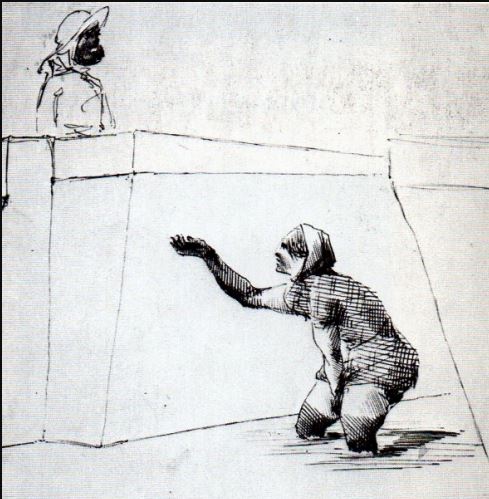
Image Courtesy of witness2fashion Word Press Blog

For more information on life amidst 19th Century London mud, I recommend the following essential reading

Jerry White, London in the Nineteenth Century: ‘A Human Awful Wonder of God’  (London: Cape, 2007)

Virginia Smith & others, Dirt, The Filthy Reality of Every Day Life (London: Profile, 2011)

Lee JacksonDirty Old London; The Victorian Fight Against Filth (Yale University Press, 2015)

If you liked this post, you may also be interested to learn the sad tale of a London Prizefighter – or to find out how to get away from London’s mean streets by locating her principal stagecoach inns. Finally, you could learn about one house in London with 5 layers of British history
A Review of ‘Tylney Hall’ by Thomas Hood

Overview of Thomas Hood & Wanstead

Review of Tylney Hall | Finding Wanstead in Tylney Hall  | Black representation in Tylney Hall

tylney hall cover

The fact that Tylney Hall (1834) is Thomas Hood’s only published novel implies that he was not really suited to this discipline of writing – especially as his reputation for humorous articles and sublime poetry was already established. This may be true given the mixed reviews Hood received for this three volume story. But the parlous state of Hood’s finances and his desperately poor health would also have compelled him to focus on shorter more intense creative output – just to make ends meet. Furthermore, Hood was actually working on a second novel entitled ‘Our Family’ at the time of his death – so we must assume he was not too bruised by the experience of writing Tylney Hall.

This post provides an overview and critique of the plot – and it does contain some spoilers!

Plot Synopsis

eppinghunt-3

This novel is set in the 1700s in a location in the environs of London. The eponymous mansion of Tylney Hall is owned by Sir Mark Tyrrel, a widower with two young sons. Sir Mark is a keen sportsman enjoying warm relations with his friends, relations and employees. His sons are as different as brothers can be. Older boy and heir-apparent Ringwood is the outdoor type, whereas Raby is a bookish, more sensitive lad who prefers poetry to the hunt. Their lives change when Sir Mark’s younger brother returns from the West Indies, barely clinging to life – bringing with him a scared and frightened boy who he identifies as his son. There is an awkward moment in which Sir Mark exclaims ‘He’s of a cross breed, he’s as brown as Gypsy Jack’. But when he sees how upset he has made the boy he quickly makes amends

‘Come, come’, said Sir Mark, laying his broad hand with an encouraging slap… ‘what I said about the skin was only for the sake of giving tongue – a good horse can’t be of a bad colour.’

As his brother lies dying, Sir Mark pledges ‘to back him through this world, and while I live I’ll ride with him round the course.’ This is an important scene because it instantly shows us that the most powerful character (Sir Mark) takes the boy to his heart – and supports him unequivocally thereafter.

black 2

Sir Mark nicknames his nephew ‘St Kitts’, alluding to his island of origin, and the narrator Hood (for the most part) refers to him as ‘the Creole’. In fact we have to wait until page 43 before the boy’s Christian name is revealed; ‘Walter’ – but I think this is a plot device emphasising Walter’s status as an outsider, rather than an outright bias against him.

The main storyline of Tylney Hall revolves around Walter’s relationship with his cousins, Ringwood and Raby. Walter is often innocently caught up in the cross-fire when the brothers fall out (as siblings do) – because whichever side he takes – both brothers end up resenting him. Ringwood in particular can be nasty and continually questions Walter’s legitimacy, suggesting that he was born out of wedlock. Perhaps the most shocking attack comes when Ringwood names his new horse ‘Brown Bastard’ – in retaliation for a betrayal he wrongly believes Walter has committed. Surprisingly the accusation of bastardy is most hurtful to Walter because he feels unable to stand on an equal footing with the brothers because of it.

fortune teller

Walter befriends a mysterious fortune-teller in the forest

Sir Mark keeps the peace at home and always supports his nephew when arguments arise, but Walter’s resentment continues to grow as a series of misunderstandings (on either side) increase his antipathy to Ringwood. Just when it seems Walter will flip, he meets a mysterious black woman in the forest who claims to have been his nursemaid in the West Indies. She counsel’s Walter to bide his time and crucially provides him with documentary evidence proving his legitimacy – the marriage certificate for his parents:

the reproach of my birth is removed; that sting will still be aimed at me, but it has lost its venom… I am now Ringwood’s equal in all but expectations

All three boys are educated at Oxford, returning to Tylney Hall during the holidays. One summer Raby meets and falls in love with Grace Rivers, the daughter of a local magistrate. But the lovers are thwarted after Sir Mark announces he has long-since agreed that oldest son Ringwood shall wed the magistrate’s daughter. Walter ought to have been pleased to see this serious rift between the brothers, but instead the news awakens the depth of his own feelings for Grace, inciting a jealous hatred towards Raby too.

cockney sportsman

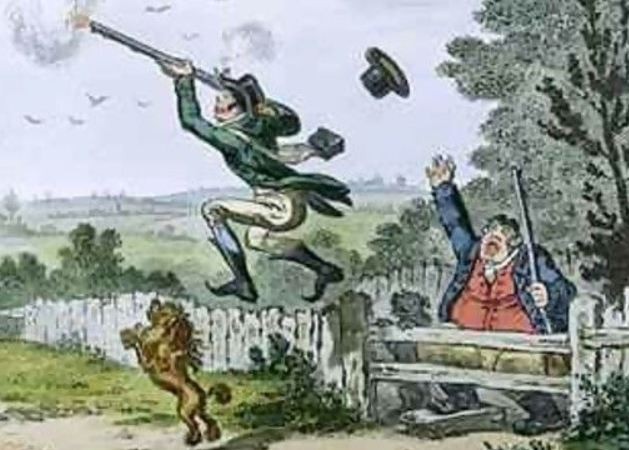
Raby is no sharp-shooter, preferring poetry to potshots

Walter knows that Sir Mark intends to buy him a commission into the army when he graduates from Oxford  – but he now decides he wants more. Observing Sir Mark’s disappointment at Raby’s complete inability to use a gun, Walter offers to give Raby shooting lessons, and takes him to a secluded part of the Flats ostensibly to shoot hares. Raby fires the gun when he sees movement in a copse and to his utter shock finds that he has shot his brother Ringwood dead. We are not told whether Walter engineered the shooting – but he does take advantage by urging Raby to flee as he will surely be found guilty of murder, given the well-known fact of the breach between the brothers.  That night a thunderstorm floods the area  – and a few days later a body is plucked from the river wearing Raby’s clothes – indicating that he has died attempting his escape.

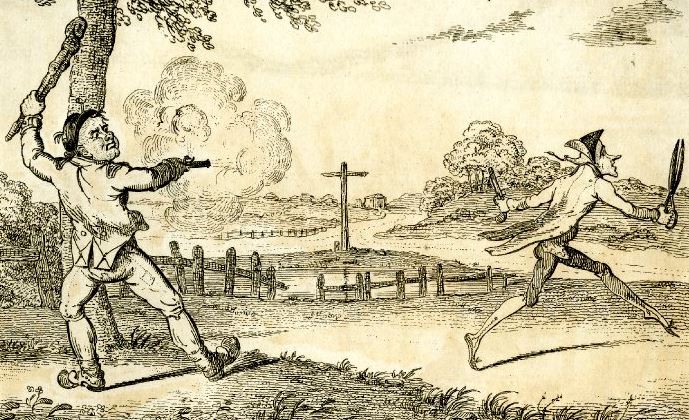
Sir Mark is devastated by this double tragedy and dies less than a month afterwards. Walter inherits the estate but he cannot rest easy as the first the local squire then the old woman in the forest threaten to expose him. As the months pass by, Sir Walter (as his is now known) begins to relax – and looks to complete his final conquest – that of Grace’s heart. This proves a bridge too far as Grace rejects his advances, and accuses him of skulduggery. Returning home from this devastating setback Sir Walter meets the squire who produces a letter confirming Walter’s hand in Ringwood’s death, and challenges him to a duel. Walter sinks to new depths of dishonour by attempting to shoot his adversary in the back while he is still taking the 10 paces – The bullet misses its mark and the squire fatally wounds Walter by return of fire.

duel
Bad-boy Walter shoots (but misses) the squire while his back is turned

All this is witnessed by a passing stranger – who happens to be Raby on his way home, after deciding to face the music. The younger brother is not after all – having swapped his clothes with a tramp before he made his escape. Walter has the decency to make a dying confession fully exonerating Raby, enabling him to marry Grace and reclaim Tylney Hall as its rightful owner.

There are a lot of deaths in the final part of the book, but these are not entirely unexpected as we have seen the resentment build inside Walter. Some of the comic set-pieces, such as an elaborately described fete champetre – held at the home of social-climbing snob Mr Twigg (and turns out disastrously bad) – contain serious events which help turn the screw of Walter’s hatred. It is hard not to empathise with Walter after the treatment he receives from Ringwood & though Walter does turn out to be a thoroughly bad apple in the end, Hood succeeds in showing that this is in some part down to the ordeal he has endured.

Style of Writing

When Thomas Hood wrote Tylney Hall he considered himself ‘young in the path in which he was treading’ and readily acknowledged that characterisation failed to an extent because ‘he could not write love scenes’. It is certainly true that the largely comic style of narration makes it difficult for Hood to switch emphasis to the darker side without jarring the flow. When looking for the absurd, such as portrayed by the character ‘Unlucky Joe’, Hood’s style of writing resembles the early works of Thackeray, who published The Yellowplush Papers around the same time. Both men earned their living contributing to popular magazines such as Punch, and both were fans of the ribald sense of humour promoted by artists such as Rowlandson. The fete scene is particularly reminiscent of Pierce Egan’s Life in London (1822) – a very influential but largely discarded masterpiece of Regency satire.

Hood’s reputation as ‘king of the punsters’ is certainly well lived up to, but perhaps too much to sustain what is a genuinely interesting and sometimes gripping plot. The whole piece comes across as a kind of bridging point between late Georgian bawdiness and the mawkish sentimentality that was about to dominate Victorian literature. It is nonetheless a worthy attempt to tackle the important and still relevant subject of privilege and prejudice.

Most of all I enjoyed its understated social commentary, in particular on the subject of ‘legitimacy’ defined by the arbitrary fate of being born on the ‘wrong side of the blanket’ – for which Walter laments

Tis no fault of mine. I had not the ordering of my birth…

Justice may award the shame to the parent, but the prejudice of man entails it on the child.

Rating 4 out of 5

Tylney Hall is more than just a curiosity, and is a very readable story.  The strength of Hood’s central black characters seems very innovative – perhaps ahead of its time. Transformed into a screenplay this could produce a powerful and unique insight into black culture in Georgian Britain.

Part Three of this series examines how accurately Tylney Hall represents Georgian Wanstead – the area upon which it is based

+++

There is a dearth of readily available information on Tylney Hall  – Gerald Massey’s website remains the best resource for Thomas Hood generally but I also recommend The Poetry Foundation

Finally, why not check out this collection of Hood’s memorable quotes

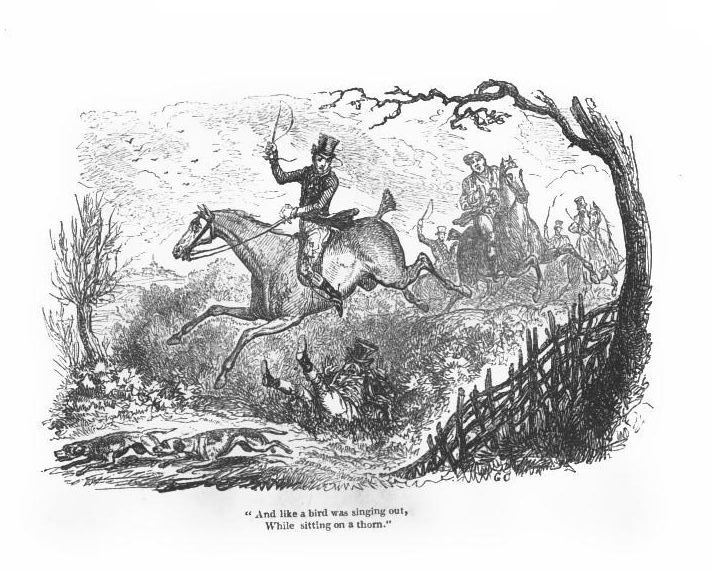
Elsewhere on my blog I have examined Hood’s relationship with the Epping Hunt. For other sporting related posts you might like the story of prize-fighter Tom Shelton or a brief history of Royal Ascot

Death of a Regency Prize-Fighter

boxingring

During my recent research into Royal Ascot I stumbled across an 1830 newspaper report relating to the death of pugilist Tom Shelton, a sportsman considered ‘one of the brightest stars’ of the Regency era.

shelton 2

Weighing in at 12 stone 7lbs – Tom Shelton

Tom Shelton’s boxing career is described in great depth in Pearce Egan’s Boxiana – Volume 2 (1824) and again in Volume 3 (1829) where his decline in stature (as age set in) is well recorded.

Born in Wrotham in Kent on May 1st 1787, Tom Shelton began life as a canal worker in and around the Thames estuary. It was hard labour for small pay, so by the age of 16 Shelton entered the ring for the first time at St Giles’ Fields for a prize of just five shillings. He was initially considered to be a ‘miller’ in style, meaning that he was not afraid to trade blow for blow with his opponent – but showed little regard for his own safety. But very soon ‘The Navigator’ (as he was named) became widely renowned as a ‘scientific boxer – a truly great man in the ring- a good in-fighter, but a left-handed hitter’. Boxiana describes a number of gruelling contests in which Shelton fought bravely to the finish. It is both awe-inspiring and sickening to read about the punishment he endured over a great many bouts between 1812 and 1825. For example on more than one occasion Shelton fought on with multiple broken ribs.

tom shelton 1

However the most harrowing tale of all relates to an incident occuring outside the ring, which all-but foreshadowed Shelton’s untimely end. In the summer of 1812, at the age of 25 Shelton found himself in Hampstead on a drinking binge with a friend. As the day wore on the men began to gamble, the stakes for which became increasingly serious as they became more inebriated. Boxiana relates that when Shelton actually lost the clothes off his back

The last desperate stake was HIS LIFE. The destructive effects of gaming were never seen in a more horrid point of view, than in this transaction between Shelton and his associate… It is scarcely possible to admit of the reality of the circumstance… to witness one man staking his life with perfect indifference as to the event, and viewing the other equally as callous, not only in winning the life of a fellow creature, but claiming the performance of the contract, with all the barbarity of a Shylock.

 suicide

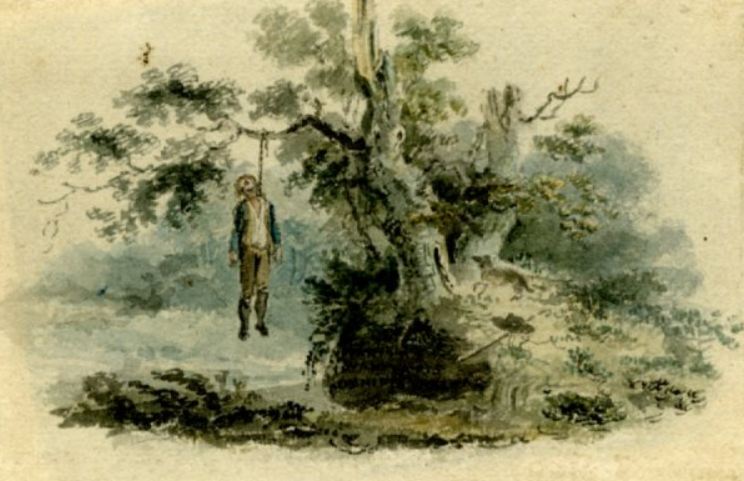
There but for the grace of unlucky good samaritan Mr Croker

When Shelton lost this final throw of the dice, his dreadful friend ordered him to hang himself from the nearest tree. Considering this to be the right thing to ‘fulfil the character of an honourable gambler’ he immediately proceeded to do so. Fortunately, a passer-by named Croker intervened to take Shelton down, thereby saving his life. Croker was rewarded with two black eyes and a broken nose for his troubles. Consequently, on 14th September 1812 Shelton was tried and found guilty of assault. Just before sentence was passed his wife Mary suddenly stood up to address the bench, stating that from this prosecution ‘she was ruined in her little shop and business, and her four young children deprived of subsistence’. She added that, ‘excepting some such irregular fits and frolics, Shelton was a good husband, and laborious and attentive to his duties’. Remarkably, the judge was greatly impressed by this act of matrimonial loyalty and Shelton was discharged.

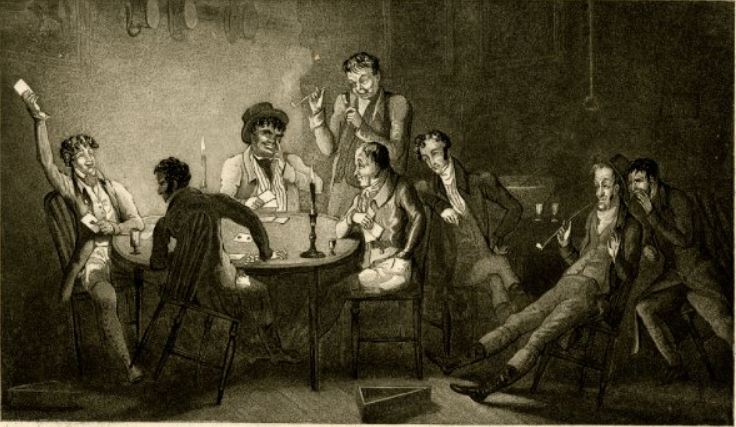
gamester reformed

‘Honour’ in gambling – what a frightening concept

It is really quite appalling to consider how close Shelton came to killing himself as a result of heavy drinking and gambling. However, it was not that Shelton had suicidal tendencies – rather that he was following a convention going back to medieval times whereby a wager was considered enforceable as a legal contract. In short Shelton went too far because he was drunk, but could never relinquish his respect for the boundaries of ‘honourable gambling’, even if his life depended on it.
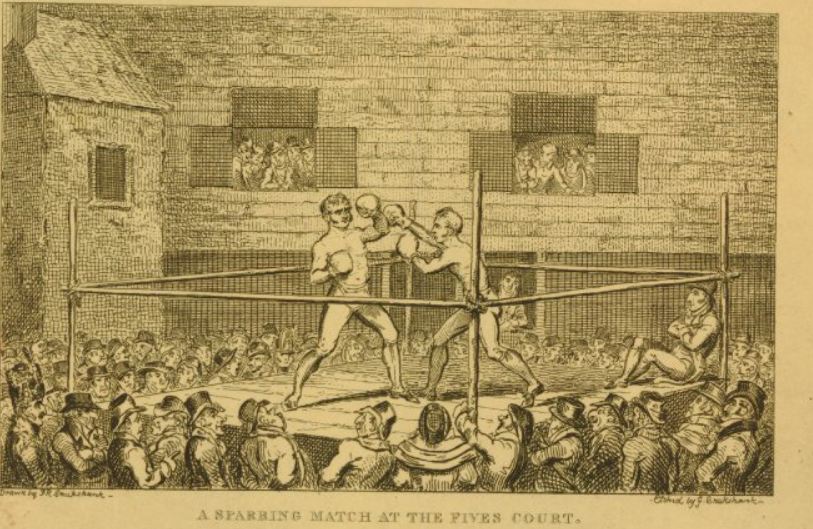
sparring at the fives court

The Fives Court – where Shelton often gave boxing exhibitions

During his boxing career, Shelton often took part in organised displays, involving sparring contests with various other well-known pugilists, and he regularly acted as a second in other bouts. As his career reached its conclusion, there are several newspaper reports describing benefit nights held in his honour. So it would seem that Shelton was a widely liked and respected sportsman.

Shelton became a pub landlord around 1820, and as his career drew to a close used his pubs for boxing events, and later dog-fighting contests. But his association with sport and the wagering involved in the outcome meant that gambling remained very much part of Shelton’s persona. By 1829 Boxiana recorded him as a man in decline, hardly surprising as Shelton was into his 40s and no longer in the top bracket of prize-fighters. He was very much yesterday’s man, and perhaps the loss of celebrity led to more serious and prolonged involvement in gambling.

fleecedatcards

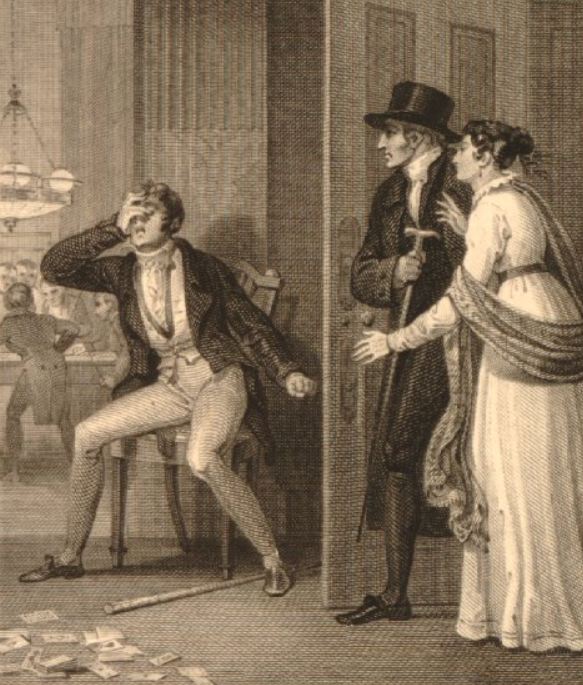
 When his career ended, Shelton went back to the tables

On Monday 22nd June 1830 Tom Shelton returned to The Ship in Montague Street, Bishopsgate, having been absent from duty for over a week. After dinner with his family and smoking his pipe, Tom confided in his wife that he had lost £800 gambling at Ascot Races. This was a colossal sum of money, perhaps 10 times what Shelton could earn annually. He said he had already tried and failed to secure an advance from employers Trueman & Hanbury. In consequence of this, Shelton was now compelled to surrender himself to Whitecross Debtors Prison on Wednesday morning, with his destitute family in tow.

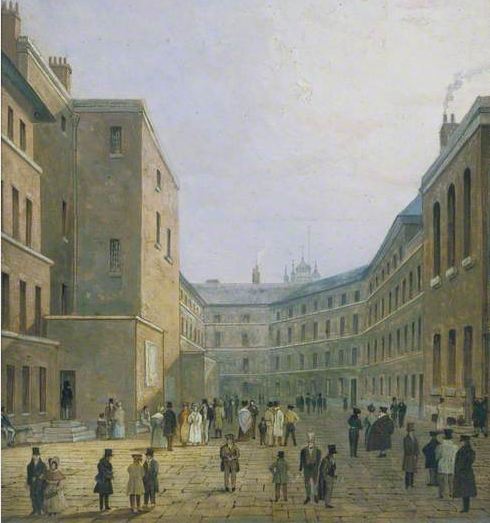
whitecross debtors prison

Life was grim for families inside Whitecross Debtor’s Prison

Not for the first time, Mary Shelton tried to rally her husband at his time of need. Despite his recent neglect of both family and business responsibilities, she argued that they were both young and able to work, & that by ‘giving up gambling and using honest and persevering industry, he might get through all his difficulties.’ Apparently soothed, Shelton asked his wife to get him a gin and water before retiring to bed. But when she was gone he produced a bottle of prussic acid from his coat pocket, swallowed the contents, and was dead before she returned.

This story of a family ruined by gambling addiction resonates very strongly today. For, at the end of the Regency period questions were raised about the dangers of unrestricted gambling and the effect it was having upon society. Then, like now, the spectre of poverty and alcohol dependency quite often played a role in the process of ruination for gambling addicts.

As early as 1828 the Morning Post decried the proliferation of gambling transactions throughout Windsor during Royal Ascot, stating that

It is high time that some serious notice be taken of these base proceedings for it is most shameful and scandalous, that in a small town like Windsor, so near our chief seats of learning, and moreover the residence of the British Monarch, these vitiating receptacles should with impunity be allowed to remain

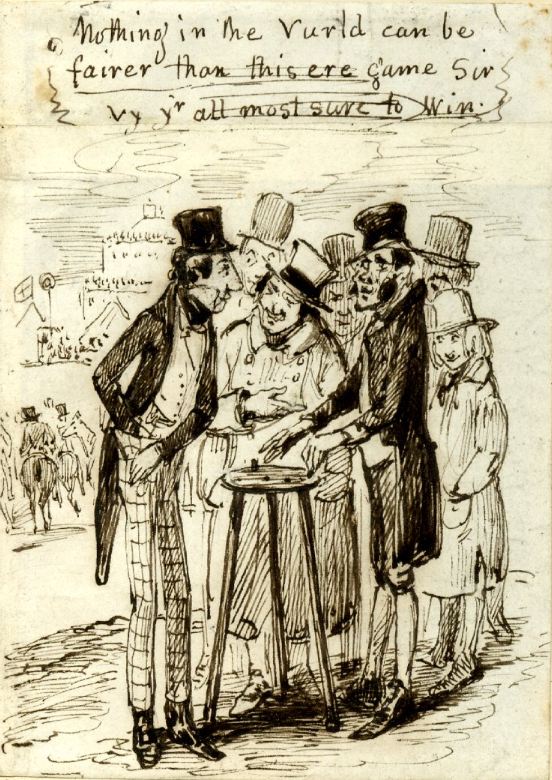
 gambling table
A common ruse was the thimble table – turning gambling into pure deceit

Though Shelton’s death and inquest were widely reported it was only a matter of days before it became old news. The following week’s headlines moved on to Mr Stevenson, a ‘sporting gentleman’ who threw himself from a window ‘under the excitement of feeling arising from his having lost £7000 on the Derby – He was not expected to survive.’ In fact it was not until the Gaming Act of 1845 that bets were finally deprived of ‘legally binding’ status, relieving men like Tom Shelton from the shackles of so-called ‘honourable’ behaviour when settling debts.

I have tried to find out what became of Shelton’s family. Considering the stigma associated with death by suicide, the inquest was a very sympathetic one. Emphasis was placed on Shelton’s previous suicidal tendency, and a string of witnesses testified to the unbalanced state of his mind, meaning that a verdict of death by insanity was quickly arrived at, to give his grieving widow some crumb of comfort. The only remaining clue I could find relates to the activities of a London prize-fighter active in the 1840s named Tom Shelton – perhaps this was one of his sons following his footsteps into the ring.

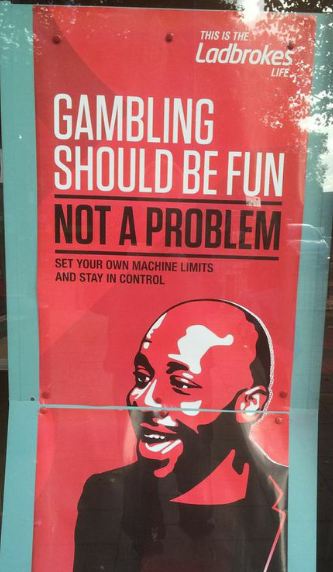
ladbrokes

Are we more civilised today? Gambling is policed by…. the gambling industry

In the most deprived areas of modern Britain betting shops proliferate, gorging themselves not on the rich but the poorest element of our society. Not just live sports but daytime TV is riven with readily accessible options for having a flutter, – there seems to be no escape. In the late Regency era gambling was equally pervasive; at card tables, sporting events, or practically anywhere likely to attract crowds. You would be faced with all manner of games of chance, many of which were rigged to ensure that losses would ensue. Then, just like today, gambling was tacitly accepted – and nothing done to counter its effects. Whilst we can forgive our ancestors for their inability to control the effects of gambling, I don’t know how we can explain modern day arrangements – whereby gambling seems to be regulated by the gambling industry itself. This smacks of putting children in charge of the sweet shop, and as long as it continues the misery and waste resultant of reckless gambling will continue unabated.

For more information on the growth and development of Boxing in the Regency period, I would heartily recommend David Snowdon’s Eganesque Blog and his accompanying Pierce Egan twitter account

For a cautionary tale of modern day gambling, see this very moving BBC report on jailed accountant David Bradford, and the effect it has had upon his thoroughly decent family.

For all else related to problem gambling, the following websites may offer help

http://www.gamcare.org.uk/          http://gamblersanonymous.org.uk/

 This blog is copyright Greg Roberts, and I hope you will inform me if intending to reproduce any part of it for your own use.
I would welcome any comments, suggestions or advice you may wish to provide and thank you for visiting my blog

If you are interested in Regency sport, you might like my history of ‘Royal Ascot’ or to find out about Wicked William and the Epping Hunt