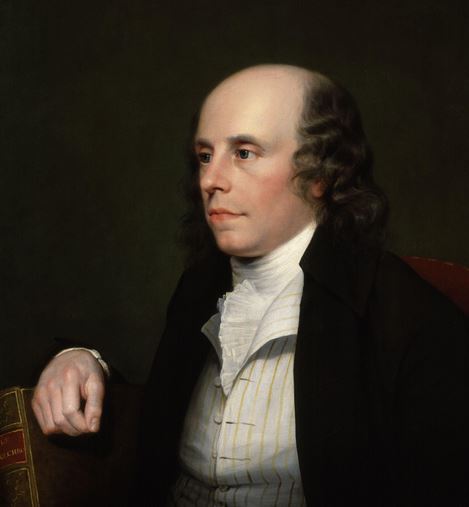
Could this be the face of ‘Wicked William’ Long-Wellesley?

        A few weeks ago I was asked to pass an opinion upon the subject of a painting acquired by Plymouth-based art dealers Parade Antiques. It was the portrait of a man in his mid-twenties which was recently discovered in the attic of a house at St Ives (Cornwall). The canvas itself was in poor condition; minus frame, artist’s signature or any other distinguishing mark to shed light on his identity.

Could this be William Long-Wellesley?

        It was only after John Cabello (Parade Antiques) had this portrait restored that he noticed a striking resemblance between his mystery man and Arthur Wellesley (Duke of Wellington,1769-1852), who was Britain’s hero at the Battle of Waterloo. Mr Cabello immediately suspected he was looking at an image of ‘Wicked William’ Long-Wellesley, the Duke’s wastrel nephew, best recalled for the destruction of Wanstead House. In Cabello’s opinion this painting is highly reminiscent of Sir Thomas Lawrence (1769-1830), who was a leading English portrait painter of the Regency period and the fourth president of the Royal Academy. 

       But what would a portrait of the black sheep of the Wellesley family be doing in a Cornish attic? And if it can be attributed to Lawrence (or one of his associates) why was it left to fester in such a decrepit state for nigh on two centuries? Most importantly, can we find any visual evidence to connect the cocky-looking man displayed in this picture to the illustrious Wellesley family?

 1. What would Long-Wellesley have been doing in St Ives?

      Strangely enough the obscure location where this painting was found may prove to be the strongest pointer to Long-Wellesley. Following his marriage in 1812, ‘Wicked William’ decided to enter Parliament, and purchased a seat for £500 in the rotten borough of St Ives. He was duly elected in November 1812, serving as the town’s MP until 1818. Long-Wellesley continued to live at Wanstead House, only visiting St Ives around the time of their assizes. Given that Long-Wellesley had civic as well as parliamentary responsibilities in Cornwall it is entirely possible that a painting was commissioned for the purpose of familiarising constituents with Long-Wellesley’s likeness in the days before photographic media. This painting may have been taken down after Long-Wellesley resigned his seat; its frame perhaps re-used for his replacement MP. Maybe the portrait remained in situ until after Long-Wellesley’s scandalous behaviour became public knowledge. Alternatively it could have adorned Long-Wellesley’s residence at St Ives, and he never bothered to retrieve it after he left the area.


2. Could Sir Thomas Lawrence really have have painted Long-Wellesley?

      Sir Thomas Lawrence is best remembered for his flattering style of portraiture, emphasising the positive physical attributes of his subjects. The man in this painting is in his mid-twenties, staring back at us unabashed, almost arrogantly, in the mode of a man of fashion. His style of clothing is very typical of the dandy, but the controlled wildness of his hair exudes masculinity with more than a hint of Romanticism. In 1814 Lawrence was commissioned by members of the Wellesley family to paint a series of portraits, including this iconic image of the Duke of Wellington.

Wellington by Sir Thomas Lawrence (1814)

        Another of Lawrence’s most notable works at this time was an ensemble entitled ‘The Three Graces’ : being Mary Bagot, Priscilla Burghersh and Emily Fitzroy Somerset – These women are Long-Wellesley’s sisters.
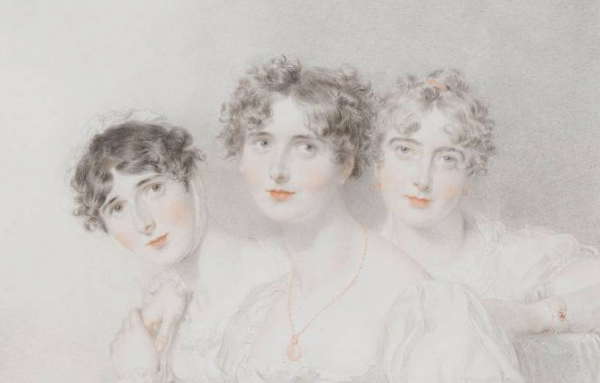
Wicked William’s three sisters as sketched by Sir Thomas Lawrence (1814)

        In the summer of 1814 William held an enormous fete at Wanstead House to honour his uncle the Duke of Wellington, which was attended by the crowned heads of Europe, in celebration of Napoleon’s defeat and exile. Given that Lawrence was at this time busily employed by the Wellesleys it seems plausible that ‘Wicked William’ could have asked Lawrence to do his portrait too. This was when Long-Wellesley was at the height of his pomp, having just turned 24 years old and thought to be so good-looking that even Lord Byron was envious. The St Ives painting has an element of swagger that would have typified Long-Wellesley. 

        It is important to acknowledge that the age of this portrait is as yet unproven. However the way this man is presented and what he is wearing does provide some hints. The sitter’s clothes are consistent with contemporary descriptions of Long-Wellesley, and the execution of the portrait is so close to the style of Lawrence that it is reasonable to assume it originates from (or relates to) the Regency period.


3. Are we looking at a member of the Wellesley family?

        The best way to determine a familial likeness is to set the mystery portrait against other members of the Wellesley family to look for common traits
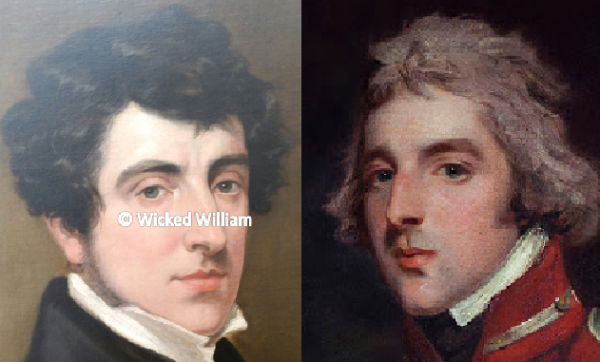
The restored painting (left) and a portrait of Arthur Wellesley by John Hoppner (right)

       In this comparison we capture Arthur Wellesley in 1808 (aged 39). Both men have thick-set eyebrows and blue eyes, their mouths and chins seem to follow the same lines.

When we place the picture alongside contemporary images of William’s sisters the evidence seems even more compelling.
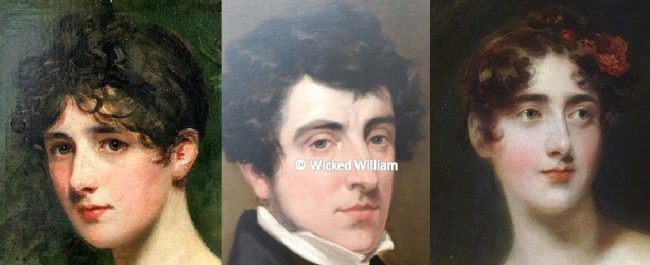
         On the left is a portrait of Mary Bagot by John Hoppner c.1807. On the right is Emily Fitzroy Somerset by Sir Thomas Lawrence c.1815. Although their portraits were painted by different artists the sisters’ features are identical. Of the two, Emily seems to be uncannily like the man in this portrait, suggesting not only that he is a close family relation, but also that this man has been painted by the same artist (Sir Thomas Lawrence).

4. Is this portrait ‘Wicked William’ Long-Wellesley?

     The story of William’s marriage to the richest heiress in Regency Britain, Catherine Tylney-Long, has become internationally famous since the publication of Angel and the Cad by Geraldine Roberts (2015). Long-Wellesley went on to wreck Catherine’s ancestral home at Wanstead House, leading to the fire sale of its priceless art and treasures; even her cherished family portraits were lost. Although William retained some of Catherine’s heirlooms, they had to be auctioned off in 1852 because he never paid the storage fees, and their current whereabouts are unknown.

       Apart from a few satires at the British Museum, there are no surviving images of William or Catherine Long-Wellesley for the duration of their marriage. All we can use for comparative purposes are a miniature of Long-Wellesley aged 16 (in the collection of the Duke of Wellington at Stratfield Saye) and etching of him in profile aged about 38 (the original of which is in my possession).

The unknown man replicates 16-year-old William in both appearance and dress

        Looking at youthful William (right), we see distinct features such as eyebrows, nose and the line of his jaw – which seem to be present in the later image. Their fashionable clothes seem to conform to the same dandy regulation of wearing a drab overcoat with high-necked collar. The curls of hair may not be so pronounced in the left-hand image, but this may have been deliberate – reined in to give the man an air of authority commensurate with his standing on public life.
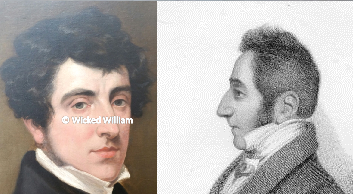
         The portrait of Long-Wellesley in his late thirties (shown on right) depicts a more care-worn man with a receding hairline and a much bigger nose. His chin looks less prominent, but the eyes and eyebrows and his mode of dress are consistent in both images. We all know that the nose never stops growing as one gets older, and Wicked William certainly seems well on the way to a full-blown proboscis akin to the Duke of Wellington. As he got older William looked increasingly more like Wellington. Even the Duke gasped at the likeness when the pair met up in 1845.

         Georgian satires ridiculed celebrities of their day by exaggerating physical appearance to create an image fit for public consumption. Their primary function was commercial; providing a cheap, popular and in-the-moment source of entertainment. Satirical representations were parodies rather than true likenesses. But it was vital to capture the essence of those featured, to make them instantly recognisable. In Long-Wellesley’s case he was often depicted carrying a rake to sow his wild oats; and presented as a womanising fool bereft of common sense. Despite this, when we compare Long-Wellesley’s satires with the St Ives portrait we again find common ground. These examples from 1811 and 1812 could easily be caricatures of the man we see in this portrait.


Conclusion

     It is clear that the St Ives painting needs further examination by art experts to fully establish its age and provenance. I have considered it purely in the context of Long-Wellesley’s life. Long-Wellesley did spend time in St Ives; he also would have been closely associated with Sir Thomas Lawrence at this time. The sitter in this portrait is almost certainly a member of the Wellesley family. Having compared this new painting with existing images and satires of Long-Wellesley, I feel certain that Parade Antiques have unearthed the genuine article, and that this really is an extremely important find.

      I am not yet sure what will become of the painting, but it would be wonderful to see it back in Wanstead. Imagine the irony of forcing Wicked William to gaze upon the wreck of his once proud estate from his position on the wall of the Temple at Wanstead Park – This would be a small yet symbolic act of penance for the misery and cruelty he wrought upon Wanstead House and its ancestral owners.

——–

Images of the St Ives portrait are produced with the kind permission of Parade Antiques, and have been watermarked to preserve their copyright.

If you would like to learn a bit more about Wicked William Long-Wellesley, you might like to find out how he got on when he served under Wellington’s command in Portugal. To learn about William’s over the top entertainments at Wanstead you could join Wicked William’s Hunt – or witness his heartless treatment of Catherine in her final days

For Wanstead related history you might like to learn about Anne Rushout, Wanstead’s Forgotten Artist – or discover multicultural Wanstead in Thomas Hood’s Tylney Hall

I am currently in the midst of writing up my thesis, which is about ‘Long-Wellesley and Publicity during the Regency period’. I hope to publish more new posts as this year goes on. As usual I would appreciate any feedback, comments, or suggestions.

‘No one likes us, we don’t care’ – Wellesley-Pole & Pistrucci

The Mint with a Pole – Part 3

Intro | Waterloo Medal | Pole & Pistrucci | The Great Re-coinage | Exit & Legacy

pistrucci image 1826 by cf voigt

Benedetto Pistrucci – Would you mess with him?

Wellesley-Pole’s recruitment of Pistrucci for the Royal Mint in 1815 was both a brave and also deeply unpopular decision. These two firebrands came together under a storm of controversy, yet successfully adopted a classic ‘bunker’ mentality to achieve new heights of numismatic brilliance. Benedetto Pistrucci (1783-1855) was born and educated in Rome. At the age of 15, he was placed with the gem-engraver Nicolo Morelli (1771–1830), whose patrons included the Pope and Emperor Napoleon. His talent for carved cameos was quickly evident as he obtained first prize in sculpture from the drawing academy at Campidoglio. Pistrucci remained in Rome until he was in his forties, producing a combination of portrait cameos and engraved gemstones. Hoping to enhance his reputation further Pistrucci moved to France around 1814. But his arrival coincided with Napoleon’s defeat and exile, so he met the Duke of Wellington and his brother Wellesley-Pole rather than the French Emperor (to whom he had hoped to present a cameo). By the time Wellesley-Pole returned to London to become Master of the Mint, Pistrucci was already there causing ripples of disapproval in artistic circles.

2014GW2957

Pistrucci intended this cameo for Napoleon (Paris 1814), but he was ‘Gone Away’

Having spent over a quarter of a century perfecting his skills Pistrucci was supremely confident in his ability and unwilling to reverentially defer to established English artists. In 1815 Pistrucci attended a party at Sir Joseph Banks’ home where a Mr Payne Knight exhibited an engraved gem believed to be an ancient relic, having been purchased some years earlier from Mr Boneli an art dealer from Golden Square. To the astonishment of the assembled guests Pistrucci announced that he had created the gem in his workshop and sold it to Boneli for twenty Roman crowns. This assertion was challenged not only by Boneli (who insisted that Pistrucci had merely polished up an ancient gemstone) but also by several renowned experts present. It was declared that there was ‘no living artist so capable’ as to have manufactured such an item. So Pistrucci offered to make a replica and present it within three months in proof of his claim. He duly delivered a near perfect match, but without the signs of wear and tear evident on the original – and he demanded £50 payment from Payne Knight for his troubles. But Knight refused to pay or to submit both items for independent adjudication.

head of flora

The ‘Head of Flora’ – which Pistrucci claimed to be his own design

So in some circles Pistrucci found himself labelled a forger and a charlatan trying to extort money from a well-known patron of the arts. But all was not lost for he acquired a vital ally in the form of Sir Joseph Banks (1743-1820). Banks was the long-serving President of the Royal Society which had a traditionally paternalistic control over the policies and activities of the Royal Mint. Knowing that Wellesley-Pole was looking for an artist to work on designs for the new coinage Banks introduced Pistrucci – but left the final decision wholly with the Master of the Mint.

wellesley pole

Wellesley-Pole looking calm and collected for a change

Wellesley-Pole soon encountered problems when he brought Pistrucci into the Mint. His Italian friend had initially submitted artwork for approval, including the now famous St George and Dragon design. But when chief engraver Thomas Wyon copied Pistrucci’s model he could not match the original. Wellesley-Pole realised he was on to a winner and paid Pistrucci 100 guineas to create the template himself. This caused ill-feeling at the Mint, which worsened after Wyon unexpectedly died. Wellesley-Pole knew no one could replicate Pistrucci’s work, so he backed his man unequivocally. Pistrucci was employed as an engraver for £500 per annum, offering him accommodation at the Mint. Wellesley-Pole acquired Pistrucci’s services on excellent terms considering that the initial contract for 100 guineas only entailed a week’s work. Pistrucci was permitted to augment his pay by carrying out private commissions, and brought his family over from Rome. However he worked up to 18 hours a day at the Mint in these early years, leaving no time for freelance projects. Staff at the Mint resented Pistrucci because he was an alien. Their antipathy lasted decades during which time he was not allowed to be called ‘Chief Engraver’.

On 11th July 1815 Wellesley-Pole invited 12 members at the Royal Academy, including Sir Thomas Lawrence, John Flaxman, and his close friend Joseph Nollekins to submit designs for the Waterloo Medal. The letter clearly stated

This can only be done by the aid of the First Artists belonging to the Royal Academy

flaxman

John Flaxman (1755-1826) – was not deemed good enough by Wellesley-Pole

But when the Royal Academy nominated Flaxman’s design for the larger Waterloo Medal, Pistrucci refused to copy it, declaring that it went against his artistic principles. Instead he submitted his own proposal which was approved by the Regent. The Regent then asked for his portrait by Lawrence to be copied for the obverse face of the medal. But when Wellesley-Pole went to see him at his studio, Pistrucci had turned Lawrence’s painting to face the wall and pointedly refused to comply even when threatened with dismissal. He said he wanted to create the Regent ‘from life’. It was an awkward situation, for Wellesley-Pole had agreed a fee of £3500 for this commission, £2000 of which had already been paid. Additionally, he was over a barrel regarding the new coinage. Remarkably Wellesley-Pole persuaded the Regent to back down, and Pistrucci got his way. The Royal Society was enraged by the Mint’s rejection of Flaxman and Lawrence’s artwork. A senior British Museum antiquary said ‘a more intimate knowledge of the talent that existed in the Kingdom…would have saved [Wellesley-Pole] from the reproach of unnecessarily insulting the whole body of native artists’.

double sovereign

Pistrucci’s iconic St George & Dragon motif – still in use today. Note his initials (bottom right)

To get some idea of the resentment stirred up by Wellesley-Pole’s appointment and dogged support for Pistrucci you only have to look at the press between 1816 and 1819 where numerous anonymous letters lambasted their partnership. Even though the Great Re-coinage was an unqualified success the barbed comments kept coming. For example the Morning Chronicle of October 29th 1818 stated

The execution of the coin of the Realm…[occurred] through the anti-national bad taste of the Master of the Mint shamefully [working] after the designs of the Italian artist.

wwp coin marks

Despite Wellesley-Pole’s private marks being very small and subtle he was likened to Cardinal Wolsey

Wellesley-Pole was delighted to discover ‘I am empowered to place such private mark as I choose [on all coin], and I have chosen my initials…WWP’. The press accused him of ‘smuggling his initials’ onto the new sovereign and they were quick to publish his reply: ‘I shall be impeached for putting my initials on the coin of the realm, as Cardinal Wolsey was for placing a cardinal’s hat on the coin of Henry VIII!’  Such was the level of vitriol probably originating from jealous and resentful members of the Royal Academy that Wellesley-Pole was compelled to make a statement in the House of Commons setting the record straight. Pistrucci fared similarly when exercising his right to leave a mark on designs used in the new coins

Pistrucci the artrist who executed the die for the Crown piece is determined that his name shall be transmitted to posterity. It is engraved at full length on both sides of the coin!! For this specimen of vanity and presumption he has no precedent

Reports on the design of the Double-Sovereign in 1819 reveal the depth of animosity against both men

Mr Pistrucci whose happy knack of making strong likenesses is well known to the British public has presented a faithful resemblance of himself in the cavalier… with a melting pot instead of a helmet. In the beast on which he is mounted the public will recognise… the Master of the Mint differing however from the Grecian charger… by a striking addition to the length of his ears… so that the whole figure on the new coin resembles a jack-ass. [In fact] the initials W.W.P are impressed on his hind-quarters… so Englishmen in future ages will not look at the jack-ass without thinking of Mr Pole.

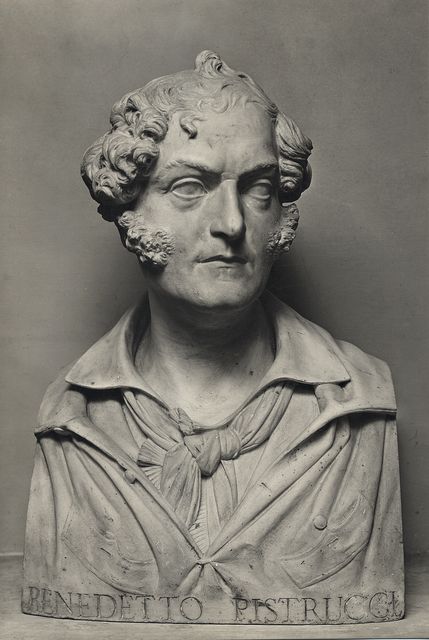
pistrucci bust

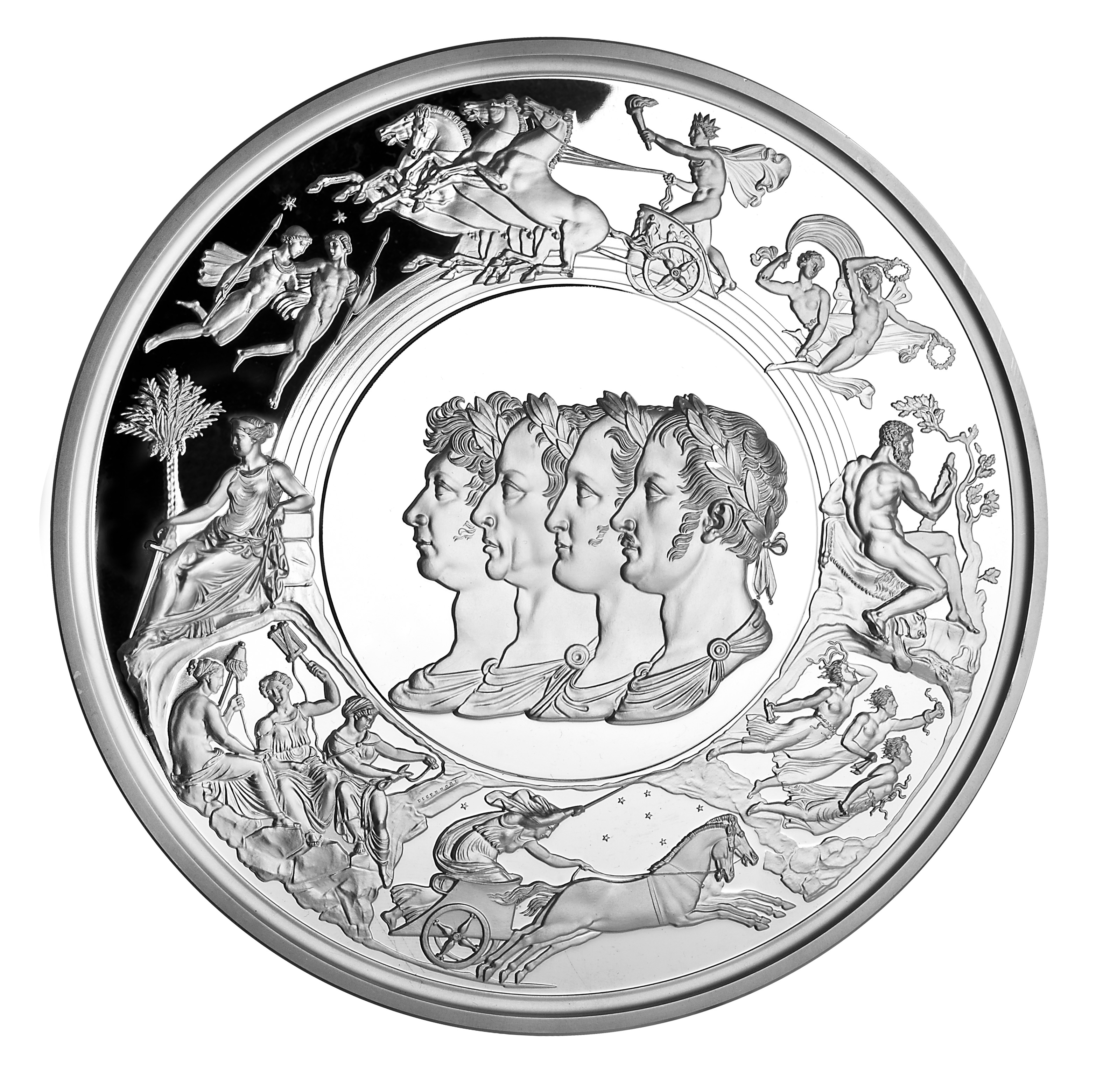
In Pistrucci, Wellesley-Pole found a like-minded character. Both men were hot-headed perfectionists unwilling to compromise in pursuit of their goals. Wellesley-Pole correctly identified Pistrucci as the man to revolutionise British coinage and backed his man to the hilt. But the consequence for both men was an estrangement from the established body of artists, and fellow Mint employees. In fact it was the Mint’s unwillingness to accept Pistrucci as Chief Engraver and their pointed omission of his name from their Red Book that led to the 30+ year delay in Pistrucci delivering the dyes needed to produce the larger Waterloo Medal.  Pistrucci complained long and often that he was promised the role of Chief Engraver by Wellesley-Pole and he genuinely feared that the Mint would cast him aside as soon as he was no longer considered essential.  So he dragged his heels for decades and by the time the dyes were presented only the Duke of Wellington remained alive of the leaders involved in the Battle of Waterloo.

Waterloo-medal-A

Though Pistrucci worked at the Mint until 1849, his most productive and inspirational phase was under Wellesley-Pole’s influence and support – between 1815 and 1820. It is fair to say that both men benefitted from each other’s obstinacy and drive for perfection. No one liked them, but luckily for us, they didn’t care because their collaboration produced coins considered to be ‘the finest that had ever been issued in Europe’.

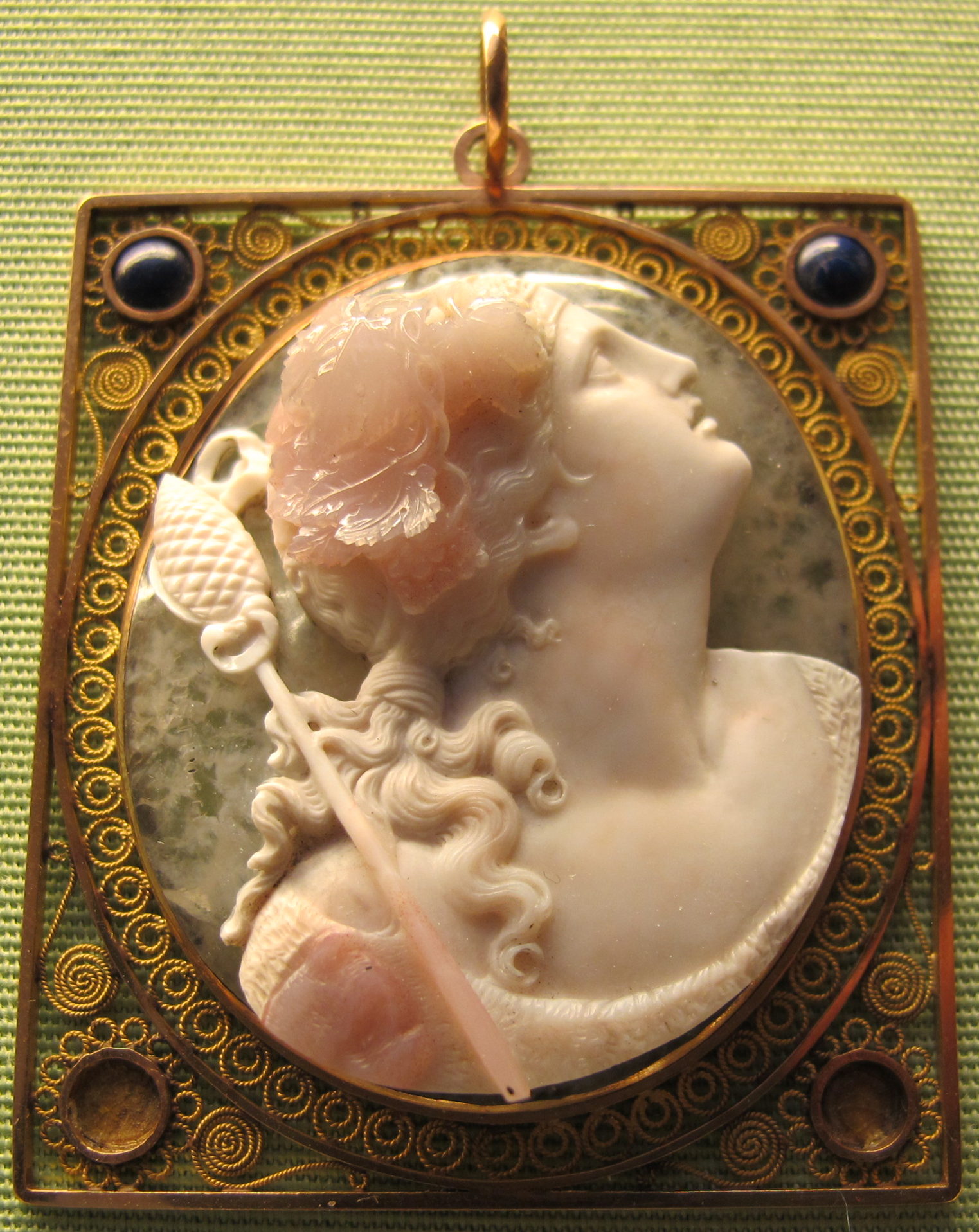
pistricci work

Example of Pistrucci’s earlier cameo work c.1810

Pistrucci was undoubtedly an essential cog in Wellesley-Pole’s machinery at the Mint, but my next part will focus on the incredible logistical achievement of The Great Re-Coinage in 1817…

Sources Used

  1. Greg Roberts unpublished dissertation ‘The Forgotten Brother’ (2009)
  2. Billing A., Gems, Jewels and Coins (London: Bell and Daldy, 1867)
  3. Humphreys H., Gold, Silver and Copper Coins of England (6th Ed, London: Bohn, 1849)
  4. British Library Add. MSS 39791
  5. Hayward J., Waterloo- The Medal, www.greatwarhistoricalsociety.com
  6. Bagot J., George Canning and Friends (London: Murray, 1909)
  7. Images of Wellesley-Pole marks on coins courtesy of The Royal Mint Museum

In November 2014 it was announced that Pistrucci’s Waterloo Medal had finally been struck, nearly 200 years after Wellesley-Pole commissioned it. The medal was presented to representatives of Britain’s allies at the Battle of Waterloo in a ceremony held at Apsley House, The Duke of Wellington’s London home

ceremony

Better late then never- Britain’s allies thanked for Waterloo

To find out more about Pistrucci’s Waterloo Medal visit The Royal Mint Museum

Waterloo 200 organisation will produce 500,000 Waterloo Medal replicas as part of events to mark anniversary of Wellington’s victory

For more information Pistrucci’s famous ‘head of flora’ cameo visit the British Museum

Traditionalists will be pleased to see that the Royal Mint are producing a 2015 Sovereign in which Pistrucci’s mark is clearly visible

To find out what Wellesley-Pole got up to after he left the Mint, watch him go to the dogs or if you want to know more about Wellington’s devotion to his staff you may enjoy Wellington & Raglan