Introduction | Origins | The ‘Cockney Hunt’ | Wicked William’s Hunt | A Fond Farewell
Cockneys in Essex? Well I never!

Rivalry between town and country folk is a long-established tradition
The origins of ‘cockney’ can be traced back as far as C14, when it had a middle-English meaning of ‘cocks-egg’. It was not until around 1600, when Samuel Rowland coined the phrase ‘Bowe-bell Cockney,’ that the word adopted specific geographical connotations. However, long before this time ‘cockney’ had already been adopted by country people as a derogatory reference to London-dwellers, whom they considered bereft of the manly attributes of horsemanship, hunting and civility. By the 1700s, as London rapidly increased in size and population, divisions between town and country folk widened. The above print from 1741 shows that Londoners (or cockneys) considered country folk to be slow, badly dressed, and backward. This particular yokel is waiting for ‘Mr Stuart’ to get off his horse before addressing him, unaware he is referring to a well-known statue. Rustic gullibility and simple-mindedness was a common theme throughout the Georgian era, used by satirists such as Hogarth and Rowlandson and perpetuated by urban domination of the press.
What a godsend it must have been therefore when the Epping Hunt began to attract large numbers of Londoners, providing a much-needed opportunity to redress the balance between town and country lifestyles. Notwithstanding its association with Bow bells, as the century wore on the phrase ‘cockney’ increasingly became linked with ‘townies’ attempting to partake in country pastimes. This is demonstrated by searching print media after the 1750s, & especially satirical prints, where there are numerous instances of clownish ‘cockney’ sportsmen. The Epping Hunt was perhaps the most high-profile event at which ‘cockney’ behaviour was lampooned.
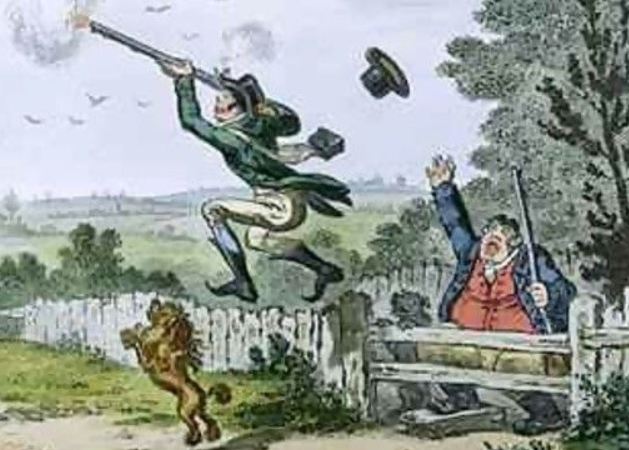
Rowlandson portrayed the perceived stupidity of Cockneys in rural settings
As stated in part 2 the Epping Hunt reached its apogee in terms of ceremonial importance in 1749. As late as 1753 the London Daily Advertiser recorded that the Lord Mayor ‘set out at 5am from Mansion House for Chigwell Row’ to attend the Epping Hunt, but thereafter London’s dignitaries increasingly shied away. Also when the Lord Warden of Epping Forest, (Lord Tylney of Wanstead House), went abroad to Italy, the Hunt lost its chief patron and became less of an attraction for London’s elite. Given that the Epping Hunt was by tradition a ‘Common Hunt’ it began to fall upon ordinary Londoners to fill the void. In order to do this they relied on the assistance of Essex landowners and tradesmen who were loath to see this lucrative tradition die out.
Just off The Highway in Wapping (or Ratcliffe’s Highway as it was once known) is a small lane adjacent to Tobacco Dock named ‘Chicwell Street’.This is named so according to legend, because it was the the site from where cockney sportsmen annually congregated on early on Easter Monday to make their pilgrimage to Chigwell in Essex. Located close to East India House and the heart of mercantile London, this became a more proletarian departure point for the Epping Hunt when the Lord Mayor lost interest in attending. By the 1770s organisation of the Epping Hunt fell upon William Mellish, MP for Essex, ably assisted by his brother Joseph, who was responsible for providing the pack of hounds on the day. They had an inauspicious start in 1774 when two horses died in a direct collision, though their riders escaped unscathed. The following year in a bid to attract back the fairer sex and lessen the perception of a cockney monopoly, the event was promoted as a ‘Lady’s Hunt’. This backfired because a young gentleman was thrown from his horse and killed on the spot prior to the stag being turned out. Then the stag headed down Bucket’s Hill towards Smitham Bottom ‘to the great disappointment of the cocknies who wanted him driven towards London’- thus no sport was had that day.
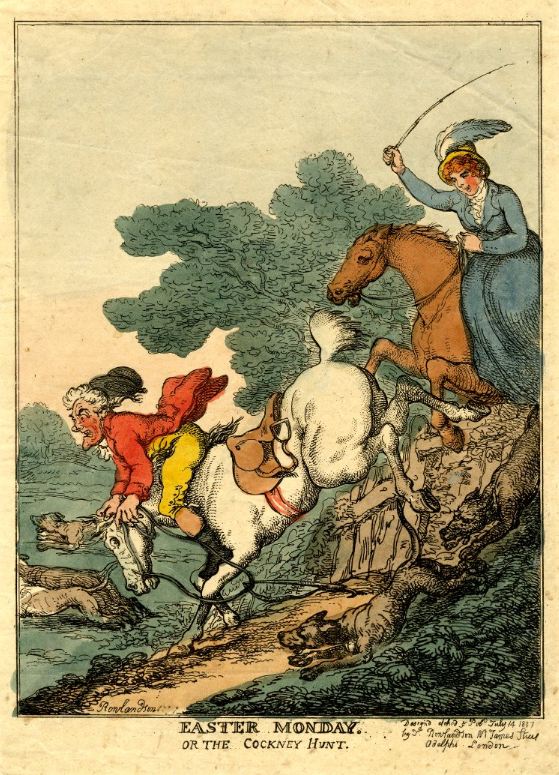
In an attempt to upgrade its image Epping became a ‘Lady’s Hunt’
However the attempted feminisation of the Epping Hunt continued right up to 1800. In 1785 The London Chronicler reported
Soon as gloomy night had withdrawn her veil from the smiling face of morn, the keen sportsman quitted his warm bed, and was mounted on his high-mettled steed before the sun spread his beams into the neighbouring vale: not a horse was to be seen East of Temple-bar, whose head was not turned towards Epping, not a citizen, who could procure a palfrey for love or money, who was not mounted and posting away to the Ladies Hunt. It is well for those who live on the road, that this important day comes but once a year, as it would be impossible for them to exist, were they to be frequent spectators of such a grotesque assemblage. [Huge numbers] arrived at the spot from whence the poor stag was to be liberated, however, there were many mishaps between that and town… The place was very much crowded with post-chaises and glass-coaches for the day, filled with sober cits and their loving dames; and notwithstanding the accidents which happened, the attendants of the chase were very numerous, both male and female, all, seemingly determined to be in at the death, but so elate they were with the idea of distancing their neighbour, they forgot they were to manage their horses, and so became distanced themselves. The stag had been turned out but a few moments before the plain was covered with the riders, ladies rolling over the beaux, and the beaux over ladies, and the horses left at full liberty.
The above-described hunt ended tragically for a Mr Humphries, a taylor from Tower Hill, who broke his neck when riding under a tree.
By 1788 Epping Hunt was openly described as ‘The Cocknies Hunt’ and its participants included ‘mercers, taylors, barbers, bakers and even bruisers – for Mendoza (a famous wrestler) and several of his tribe were there.’ The Literary Chronicle published the following insight into the excitement roused in London by the Epping Hunt
For weeks before Easter in every year, all the riding schools are filled with cockney Nimrods; every nag is employed on the Sundays; the visits to Hyde Park, in order to see the deer, and thus be able to identify the Epping stag, when they catch a glimpse of him, become frequent; and nothing is read at the London Institution but Daniel’s ‘Rural Sports’ or Beckford on ‘Hunting’… When the important day arrives early in the morning all the livery stables were so cleared… and every kind of vehicle was in requisition. There were horses of all colours and sizes… not were their riders less various, they included all orders and degrees of men; some went to share in the diversion of the hunting, others to laugh at the hunters. A friend from Epping invited me down and [when] the stag was let out, within five minutes I could have had my choice of fifty horses, who have just thrown their riders… while the forest was strewn with hats, and various contents from the pockets of hunters.
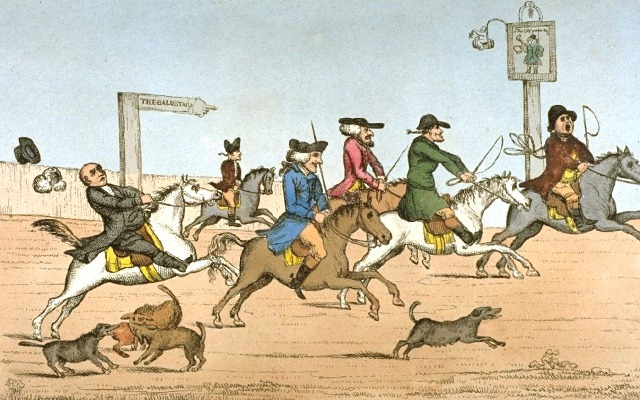
By 1795 the Epping Hunt was almost universally derided as a parody of what an organised hunt should be. Despite this condemnation The Times reported ‘tens of thousands of spectators and participants from the metropolis.’ Yet just when it seemed that nothing could diminish public enchantment with the Hunt, a piece of lawlessness jeopardised its future. Early in 1798 hunt-organiser Joseph Mellish was killed by highwaymen on the road near Woodford, thus with no pack of hounds available (and possibly as a mark of respect) the hunt was cancelled. Then two years of extremely wet weather led to a Hunt washout, meaning that a hiatus unwittingly set in during which cockney hegemony was wrested by the resumption of interest from Wanstead House.
In 1802 Wanstead House was leased to the Duc de Conde, who was a member of the exiled French Royal Family. In tribute to these French guests, 1802’s Epping Hunt was switched to the Bush at Wanstead, and over the next 3 years held at the Bald Faced Stag in Bucket’s Hill. For security reasons ‘cockney’ participation very much curtailed. When the City of London abolished the Common Hunt in 1807 it was thought that the Epping Hunt would end. But the ordinary citizens of London were not quite ready to give up this tradition, and attempted to keep it alive. Tommy Rounding, a publican from the Horse and Wells in Woodford was nominated to provide stag, venue and hounds for all-comers once more. But he could not emulate the golden years and by 1810 the Morning Post reported an event lying on its deathbed
To drive the deer with hound and horn, The Cocknies took their way
Yesterday, previous to the buck being enlarged, there was an immense concourse of sportsmen appeared on the ground, the majority of whom were mounted on animals not capable of keeping up with a lame goat. Then buck’s horns were adorned with ribands; and as the scent did not lie in consequence of the warm and dry weather, the hounds were once or twice at fault, to the great delight of the lazy hunters and bad horsemen. The hounds did not run a mile before several of the Cockney sportsmen were thrown out, while they were mortified by the gibes and jeers of those who followed on foot. Such a scrambling up hedges, and falling into ditches, was never before witnessed, and the old buck soon gave the hounds and the hunters the go by. There were some of the company exceedingly well mounted and well understood the chase: but, on the whole, the equestrian display was highly ludicrous and laughable.
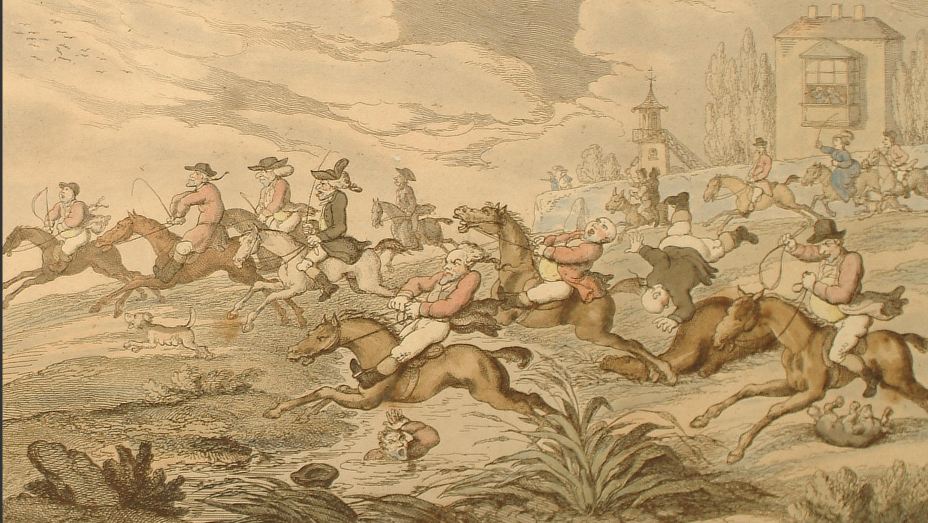
Rowlandson’s The City Hunt – 1810
Given the farcical level at which the Epping Hunt languished, and its association with lower-class ‘cockney’ yobs, it would have taken a complete fool to consider reviving it as a high-calibre event. Step forward ‘Wicked William’ Long-Wellesley….
Interesting article.
Thanks Pierce