A Guide to Commuting In Regency London

Rules of the Road | Wanstead | UK Destinations | Porters, Goods & Luggage
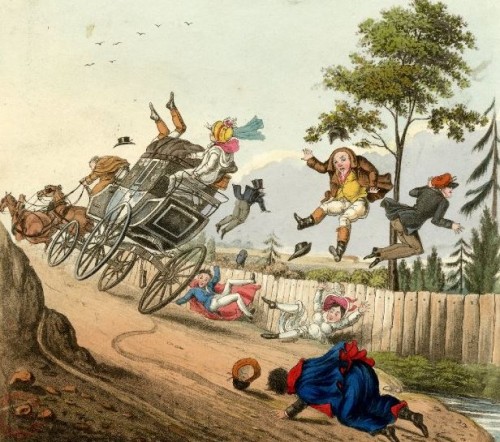
stagecoach perils

Finding a stagecoach might be the start of your troubles

Should you ever find yourself transported back to Regency London (1819), here is an essential guide to making your way home. Remember that this was an age before trains, or motorised public transport could whisk you home in time for tea. Your destination will undoubtedly be unrecognisable from how it looks today, yet I hope my advice will remove you from the streets of the Metropolis before darkness sets in, and the Regency Underworld takes over.

Having explained the rules and regulations of coach fares, this second post focusses on my own locality, namely Wanstead and its environs. But part three now provides information upon travelling to other destinations throughout Britain. Special priority will be given to requests submitted by anyone overly anxious about the dangers of slipping through a time portal.
book reference

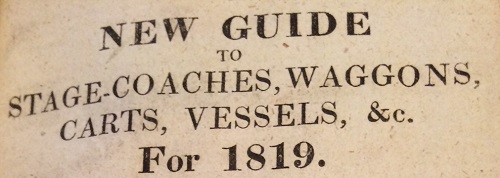
Information drawn from this hand-book

So if one day you do happen to wake up in 1819, please DON’T PANIC because London already has a highly organised and efficient transport system, relying on horse power [and Old Father Thames] to move people from A to B. You will discover a network of coaching inns and wharves, acting as proto ‘station terminals’ taking you to all manner of destinations.  Each can offer a choice of departure times, mode of carriage, and hospitality to suit the weary traveller should they decide to bide a while longer in the City before departure.

Before you book your journey, it is necessary to draw your attention to the terms and conditions prevailing in 1819.  After all you don’t want to end up in darkest Snaresbrook being bludgeoned by an irate coach driver because you have failed to read the small print governing Regency period transportation.

Most coaching inns provide stagecoaches, with some offering luxury Chariots to their richest clients. However, to reach your destination safely you may be compelled to board a Waggon alongside farm animals – or worse still, endure the ignominy of sharing a Cart with anything from perishable goods through to dead bodies (perished goods heading back to their parish for burial). So please study the timetable carefully to ensure you make the right choice!!


Wanstead [Essex, 8 miles from London] – Approximate cost 11 shillings

Magpie and Stump3
The Magpie & Stump – With prime views of Newgate Prison executions from the upstairs windows

As late as 1821 Wanstead was a very sparsely populated, with most local employment engaged at Wanstead House. In fact the only means of hired travel to Wanstead was by Cart:-

Kings Arms, Leadenhall Street, and Spotted Dog, Strand 4pm daily; Blue Boar Cellar, Aldgate, Kings Arms & Flower Pot, Bishopsgate; Three Nuns, Whitechapel, and White Hart, Strand, 2pm daily; Cheshire Cheese, Crutched Friars, and Magpie & Stump, Newgate Street, daily (on demand)

Given that the Wanstead Estate produced a great deal of fresh fruit and vegetables as well as timber, it is likely that Carts travelled to London laden with goods early each day and then in the afternoon served as carriages for their return journey.


Leytonstone [Essex, 6 miles] – Approximate cost 8 shillings
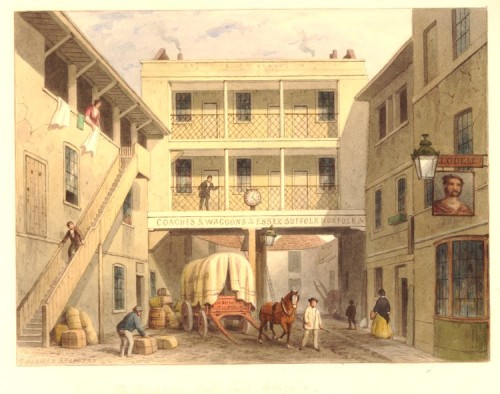
saracens head aldgate 1855

The Saracen’s Head, Aldgate – Regular trips to Leytonstone

Given the surprising difference in mileage from that of nearby Wanstead, I assume that ‘Laytonstone’ (as it was then termed) must have had a drop off point nearer the parish boundary with Stratford. There are far more options available to Leytonstone dwellers:

By Coach daily: – The Bull, Aldgate, 11am and 3pm; Kings Arms, Leadenhall Street, 10am, 3pm, 4pm and 7pm; Saracen’s Head Aldgate, and Three Nuns, Whitechapel, 10am and 7pm; Blue Boar Cellar, Aldgate, 4pm during summer, 3pm in winter.

By Cart daily:- White Hart, Strand, Flower Pot and King’s Arms, Bishopsgate, and The Bull, Whitechapel at 3pm, Cheshire Cheese, Crutched Friars, The Bull and Blackboy & Camel, Leadenhall Street, and Magpie and Stump Newgate, (on demand)


Snaresbrook [Essex, 8 miles] – Approximate cost 11 shillings
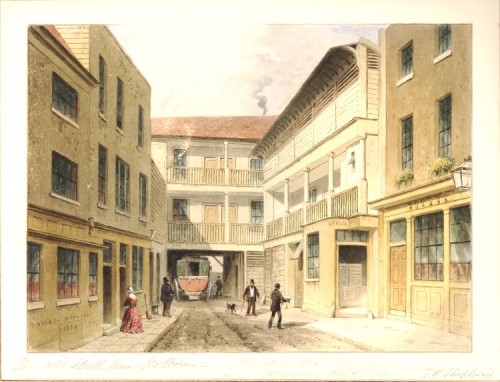
the bell gracechurch st

The Bell, Bell Yard, Holborn – served Snaresbrook

During my research into Wanstead House I discovered that Snaresbrook was an important stage post for carriages travelling in the direction of Norfolk. This may explain why there are a reasonable amount of options available in London for what was (at this time) mainly open country.

By Coach daily:- Flower Pot and Four Swans, Bishopsgate, 10am, 4pm and 7pm

By Waggon daily:- The Bull, Aldgate, 3pm

By Cart daily:-   The Bell, Bell Yard, Gracechurch Street and Flower Pot, Bishopsgate Street 3pm and Kings Arms, Bishopsgate, at 2pm


Woodford [Essex, 9 miles] – Approximate cost 12 shillings
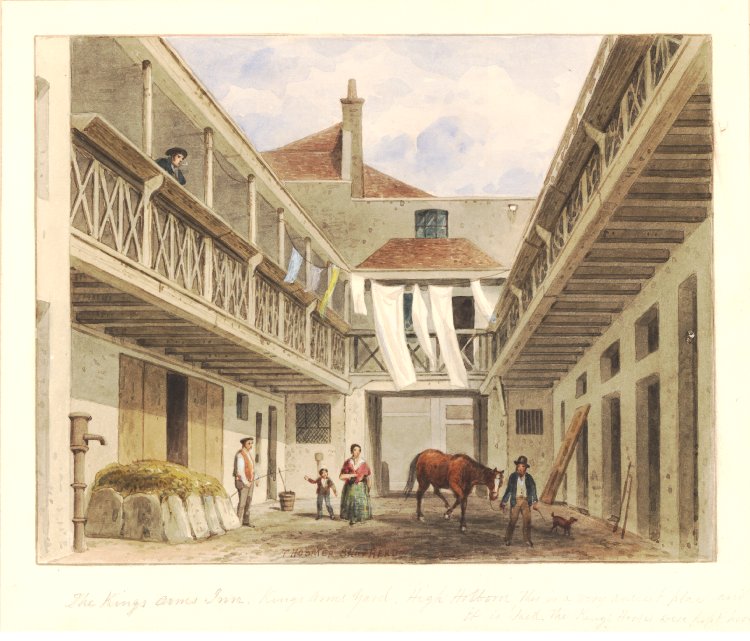
the kings arms holborn

The Kings Arms – good for Woodford

By 1819 Woodford had a number of fine mansions, farms and estates, so this may explain the range of options available for travel to that destination

By Coach daily:- King’s Arms, Leadenhall Street, 10am, 3pm, 4pm and 7pm; Saracen’s Head, Aldgate, and Blackboy & Camel, Leadenhall Street 3pm and outside No 93 Bishopsgate Street 4-30pm. The Bull, Leadenhall Street has a service 3pm daily apart from Sunday which leaves at 10-30am; and Three Nuns, Whitechapel, does 10-30am and 7pm daily, apart from Sunday when it departs at 9am and 7pm

By Cart daily:- Three Nuns, Whitechapel, 4pm; Flower Pot, Bishopsgate, 2pm; The Bull, Aldgate,  3pm and Magpie & Stump, Newgate Street, 2pm daily. Kings Arms, Bishopsgate, offers a service Wednesdays & Saturdays only at 2pm


Woodford Bridge [Essex, 10 miles] – Approximate cost 13 shillings
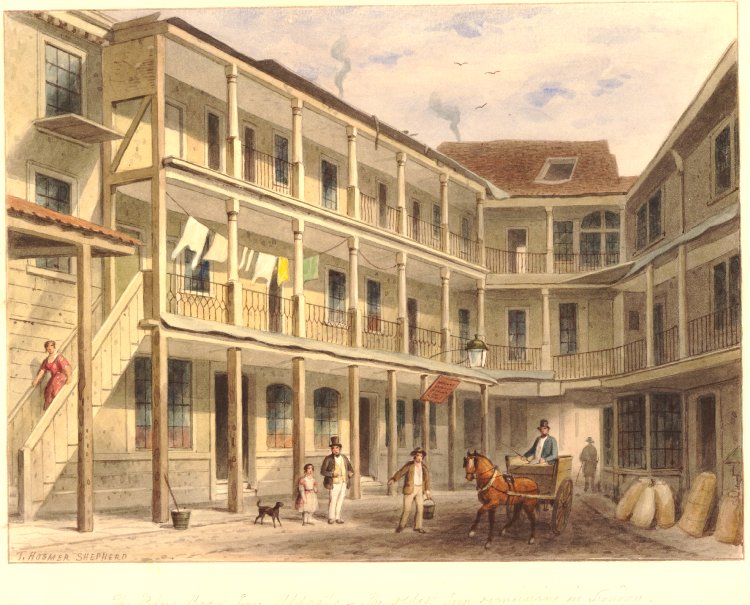
blue boar aldgate

The Blue Boar Cellar, Aldgate – try here for Woodford Bridge

Given that Woodford Bridge is close to Woodford, I am surprised to note the lack of overlap in service between these two destinations. The Bull, Aldgate for example offers a Coach to Woodford Bridge but only a cart to Woodford – and none of the regular coach services to Woodford have the option to stay on until Woodford Bridge. Perhaps folk were happy to walk the mile or two between destinations rather than looking upon coach services as a series of stops – which they clearly weren’t given the limited passenger capacity of each carriage.

By Coach daily:- The Bull, Aldgate, 3pm and Blue Boar Cellar, Aldgate,  4pm winter and 3pm summer, daily, save for Sunday which is at 8am

By Cart daily:-  Blue Boar Cellar, Aldgate,  4pm winter and 3pm summer, daily, save for Sunday which is at 8am, and The Bull, Aldgate, and Talbot, Whitechapel, Tuesdays, Thursdays and Saturdays  only at 3pm

♦   ♦   ♦

I hope you have found this an interesting guide as to how our ancestors found their way home from London. All information is drawn from a book in my possession, published by Critchett & Woods at the end of 1818. Meticulous work seems to have gone into the production of their guide – and I will be dipping into it again to examine other destinations served by the once great coaching inns of old London town.

These beautiful water colour paintings of London’s lost inns are all by Thomas Hosmer Shepherd (1792-1864). If he was around today I would gladly buy him a pint for his dedicated attention to detail.

If you like to know about old London pubs and coaching inns, I recommend Pubs History – an excellent resource for any local historian

Some Advice on Coach Travel in Regency London

Rules of the Road | Wanstead | UK Destinations | Porters, Goods & Luggage

Please bear in mind the following ground rules to ensure your acceptance as a passenger, and more importantly what you might expect to pay, should you ever find yourself back in Regency London, at the start of 1819.

rates 1

Much like modern times, basic fares can be liable to surcharge
  1. The Coachman is entitled to decide whether to calculate the fare according to time OR distance. A journey of 5 miles for example would cost 5 shillings – which is the same charge as a 2 hour journey would cost. These charges are per Coach, not per person. Hence it would be wise to ensure you travel with others to avoid meeting the full expense of your journey. (See table of charges above). Should traffic out of London be heavy the Coachman may recalculate his fare according to time, and you will end up footing the bill.
  2. Every Coach or Chariot hired to go out into the Country, and setting down passengers, after 7pm (between Michaelmas Day and Lady-day, or Sept 25th and March 25th to you) is entitled to the full rate or fare back to the nearest paved roadway, or to any designated taxi tank which lies beyond the paved roadway. Who would have thought that pavements played such an important role in determining fares charged? It is clear that pavements represented urban areas where passengers could be picked up, so the traveller was obliged to compensate his coachman for however long he was off-grid and unable to find new clients.
  3. Any Coach or Chariot leaving London during the day-time is entitled to sixpence per mile for every mile above 4 miles ridden. So, if you are unlucky enough to live in Woodford Bridge you may incur a surcharge of up to 3 shillings.
  4. This is an age before standardised times, so it has been decided that sunset begins at 8pm between Lady-day and Michaelmas (25th March to 25th September) and during the winter months sunset falls at 5pm.
  5. Every Hackney Coachman is obliged to carry four adult persons inside his coach, and a servant outside (on top), if required. Chariots can only take three persons inside, and obligatory servant braving the elements outside. However, if the client wants to squeeze more passengers on board – he must pay one shilling for each person (not being a child in arms or on lap) in addition to the fare.

coach overturned

Beware the Overloaded Coach

Armed with the above information, you should feel more confident about making your way to one of a myriad of London Inns and Wharves from where your journey can be booked, and the fun begins!

blue boar trade card

Coaching inns were a hub of commercial and social activity

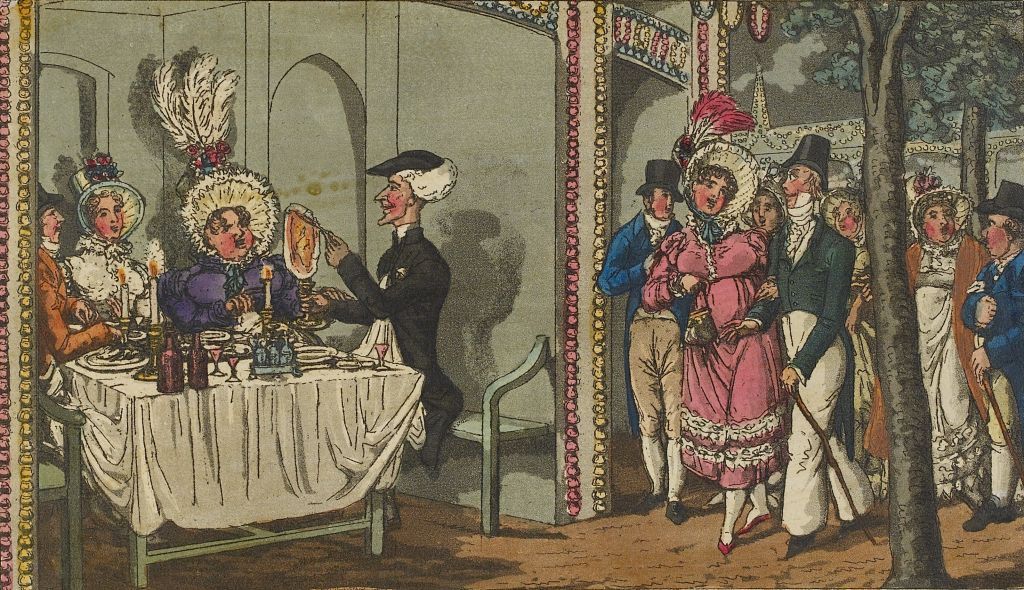
In 1819 there were over 120 different coaching inns available in central London, each having a unique timetable of departure times and modes of transport. Many inns were a hive of commercial activity, where goods and services could be traded – quite often tradesmen used their local inn on business cards. Most inns also offered entertainment alongside accommodation for their clients. Sports such as boxing were a common draw, delaying passengers from leaving too soon. The Magpie & Stump, for example, was able to offer rooms overlooking the courtyard of Newgate Prison, where public executions were held. By tradition the pub sent a final pint to each condemned man.

Magpie and Stump4

Coaching Inns – important business centres

If Regency London appeals to you, you might be interested in the fascinating history of one Georgian mansion – or, to learn more about the Regency boxing scene, hear the sad tale of Tom Shelton. For a sense of occasion you could always go to Wicked William’s Hunt – or spend the day at Royal Ascot

Some tips on Visiting Archives


archives 1

For anyone interested in history I cannot recommend too highly how rewarding trawling through an archive can be. Whether you are a novice taking your first steps into family history or an expert at the cutting edge of historical research, archival records can offer invaluable clues, enriching your knowledge and understanding.

Over the years I have benefitted greatly from dealing with archives throughout the UK compiling a comprehensive research database – which formed the backbone of my University of Westminster thesis. I may not be the most prolific blogger but I always try to use original information – the fruit of personal research – in order to offer original perspectives on the topics chosen.

During this summer I expect many historians will head off to libraries, museums and archives searching for tantalising pieces of evidence to bolster their areas of study. No doubt they will be joined by countless novices on day trips intending to uncover their family history.

To help you make a success of your visit, I have cobbled together the following tips

archives 3

A CARN Reader’s Ticket will get you into most regional archives (See Point 3)
  1. Opening Times – days and hours of opening vary greatly. If you think you might need a lot of time – chose to visit on a day where the archive opens late
  2. Advance Contact – Always try to contact the archive in advance to give them some idea of what you are looking for and what you hope to achieve. Documents and maps may not always be ‘off the shelf’ items so you will save a lot of time and trouble by ascertaining whether items need to be retrieved ahead of your visit
  3. Permission to Access – Always check what documentation you may need to provide in order to obtain a Reader’s Card. Most archives will only issue a Reader’s Card once 2 or 3 forms of identification are provided. Once you obtain a Reader’s Card, however, you should be able to come and go as you please – depending on the expiry date given on the card. If in doubt always ring the archive before you make a visit. Some Reader’s Cards can be used in more than one location, such as the County Archive Research Network (CARN) – these are very handy to have.
  4. Knowing What You Want –  Always prepare a list of exactly what items you wish to see prior to your visit. If possible send this to the archive 48 hours in advance. Failing this ALWAYS order the most important documents the moment you arrive because you will often be delayed while your documents are being retrieved. You can then get a cup of tea or settled at a desk while you await your treasure trove. Then each time you return one document, order the next one on your list. This means you can avoid the frustration of lengthy wait times between receiving items. Always check the rules on ordering items as some archives have a limit on how many items you can have at a time, and some will refuse to provide new items during lunch hours. If you are smart and pre-plan your day you can overcome these obstacles. It really is all about the timing
  5. Laptops and Cameras – Please be careful about checking whether you will be allowed to bring laptops or cameras to an archive. In the case of laptops, remember there is nothing more frustrating than going to an archive with no available plug points – so make sure your battery is fully charged! Please be understanding about the rules laid down because archives nowadays have to adhere to very strict copyright laws which may prevent any use of any electronic equipment. Thankfully most archives will permit the use of cameras – but you may be asked to sign up to their terms and conditions of use –which quite often requires you to pay a license fee. It is vitally important to remember that photographs are for private use only – you must not publish any documents copied without permission of the copyright holder, especially not for financial gain.
  6. Photocopying – Archival policy on photocopiers is similarly complicated. Some documents are no longer permitted to be photocopied because of the damage caused by laser copiers. If you are faced with this problem it is always best to ask the archivist how you can obtain a copy – and offer to pay for it to be sent on to you at a later date. Generally speaking, however, photocopiers are freely available in archives. Usually you will be asked to purchase a copying card permitting a fixed number of copies depending on the price you paid.
  7. What Not to Take – Never bring pens to an archive – always use pencils (without rubbers) and don’t forget your pencil sharpener! You will be asked to put valuables, bags etc in a locker so its best not to turn up with too much baggage – and remember that items are left in lockers at your own risk.
  8. Dealing with Archivists  – Remember that archive staff are always willing to help. Don’t be afraid to ask how to use equipment such as microfiche, or to seek advice if you are stuck. You are dealing with highly trained professionals whose earnest desire is to help you achieve your goal. Above all, be patient and polite!
  9. Support your Archives – Before you leave the archive I would urge you to remember to leave positive feedback whenever and wherever possible. Most archives are hanging on by their fingertips during this era of austerity. Nothing defends an archive better than regular visitors and generous praise, so please do your bit. If there is an option to donate, please give generously so that we can all continue to enjoy this fantastic free British resource


archives 4

Essex Record Office – Light and Airy, perfect for study

Some General Information

The best place to begin any historical research is via the National Archives  Access2Archives website. This tremendous search engine will pinpoint exactly where your documents can be found. I would always recommend contacting the libraries, museums or archives listed for further and better information before you set out on a visit. If the archive is too far afield, you may be able to order photocopies and have them posted on. This could cost a lot less than a lengthy journey and possible overnight stay.

If your interest is local or family orientated it is always worthwhile visiting your nearest public record office, as they might already have a Family History Group or a local history Society where you can go for help and support.

archives6

Don’t be deterred by its brutalist architecture – The National Archives is a treasure trove

The Holy Grail of historical research is the National Archives in Kew – not only a great day out in a lovely location down by the Thames, holding a vast array of military, social, and governmental records, but it also host regular exhibitions and events.

archives5

Gwent Archives – A beautiful setting and wonderfully helpful staff

My personal favourite archives have been The University of Aberdeen, Gwent, National Library of Ireland in Dublin, Southampton, Keele University Library and Essex Record Office

Based on research at Gwent Archives, you may like the story of Fitzroy Somerset’s arm. City of Westminster archives provided background info for Wellesley-Pole’s vagrant, and Keele University Library yielded the tale of Lady Westmoreland’s rebuke. Last but not least a brief history of the Epping Hunt relied upon documents found at Essex Record Office

I hope you find this blog helpful and be encouraged to make use of your local archive and would welcome any comments and suggestions on anything I may have omitted to mention. Happy searching!

Black representation in ‘Tylney Hall’ (1834)


Overview of Thomas Hood & Wanstead

Review of Tylney Hall | Finding Wanstead in Tylney Hall  | Black representation in Tylney Hall

black opera

High status black Georgians, fact or fiction?

Thomas Hood’s Tylney Hall would make a great film because it offers historical drama which doesn’t merely include black roles, but positively revolves around them. To think that Britain in 1834 could (and did) celebrate black culture is something we should all be proud of, and Tylney Hall may well be regarded as a by-product of public opinion in the year that slavery was finally abolished. Whilst it was a rarity, the occurrence of high status black people in Georgian society was not beyond the bounds of probability, hence Hood was not stretching credibility beyond its limits.

This final post examines three characters from Tylney Hall – each of whom provide a valuable insight into the presence and status of black people in late Georgian England. By 1800 black people were a relatively common sight throughout Britain. Historian Grechen Gerzina (who has written a number of excellent books and articles upon this subject) calculates that by 1800 up to 3% of Londoners were black. So let’s meet those created by Hood

Pompey (A servant)

kitchen stuff - black servants

Black servants were highly sought after

The character of Pompey is engaged as a black footman by Mr Twigg, a Londoner who has recently bought a house near Tylney Hall. Hood does use racial stereotyping by having Pompey utter phrases such as ‘Nebber mind’  and ‘me berry glad to see him face’ but this should not be taken out of context. Throughout Tylney Hall Hood relies on accents for comic effect; not just for national but also class differences, and perhaps the most ridiculed of all is the Scottish dialect. So what impression do we get of Pompey?

From the first moment Pompey appears he is impeccably dressed in ‘a new suit of sables’ provided for him by pretentious boss Mr Twigg. We learn that Pompey had formerly served as a soldier under Herbert Tyrell, Sir Mark’s recently deceased brother – who is lying in state at Tylney Hall, and had followed him back to England. Pompey causes a bit of stir by sneaking into the room where his former commander lay, and Hood shows us the loyalty and respect of this ‘affectionate African’. We soon learn that the real target of Hood’s satire is in fact Mr Twigg, a city-dwelling ‘cockney’ whose chav-like behaviour grates upon all and sundry. We get the measure of Twigg’s snobbery when he declares:

It is a strange thing that a man like me can’t have a black footman as well as other people of property

We see how highly regarded for black servants were amongst the upper classes in late Georgian England, and though Pompey is firmly a comic character – his positive attributes are always foregrounded.

Marguerite (A mysterious woman living in the forest)

fortune teller

Marguerite – Scary lady from the forest

Marguerite is without doubt the best character in Tylney Hall. Early in the book the local magistrate Justice Rivers warns Sir Mark Tyrell of a strange woman living in the forest outside Tylney Hall. ‘She possesses, at least, the remains of beauty… as for age she may be 50 or 30.’ Though Marguerite’ as she is known is harmless, her exotic ways and palm-reading skills have made her appear very frightening to the superstitious locals, most of whom live in dread of encountering her.

When Sir Mark finally meets Marguerite upon the road, Mr Twigg decries her as ‘a witch’ but he sees a woman ‘dressed in faded mourning [that] could not conceal the symmetry of a shape that had belonged to that fine order of forms, which is peculiar in the half-caste families of the West Indies. She had the taper waist, the full round limbs, and the graceful easy carriage.’ Immediately we see beyond Twigg’s prejudice, the real person standing before them, and Hood drives the point home exquisitely: When the Squire offers Marguerite sixpence she replies with contempt  ‘Give it to your slaves’.

The dignity with which Marguerite is presented more than makes up for her eccentric behaviour, and of all the characters in Tylney Hall she is bestowed with the best lines. When Marguerite finally meets young Walter she reveals her former role as nursemaid to him back in the West Indies, and is able to give him some personal possessions entrusted to her by Walter’s long-dead mother. ‘I was your mother’s dearest friend – her sworn sister, your nurse.’ We can only applaud her for adding

As for my poverty I feel it not; so put up your purse. Should I want money… your hand Walter Tyrrel is the only one on earth that would not revolt my pride… the world is a worthless weedy place to me, but its prejudices are of importance to the young and hopeful. My acquaintance can do you no credit. You must neither name me, nor recognise me, before others… Seek me not, heed me not, mention me not; but if I should summon you at any time… be sure…to come to me.

Perhaps her most emotive scene occurs when Marguerite is finally hauled up before the magistrate for vagrancy and she walks free after declaring

I will tell you I have the same natural privileges as yourself; the same right to live where I will, or how I will, to starve on wild herbs and berries in preference to the menial’s pittance, and to sleep under the bare cape of heaven rather than the roof of a poor house… The Liberty that God gave me, man shall not wrest from me.

We see the depth of Marguerite’s devotion to Walter in that she is prepared to accept any hardship on earth in order to help and protect him when she tells him he is ‘the last link of a chain of love, the whole tie that attaches me to a weary world’.When she hands Walter a copy of his parents’ marriage certificate, Marguerite relieves the boy of his greatest pain, that of being labelled a bastard – and she coalesces in his plot for revenge but urges him to wait for the right opportunity

the time is not yet come. But remember every wrong, record every insult; add word to word, and deed to deed, till the whole heap of injury be worthy of a stern and deep revenge, a full and final atonement.

Marguerite plays a crucial role when the time does come, helping Walter persuade Raby to flee after his accidental shooting of older brother Ringwood.  There is one important twist to the story in regard to her, which I feel ought to withhold in case you may wish to read the book. Suffice to say that this poverty-stricken (yet noble woman) plays a significant part in the denouement. Her final scene is perhaps the most unsatisfactory aspect of Tylney Hall as it is seems not only hurried but also unworthy of her character.

Nevertheless Marguerite brings a strong presence to Tylney Hall and I find it refreshing that whilst being black is a device Hood uses to emphasise her outsider status, he paints a very positive picture of her as a strong woman of principle.

Walter Tyrell (member of the Tyrell family of Tylney Hall)

black 2

Walter is depicted as a noble but resentful character

Walter is not only the central character of Tylney Hall but for the most part of the book we observe events from his standpoint – we feel the prejudice against him, we understand the pain he endures and what leads him to exact his revenge. Any reader of Tylney Hall might argue that Walter’s ultimately awful actions negate his positive foregrounding as a black person. But I think this would be unfair since Hood has ample opportunity of making Walter a savage (as was perhaps expected at that time), but he instead consciously invites us to sympathise with Walter’s ordeal and to hope he came come through it unscathed.

My review of Tylney Hall goes into more detail about Walter’s rivalry with his cousins Ringwood and Raby Tyrell, so all I want to stress here is the status and placement of Walter as a black noble in the pages of this novel. If Tylney Hall tells us anything it reveals the rigidity of class-lines within Georgian society. For, as soon as Sir Mark takes Walter into his care and up to his social position, there is no sign of any racial prejudice. Walter is enabled to go to Oxford, where he gets a degree – and enjoys exactly the same privileges as cousins Ringwood and Raby. The primary issue is not race but the question of Walter’s legitimacy – because being a bastard was perhaps the greatest barrier of all to social advancement. It is on this head that Walter’s enmity with Ringwood originates. Walter’s determination for equality with his cousins leads onto the second conflict – his plain old-fashioned jealousy of Raby’s love affair with Grace Rivers. Though we are made a party to Walter’s evil machinations, these are ALWAYS stirred following some kind of unfair slight has come his way. An example of this occurs at Mr Twigg’s garden party after Ringwood is splashed by a water hose operated by Twigg’s naughty son, when Ringwood instantly blames Walter (who happens to be nearby) and humiliates him in front of the assembled guests.

When there IS racial prejudice against Walter it is conveyed in a way that shocks reader and fellow characters alike. Sir Mark is perhaps the most representative of this push against racism because he steadfastly protects Walter and treats him as one of his own. Other characters, for the most part, treat him with due deference as an aristocratic person – meaning that when Walter finally does turn evil he has not already accumulated any bias because of the colour of his skin. In the end Walter’s actions alone define him, as they should any character in a well-written novel.

Conclusion

black street traders

Street scene c.1840s reveals multicultural London

I hope you have enjoyed my series of blogs on Tylney Hall and will share with me the hope that this far from perfect, yet still important and interesting, novel really ought to be revived. Its insight into the lives of black people in Georgian England may be unique. Also the date of publication (1834) plus the very recognisable representation of Wanstead and Epping Forest provides a prototype of early multicultural suburban life.

For more information on Thomas Hood and Epping Forest you might like ‘A Fond Farewell’ or why not find out how one London home can contain so much history

The best websites for Epping Forest are The Corporation of London (for activities) or the Essex Record Office (for historical research). For modern-day Wanstead news and views look no further than Wansteadium

I always welcome comments and suggestions, and will be blogging again soon on the subject of Wanstead Park


Finding Wanstead in Thomas Hood’s Tylney Hall

Overview of Thomas Hood & Wanstead

Review of Tylney Hall | Finding Wanstead in Tylney Hall  | Black representation in Tylney Hall

Up the slope Wanstead Park

Hood conjured a vision of Wanstead Flats – not Wanstead House

The overview to this blog looks at Thomas Hood’s impact as a poet and wry observer of the joy and hardships of life in the early decades of the nineteenth century. As explained, his only novel Tylney Hall (1834), gave readers false hope of discovering what actually happened at Wanstead House, nearby ancestral home of the Earls of Tylney –  which had been suddenly and brutally demolished less than a decade earlier. Such a glaringly obvious deceit within the novel’s title undoubtedly upset readers. The Literary Gazette echoed this widespread disappointment

It was inferred that the private histories of the Wellesley and Long families had furnished matter for the novel…. Accordingly, not a few copies travelled eastward, through Stratford-le-Bow, but, of course, to the signal discomfiture of the speculators [because] the figures were not drawn from living models

I am fascinated by the fact that the central character – from whose perspective we follow events – is a black man – Not a stereotypically menial representation found in the background of much Georgian art, but a wealthy, educated and well-connected black man, with a profound understanding of the prejudice he encounters. What’s more he is not the only black character in the book. I thought this plot-device would have set alarm bells ringing as to Tylney Hall ‘s credibility. But having examined several contemporary reviews of Hood’s novel – both good and bad – I find no evidence to suggest that the presence of black people of worth was anything out of the ordinary to late Georgian readers.

middling heat in the west indies 1817

Tylney Hall avoids traditional black stereotypes

So how much, if anything, does Tylney Hall represent the geography and social fabric of eighteenth century Wanstead? I will answer this question in two sections, firstly looking for physical evidence of Wanstead’s presence – and secondly questioning whether the presence of black (or Asian) people in that part of the world was as commonplace as Tylney Hall implies

1. Finding Wanstead in Tylney Hall

It is important to remember that Hood was often unwell during his years at the Lake House. Thus the writer had to rely heavily upon his surrounding neighbourhood to create the backdrop for Tylney Hall. From the outset Hood makes no effort to disguise the fact that Wanstead is the setting.

Rabbits1900

The Three Rabbits was within walking distance of Hood’s home

The opening chapter of Tylney Hall  takes us to the Rabbits public house ‘set in a bleak wasteland called the Flats…On the other side stretched an immense park, behind an angle of which lay perdue a small village.’ Straight away the geography of Wanstead is laid before us – from Manor Park’s Three Rabbits pub in the south up to the village beyond Wanstead Park. Hood gives a lovely description of the pub and its characters, including their regular whist drives. We also learn that the local coaching inn, which stands outside the grounds of ‘Tylney Hall’ is called ‘The Green Man’  – not just the same name but the same proximity of Leytonstone’s Green Man pub to the gates of old Wanstead House.

green man

The Green Man Inn (Leytonstone) features in Hood’s Tylney Hall

Tylney Hall is less obviously a replica of the real Wanstead House. Perhaps Hood never visited Wicked William’s Palladian palace before it was demolished, for interior descriptions of Tylney Hall are scanty. However Tylney Hall does possess ‘a great many Gobelin Tapestries’ – copying one of the main treasures advertised for sale by George Robins in 1822, suggesting that Hood may have seen or possessed an auction catalogue. External features of Wanstead House – such as the stables (still standing today) and the octagonal Basin are replicated by Hood for the fictitious Tylney Hall

gobelin tapestry

Gobelin Tapestries prominently featured in Robins’ auction catalogue (1822)

Hood’s lovely descriptions of the park, lake and waterways around ‘Tylney Hall’ can only be picked up and appreciated by readers familiar with the landmarks in question. We can therefore conclude that Hood’s novel is definitely a homage to Wanstead Park.

2. Finding black people in Wanstead

cruickshank from the west indies

West Indian immigrants satirised by Cruickshank (1824)

Recent research has shown that black people were fairly commonly employed as servants in wealthy or titled households during the Georgian era. As such many were educated to a high-level commensurate with their status within the hierarchy of the home. In many cases these families contained mixed race children or servants – either of whom would have enjoyed the protection of their wider family group. Those who returned from service in the East India Company often settled in close knit ‘Anglo-Indian’ communities – The writer William Makepeace Thackeray  (1811-1863), who was born in Calcutta and returned to England in 1815 to complete his education – lived in one such community – sticking together to overcome local resentments. Another example may be found in the story of Dido Elizabeth Belle, which has recently been made into a film. But most importantly, there was a general influx of foreign settlers in Britain’s urban areas from the eighteenth century onwards. By the 1790s significant immigrant communities, arriving from Africa, the West Indies or Asia – either aboard merchant ships, or demobbed military/naval conscripts. In London, for example, the slums around St Giles were considered to be black ghettos.

During my research on ‘Wicked William’ of Wanstead House I discovered that during the 1790s the Wellesley-Pole family regularly opened a soup kitchen from their home in Savile Row – This weekly event was attended by such numbers of homeless black immigrants that they were eventually ordered to close it to keep the peace.

the rabbit salesman

For many,  black people were a regular feature of everyday life

So, let’s take these findings to the Wanstead area. First of all we can see that a great many estates in and around Epping Forest were bought up and subsequently developed by East India Company employees and merchants. Given its relatively close proximity to London and the docks – it is therefore perfectly reasonable to conclude that Hood’s Tylney Hall does reflect the reality of black people – rich and poor, entitled and subservient – who may have lived or worked around Wanstead at this time.

In my final part I will take a closer look at three black characters from Tylney Hall to get a better understanding of their place in society and the interaction they had – both good and bad – with those around them. I want to show that for Hood at least – there was a true respect for black people. Perhaps Hood was reflecting the prevalent public enthusiasm for black culture following the recent Abolition of Slavery Act (which gained Royal Assent just two months prior to publication). But I prefer to think his experience of living amidst the poor and under-privileged around Wanstead was the more fertile ground where his characterisations were formed

+++

Paul Edwards has written a great article in History Today looking at black personalities in Georgian England

For more information on the subject of black history try this select bibliography:

Reconstructing the Black Past: Blacks in Britain 1780-1830 by Dr Norma Myers

The Fortunes of Francis Barber: The True Story of the Jamaican Slave Who Became Samuel Johnson’s Heir by Michael Bundock

Untold Histories: Black People in England and Wales During the Period of the British Slave Trade, C. 1660-1807by Kathleen Chater

Black England: Life Before Emancipation, and  Black Victorians/Black Victoriana – both by Gretchen Gerzina

London In The Eighteenth Century: A Great and Monstrous Thing  by Jerry White

Finally you may like to read more about the Wellesley-Pole’s charitable work, as they attempt to rescue a tramp. If only their son Wicked William of Wanstead House had the same attitude when he went amongst the needy

A Review of ‘Tylney Hall’ by Thomas Hood

Overview of Thomas Hood & Wanstead

Review of Tylney Hall | Finding Wanstead in Tylney Hall  | Black representation in Tylney Hall

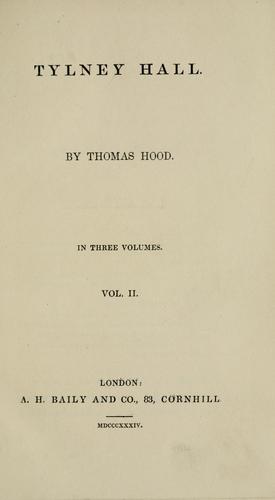
tylney hall cover

The fact that Tylney Hall (1834) is Thomas Hood’s only published novel implies that he was not really suited to this discipline of writing – especially as his reputation for humorous articles and sublime poetry was already established. This may be true given the mixed reviews Hood received for this three volume story. But the parlous state of Hood’s finances and his desperately poor health would also have compelled him to focus on shorter more intense creative output – just to make ends meet. Furthermore, Hood was actually working on a second novel entitled ‘Our Family’ at the time of his death – so we must assume he was not too bruised by the experience of writing Tylney Hall.

This post provides an overview and critique of the plot – and it does contain some spoilers!

Plot Synopsis

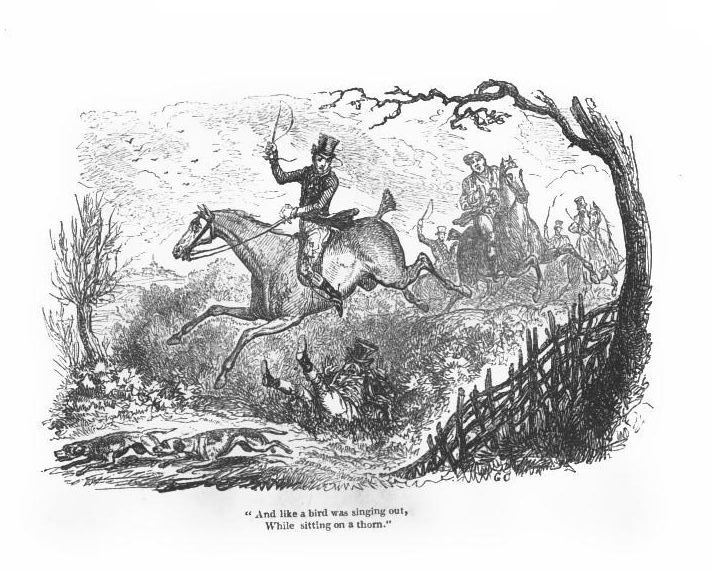
eppinghunt-3

This novel is set in the 1700s in a location in the environs of London. The eponymous mansion of Tylney Hall is owned by Sir Mark Tyrrel, a widower with two young sons. Sir Mark is a keen sportsman enjoying warm relations with his friends, relations and employees. His sons are as different as brothers can be. Older boy and heir-apparent Ringwood is the outdoor type, whereas Raby is a bookish, more sensitive lad who prefers poetry to the hunt. Their lives change when Sir Mark’s younger brother returns from the West Indies, barely clinging to life – bringing with him a scared and frightened boy who he identifies as his son. There is an awkward moment in which Sir Mark exclaims ‘He’s of a cross breed, he’s as brown as Gypsy Jack’. But when he sees how upset he has made the boy he quickly makes amends

‘Come, come’, said Sir Mark, laying his broad hand with an encouraging slap… ‘what I said about the skin was only for the sake of giving tongue – a good horse can’t be of a bad colour.’

As his brother lies dying, Sir Mark pledges ‘to back him through this world, and while I live I’ll ride with him round the course.’ This is an important scene because it instantly shows us that the most powerful character (Sir Mark) takes the boy to his heart – and supports him unequivocally thereafter.

black 2

Sir Mark nicknames his nephew ‘St Kitts’, alluding to his island of origin, and the narrator Hood (for the most part) refers to him as ‘the Creole’. In fact we have to wait until page 43 before the boy’s Christian name is revealed; ‘Walter’ – but I think this is a plot device emphasising Walter’s status as an outsider, rather than an outright bias against him.

The main storyline of Tylney Hall revolves around Walter’s relationship with his cousins, Ringwood and Raby. Walter is often innocently caught up in the cross-fire when the brothers fall out (as siblings do) – because whichever side he takes – both brothers end up resenting him. Ringwood in particular can be nasty and continually questions Walter’s legitimacy, suggesting that he was born out of wedlock. Perhaps the most shocking attack comes when Ringwood names his new horse ‘Brown Bastard’ – in retaliation for a betrayal he wrongly believes Walter has committed. Surprisingly the accusation of bastardy is most hurtful to Walter because he feels unable to stand on an equal footing with the brothers because of it.

fortune teller

Walter befriends a mysterious fortune-teller in the forest

Sir Mark keeps the peace at home and always supports his nephew when arguments arise, but Walter’s resentment continues to grow as a series of misunderstandings (on either side) increase his antipathy to Ringwood. Just when it seems Walter will flip, he meets a mysterious black woman in the forest who claims to have been his nursemaid in the West Indies. She counsel’s Walter to bide his time and crucially provides him with documentary evidence proving his legitimacy – the marriage certificate for his parents:

the reproach of my birth is removed; that sting will still be aimed at me, but it has lost its venom… I am now Ringwood’s equal in all but expectations

All three boys are educated at Oxford, returning to Tylney Hall during the holidays. One summer Raby meets and falls in love with Grace Rivers, the daughter of a local magistrate. But the lovers are thwarted after Sir Mark announces he has long-since agreed that oldest son Ringwood shall wed the magistrate’s daughter. Walter ought to have been pleased to see this serious rift between the brothers, but instead the news awakens the depth of his own feelings for Grace, inciting a jealous hatred towards Raby too.

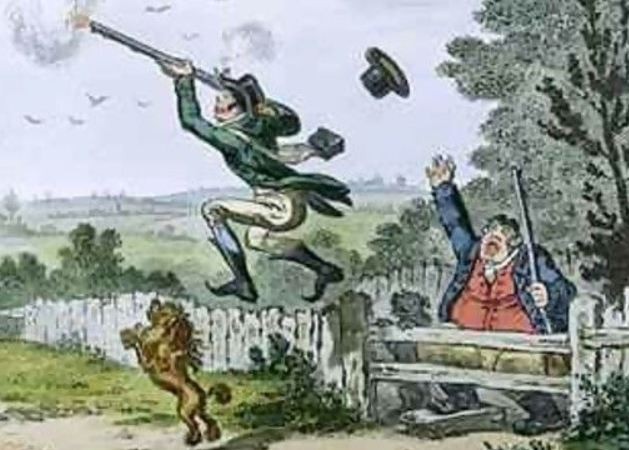
cockney sportsman

Raby is no sharp-shooter, preferring poetry to potshots

Walter knows that Sir Mark intends to buy him a commission into the army when he graduates from Oxford  – but he now decides he wants more. Observing Sir Mark’s disappointment at Raby’s complete inability to use a gun, Walter offers to give Raby shooting lessons, and takes him to a secluded part of the Flats ostensibly to shoot hares. Raby fires the gun when he sees movement in a copse and to his utter shock finds that he has shot his brother Ringwood dead. We are not told whether Walter engineered the shooting – but he does take advantage by urging Raby to flee as he will surely be found guilty of murder, given the well-known fact of the breach between the brothers.  That night a thunderstorm floods the area  – and a few days later a body is plucked from the river wearing Raby’s clothes – indicating that he has died attempting his escape.

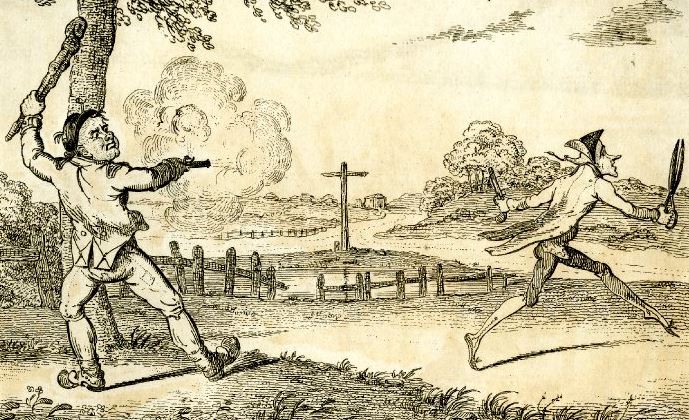
Sir Mark is devastated by this double tragedy and dies less than a month afterwards. Walter inherits the estate but he cannot rest easy as the first the local squire then the old woman in the forest threaten to expose him. As the months pass by, Sir Walter (as his is now known) begins to relax – and looks to complete his final conquest – that of Grace’s heart. This proves a bridge too far as Grace rejects his advances, and accuses him of skulduggery. Returning home from this devastating setback Sir Walter meets the squire who produces a letter confirming Walter’s hand in Ringwood’s death, and challenges him to a duel. Walter sinks to new depths of dishonour by attempting to shoot his adversary in the back while he is still taking the 10 paces – The bullet misses its mark and the squire fatally wounds Walter by return of fire.

duel
Bad-boy Walter shoots (but misses) the squire while his back is turned

All this is witnessed by a passing stranger – who happens to be Raby on his way home, after deciding to face the music. The younger brother is not after all – having swapped his clothes with a tramp before he made his escape. Walter has the decency to make a dying confession fully exonerating Raby, enabling him to marry Grace and reclaim Tylney Hall as its rightful owner.

There are a lot of deaths in the final part of the book, but these are not entirely unexpected as we have seen the resentment build inside Walter. Some of the comic set-pieces, such as an elaborately described fete champetre – held at the home of social-climbing snob Mr Twigg (and turns out disastrously bad) – contain serious events which help turn the screw of Walter’s hatred. It is hard not to empathise with Walter after the treatment he receives from Ringwood & though Walter does turn out to be a thoroughly bad apple in the end, Hood succeeds in showing that this is in some part down to the ordeal he has endured.

Style of Writing

When Thomas Hood wrote Tylney Hall he considered himself ‘young in the path in which he was treading’ and readily acknowledged that characterisation failed to an extent because ‘he could not write love scenes’. It is certainly true that the largely comic style of narration makes it difficult for Hood to switch emphasis to the darker side without jarring the flow. When looking for the absurd, such as portrayed by the character ‘Unlucky Joe’, Hood’s style of writing resembles the early works of Thackeray, who published The Yellowplush Papers around the same time. Both men earned their living contributing to popular magazines such as Punch, and both were fans of the ribald sense of humour promoted by artists such as Rowlandson. The fete scene is particularly reminiscent of Pierce Egan’s Life in London (1822) – a very influential but largely discarded masterpiece of Regency satire.

Hood’s reputation as ‘king of the punsters’ is certainly well lived up to, but perhaps too much to sustain what is a genuinely interesting and sometimes gripping plot. The whole piece comes across as a kind of bridging point between late Georgian bawdiness and the mawkish sentimentality that was about to dominate Victorian literature. It is nonetheless a worthy attempt to tackle the important and still relevant subject of privilege and prejudice.

Most of all I enjoyed its understated social commentary, in particular on the subject of ‘legitimacy’ defined by the arbitrary fate of being born on the ‘wrong side of the blanket’ – for which Walter laments

Tis no fault of mine. I had not the ordering of my birth…

Justice may award the shame to the parent, but the prejudice of man entails it on the child.

Rating 4 out of 5

Tylney Hall is more than just a curiosity, and is a very readable story.  The strength of Hood’s central black characters seems very innovative – perhaps ahead of its time. Transformed into a screenplay this could produce a powerful and unique insight into black culture in Georgian Britain.

Part Three of this series examines how accurately Tylney Hall represents Georgian Wanstead – the area upon which it is based

+++

There is a dearth of readily available information on Tylney Hall  – Gerald Massey’s website remains the best resource for Thomas Hood generally but I also recommend The Poetry Foundation

Finally, why not check out this collection of Hood’s memorable quotes

Elsewhere on my blog I have examined Hood’s relationship with the Epping Hunt. For other sporting related posts you might like the story of prize-fighter Tom Shelton or a brief history of Royal Ascot

Thomas Hood, Tylney Hall & Multicultural Wanstead

Overview of Thomas Hood & Wanstead

Review of Tylney Hall | Finding Wanstead in Tylney Hall  | Black representation in Tylney Hall

 thomas-hood-5

Thomas Hood (1799-1845) is a shamefully overlooked 19th century literary great – for whom a renaissance must surely beckon. His obscurity is all the more surprising when we consider how immensely popular he was throughout the Victorian era. Try Googling him and you will find scant reward. During his own short lifetime Hood overcame debilitating illness and grinding poverty to become a national treasure. He contributed humorous articles to popular magazines such as Athenaeum and Punch & also single-handedly ran his own magazine The Comic Annual (1830-42). He wrote just one novel – Tylney Hall (1834) – which I will be discussing in this blog, but poetry was his real forte.

sonnet to vauxhall

Hood’s Sonnet to Vauxhall – illustrated by Rowlandson

Hood’s output was created at great cost to his health. In his early days he was a talented engraver working alongside artists such as Thomas Rowlandson (a man with whom he later often collaborated), but was compelled to abandon this profession and seek an outdoor life to recover his strength. It was a tough existence for by 1841 when Hood became an invalid he was only saved from financial ruin thanks to the intervention of Prime Minister Sir Robert Peel, who was a great fan of his works. When Hood eventually died his family were granted a state pension – and the public continued to adore him. A memorial was later built by public subscription in Kensal Green cemetery. As the century progressed Hood’s poetry and witticisms remained familiar enough to be often quoted in ordinary conversation. As late as 1903 William Rossetti (of Pre-Raphaelite brotherhood fame) described Hood as ‘the finest English poet between the generations of Shelley and Tennyson’. However, since these heady heights of appreciation Hood has quietly slipped into obscurity, and has long-since vanished from the modern-day English literature curriculum.

 lakehouse

Hood wrote Tylney Hall whilst living in Wanstead Park

Yet one bastion of recognition for Thomas Hood still remains intact, and it can be located in the environs of Epping Forest, and most particularly Wanstead. After his marriage in 1824 Hood lived in Islington but made frequent visits to the countryside beyond London,  especially to Epping Forest, and he formed a deep affinity with the area. I have already described how Hood encapsulated the rough and tumble tradition of the Epping Hunt (1829), recording for posterity the rituals of that annual cockney jamboree. He was also fully cognisant of the scandalous loss of Wanstead House, ironically benefitting from its destruction by renting the Lake House in Wanstead Park from ‘Wicked’ William Long-Wellesley.

wickedwilliam


Wicked William – Hood’s shady landlord (1832-35)

Hood’s arrival in Wanstead in 1832 coincided with Wicked William’s enforced exile – so it is unlikely that landlord and tenant spent much time together. Though he was always a feckless waster, William was notoriously generous and probably offered Hood terms well below the market rate. Perhaps Long-Wellesley’s vanity was sated by Hood’s eulogy to the Epping Hunt – because the men were already acquainted. This unlikely friendship endured, for it is recorded that William regularly visited Hood’s sickbed in 1837, when both men were living in Belgium.

eppinghunt-1

This scene from The Epping Hunt  shows Hood preferred whimsy to satire

Hood was active during a time of great social and technological change – as the long 18th century drew to a close and young Queen Victoria assumed the throne. From the outset of his career Hood purposefully rejected the brutality of late Georgian satire which sought to undermine its subject, preferring to adopt a kinder and more affectionate style. His whimsical humour presaged the rising sense of decency and respectability throughout society, foreshadowing the sentimentality and mawkishness which defined popular Victorian literature. Hood’s style is very like Thackeray’s early writing, light-hearted and amusing – never over-analytical.

Despite his comic reputation, Hood was capable of portraying the biting hardship of contemporary poverty. For example, Song of the Shirt (1843) highlighted appalling working conditions of the era – where Hood showed remarkable foresight in writing from a female perspective – describing a needleworker’s daily struggle for existence and the cruelty of her employer

song of the shirt

Despite being penned by a man, Song of the Shirt ought to be considered one of the most important proto-feminist works of literature ever written. It was based on a contemporary court case involving a woman who was forced to sell her employer’s equipment simply to put food upon the table – a decision that led to prosecution. The case is long forgotten but this poem became a standard-bearer for highlighting the effect of inequality upon humanity, inspiring a generation of mid-Victorian artists

bridge of sighs

Opening stanzas of Bridge of Sighs 

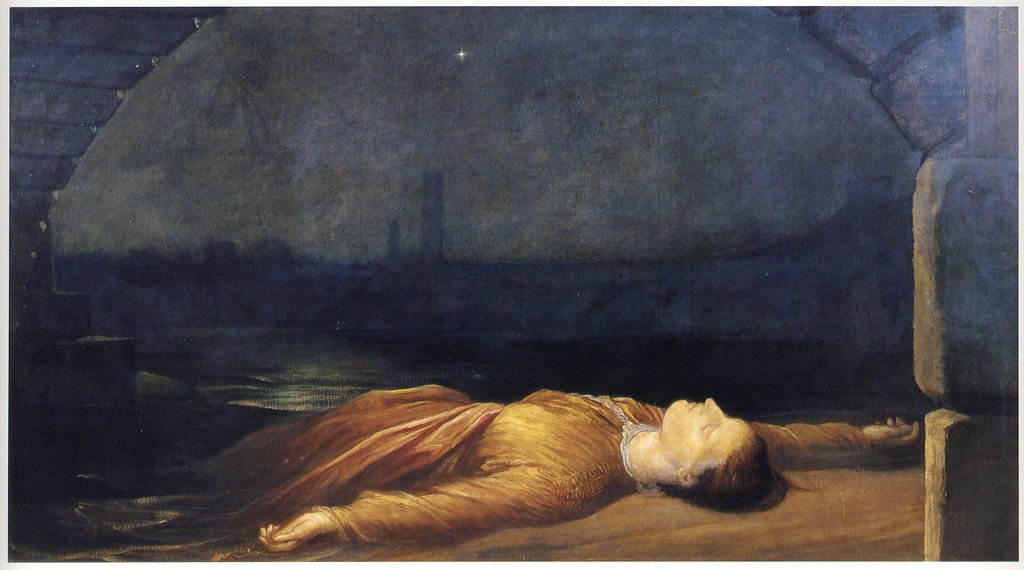
Another poem Bridge of Sighs (1844) again draws on real life by recounting the tale of a homeless young woman who committed suicide by throwing herself from Waterloo Bridge in London – At a time when suicide was frowned upon Hood declares that whatever sins she may have committed are cleansed by the sadness of her death

 found drowned

Hood’s poem inspired Found Drowned by Frederick Watts (1852)

Were it not for Hood’s own untimely demise he may have further developed his talent for social commentary. But in death as in life Hood has been unlucky, for the gentle observational humour of his earlier years has become his posthumous trademark.

grave

I will be turning to Hood’s only novel Tylney Hall in the second part of this blog. Written in 1834, whilst he was living in Wanstead, the title is a very thinly veiled reference to Long-Wellesley’s once great mansion, Wanstead House. But attempting to cash in on Wicked William’s story was an unwise move because it raised expectations that Tylney Hall would reveal the truth about Wanstead House, and satisfy public curiosity as to why it was demolished. – This led to criticism and affected sales, forcing Hood to add a note in the preface explaining that ‘Tylney Hall’ alluded to the topography of Wanstead Park, but not its disreputable owner.

wansteadcolour

Tylney Hall – not about Wanstead House

It is easy to see why a desperately poor artist with young mouths to feed would use any means possible to promote his work. But by choosing ‘Tylney Hall’ for a title Hood inadvertently and fatally undermined his novel – by unnecessarily calling into question the accuracy of its content.

Easter Monday 1817 by Henry Thomas Aitken

Tylney Hall does show Wanstead as it was to Thomas Hood

Because Hood’s works were always inspired by his own life experiences I believe that the world created in the pages of Tylney Hall should not be rejected, as we are offered a tantalising and surprising viewpoint of life in multicultural Wanstead 200 years ago. Additionally we find perhaps the first English novel to centrally feature strong and noble black characters, to whom we can sympathise and relate. The second part of this study will examine this more closely, proving that that Hood really was ahead of his time thus worthy of a new and more fitting appraisal.

Dr Sara Lodge has written a comprehensive critique of Thomas Hood in her book Thomas Hood and nineteenth-century poetry: Work, Play, and Politics (Manchester University Press, 2007)

To read more of Thomas Hood’s poems click here – or try a tasty selection of his best quotes

Gerald Massey has an excellent website devoted to Thomas Hood

You may also like to read about more Epping Hunt related buffoonery courtesy of Wicked William or to know about his short-lived military career.

Arthur Wellesley repackaged: the birth of ‘Wellington’

wellesley pole
Wellesley-Pole: the man who named ‘Wellington’

In previous blog posts I have described how Wellesley-Pole’s orchestrated The Great Recoinage (1817), the Waterloo Medal (1816), and modernised Royal Ascot (1822-1830). But he was also responsible for the ‘birth’ of Wellington: for it was our man Wellesley-Pole who created the iconic title under which Arthur Wellesley’s glories came to pass.

wellington young

R.I.P. Arthur, long live Wellington!!

The circumstances of Wellington’s creation are revealed in the Raglan MS at Gwent Archives, containing correspondence between Wellesley-Pole and Arthur from 1807-1818. This very important primary source is often used to illustrate Arthur’s unvarnished opinions about the performance of government, progress of the war, and the conduct of his family during these momentous years. Yet the many letters FROM Wellesley-Pole TO Arthur are barely ever cited – despite the fact they contain an equally rich vein of personal insight into the political intrigues of the time. It is quite sad to see Wellesley-Pole so overlooked – especially within his own personal archives.

Historians love to lay into William Wellesley-Pole. They portray him as ‘opportunistic’, ‘not a little devious’; ‘the worst type of hanger-on’; and harshest of all: ‘a nonentity’. Even his obituary is nowadays considered to be one of the most savage ever printed

From an early period of his career it was evident to all … that he was by no means destined to fulfil so prominent a position in public life as his brothers…Journalists and demagogues denounced him as a Minister who not only deserved to be degraded and punished, but as a criminal for whose enormities no amount of penal infliction could be excessive…His spirit quailed before a crisis…at no time in his life did he display Parliamentary talents of a high order…Mr Wellesley-Pole was simply angry- angry at all times with every person and about everything.; his sharp, shrill, loud voice grating on the ear…an undignified ineffective speaker, an indiscreet politician…advancing in years without improving in reputation.

The Times, February 24th 1845

Wellesley-Pole Wellesley-Pole would have been more feted had he not been entirely overshadowed by his illustrious brothers; Richard, Governor General of India (1797-1805); and Arthur, probably Britain’s greatest military leader. Withing his family, far from being a ‘nonentity’ – Wellesley-Pole was actually a very loyal and trustworthy brother, content to stay out of the limelight, & blessed with the one gift that eluded the rest of the Wellesley clan: a long and happy marriage.

Only by reading both sides of the Raglan MS does it becomes clear that, from his position at the heart of government, Wellesley-Pole played a vital supporting role; acting as a kind of ‘remote-secretary’ on Arthur’s behalf. His services ranged from provision of tea and other home comforts, through to supplying a new sword or replacement horses. Crucially Wellesley-Pole relayed the latest news, gathered opinions, and was able to soothe the often fractious relationship between the Cabinet and the Peninsular Army.

(c) National Trust, Mount Stewart; Supplied by The Public Catalogue Foundation

Victory at Talavera raised Arthur to the peerage

Following Arthur’s victory at the Battle of Talavera in 1809, the Government asked Wellesley-Pole to find a suitable title for his feted brother. He was reluctant to be saddled with such an important responsibility, but King would not wait, and an immediate decision was required. So Wellesley-Pole took up his pen and wrote to Arthur:

After ransacking the peerage… I at last determined upon Viscount Wellington of Talavera and of Wellington, and Baron Douro of Welleslie in the County of Somerset. Wellington is a town not far from Welleslie, and no person has chosen the title. I trust that you will not think there is anything unpleasant or trifling in the name of Wellington, but [in the] circumstances… I could not easily have done better. I own I feel in rather an embarrassing situation for it is impossible for me to know whether I have acted as you would have had me…but you should have explained to me your wishes before ever you left England, in case of such an event.

In the anxious days awaiting a reply from the Peninsula, Wellesley-Pole’s nerves became somewhat frayed when Arthur’s wife Kitty was reported to have declared

kitty pakenham

Wellington I do not like for it recalls nothing. However, it is done & I suppose it could not be avoided.

The fact Wellesley-Pole did not consult Kitty says a lot about the role of women in society at that time, for it seems odd that she was only told after the deed was done, and literally had to live with Wellesley-Pole’s decision for the rest of her life.

Eventually and to Wellesley-Pole’s immense relief his choice of title met with unqualified approval from Arthur:

My opinion is that you have done exactly what you ought to have done… You have chosen most fortunately, and I am very much obliged to you. I could not have been better off for a name if we had discussed the subject twenty times

It seems obvious to me that a greater study of Wellesley-Pole’s close relationship with Wellington not only offers a fuller understanding of this great military genius, but could provide Wellesley-Pole much needed relief from his critics: The creation of ‘Wellington’ was not an egotistical act on Wellesley-Pole’s part, for a quick perusal of the relevant letters shows that Wellesley-Pole had no choice but to stand proxy, and that his motives were honourable as he tried to balance the needs of government with the wishes of his beloved brother.

Another great example of Wellington and Wellesley-Pole in concert can be found in the production of the Waterloo Medal but things were no quite so rosy when Wicked William joined Arthur’s Peninsular Army An equally tough role for Wellington was his choice of favourite niece from Wellesley-Pole’s three graces.

If you live in London, why not visit Apsley House and see the Duke of Wellington’s home

6 Reasons why France should salute the Iron Duke

wellington

With the celebrations of the bicenntenial of Waterloo almost upon us, it obvious that France should commemorate the end of Napoleon’s fascinating rule rather than focussing on what was a decisive military defeat. However it should not follow that the Duke of Wellington should be portayed as the ‘baddie’ responsible for drawing the curtain down upon one of the most exciting periods in French history. To do so would be an injustice to the Iron Duke given that he was a confirmed Francophile – whose dispute was directly with Napoleon, and concern for the French citizens was always paramount.

wellington at waterloo

The recent creeping campaign to undermine Wellington’s role at Waterloo is, to me, bad enough. But the attendent lack of recognition for his important role in PROTECTING France both during and after the conflict is a step too far.

Thus I have drawn up six brief reasons why Wellington ought to receive some grudging Gallic recognition

1. Military Training

angers

Arthur learned his trade in France

Anyone familiar with the life and career of the Duke of Wellington will know that at the age of 16  (when simply known as Arthur Wellesley) he enrolled at the French Royal Academy of Equitation in Angers. It was in France that Arthur first showed any signs of talent. At Angers Arthur learned equestrian skills and became very fluent in French, which was to serve him well in future. Crucially Arthur met fellow students, some of whom were victims of the French Reign of Terror – others who rose through the ranks to fight against him under Napoleon – he never forgot the friendships made or the bonds he felt towards France

2. Wellington the Francophile

buhl

Wellington adored French art and furnishings

Wellington’s love for the French people extended way beyond the ties of personal friendships. For he was also a great admirer of French culture, and particularly its art and furnishings. Whilst Napoleon was exiled to Elba in 1814 Wellington was in Paris – not lording it over the people, but negotiating fair prices to buy works of art including French Buhl furnishings. He set an example by not acting as the commander of an army in occupation, but immersing himself into the cut and thrust of Parisian life and becoming a consumer – paying the going rate without quibble.

3. Military Campaign in France 1813-14

toulouse1814

Wellington’s civilised entry into Toulouse, 1814

Towards the end of the Peninsular War in 1813 Wellington went to great lengths to ensure his armies pouring into France acted with absolute decorum towards the peasantry. Anything taken was always paid for, crops were not trampled down, and the British-led army refrained from hostilities expected from any invading army.

4. After the Battle of Waterloo

waterlooaftermath

Horrific aftermath of Waterloo

Anyone who thinks that Wellington lacked emotion towards his troops would be well advised to read the correspondence of Thomas Creevey (1768-1838), better known as the Creevey Papers. Though Creevey was not a fan of Wellington, he describes the Iron Duke returning to the fields of Waterloo and Quatre Bas in the days following the battle to aid and assist French and Allied troops alike. Wellington is horrified to find one French soldier unattended and went to his aid – apologising for his situation and calling for medical assistance. The pain Wellington felt for Waterloo encompassed all participants; he never demonised the French.

5. Respect for the enemy

marshall ney

Wellington could not stop Bourbon vengeance : Marshall Ney

Throughout the Peninsular War Wellington held a more than healthy respect for French generals opposing him in the field. To those who claim that Wellington was over-cautious it might be argued that he was wise to avoid meeting renowned military leaders –  unless it was on his own terms. One such general, Marshall Ney, survived to rejoin Napoleon at Waterloo – having been retained by the restored Bourbon monarchy. After Waterloo the Bourbons decided to make an example of Ney. When Wellington heard he went to great lengths to appeal for clemency, but the King refused to speak with Wellington – & Ney was executed by firing squad. His death divided opinion in France, but showed Wellington to be a man of honour. The Duke’s respect for the enemy went right to the top – and certainly cut both ways. For, when his number was up, Napoleon offered to surrender to Wellington only. I have always thought it a shame that Wellington passed up the opportunity to meet Napoleon at this time as I am sure their conversation would have been legendary.

6. Protection of Paris

occupation

The British – a very civilised army of occupation

Perhaps the most important, yet easly forgotten, role Wellington played in the war against Napoleon was by his presence at Paris. Arriving from the east: Russian, Prussian and Austrian armies were intent upon revenge for the many atrocities their armies and people endured at Napoleon’s hands -and it was almost second-nature for ordinary soldiers to rape and plunder the vanquished population. But while Wellington was around, there were be no horrific reprisals. Draconian punishments befell any British soldier seen to undermine relations with their hosts – and this policy was greatly influential in restraining other occupying troops. This ultimately helped to restore good relations on all sides. The Congress of Vienna stands up very well because of this international civility, especially compared with the bitterness and revenge that bedevilled the Treaty of Verseilles a century later.

louvre

The Louvre, Paris c.1815

In some respects it may be argued that Wellington’s admiration for France went too far – for he played a major role in preventing art treasures amassed at the Louvre being reclaimed by those from whom Napoleon had seized them.

Conclusion

It was a good thing for France that the Duke of Wellington saw his task as the defeat of Napoleon and not a vendetta against its people.  Whatever the ifs and buts about his credit for the Battle of Waterloo, the Iron Duke WAS crucial in protecting France and enabling her to restore relations with the rest of Europe. Though the people of France could never love Wellington, I hope at least they can acknowledge that he was not the worst of enemies to have at a time of military defeat.

loius return

Bringing back the Bourbons? – Not so popular there Arthur!

If you have enjoyed this post you may be interested in Wellington and Fitzroy Somerset at Waterloo or to know how Wicked William rated his illustrious uncle.

Find out more about the production of the Waterloo Medal, via Wellington’s brother Wellesley-Pole

For news, views and information on this year’s Waterloo celebrations visit Waterloo 200 or Waterloo2015 – not forgetting the simply splended Unseen Waterloo

If you live in London, why not visit Apsley House and see the Duke of Wellington’s home

Last but not least, I must mention Geraldine Roberts’ book Angel and the Cad, which is launched by MacMillan on June 18th – Yes, the bicenntenial of Waterloo!!  – in which the Duke of Wellington & Waterloo feature heavily.

Any comments or feedback, as ever, would be greatly appreciated. Otherwise tune in for more Wellesley-related articles!

No Longer Minted : Wellesley-Pole’s Exit (1823)

Wellesley Pole’s departure and legacy

Intro | Waterloo Medal | Pole & Pistrucci | The Great Re-coinage | Exit & Legacy

wwp by pistrucci

Wellesley-Pole leaving medal – by Pistrucci

The bold manner in which you devised, and… executed one of the most difficult works…during the present Reign, or possibly any former one, does honour to the name of Wellesley

Sir Joseph Banks – Letter to Wellesley-Pole 21st June 1817

In the summer of 2009 it came to light that the Royal Mint had made a terrible blunder with the redesign of the 20p piece, meaning that for the first time in over 300 years an undated British coin entered circulation. Any one lucky enough to find one of these ‘mistakes’ could reasonably be expected a windfall, since coin experts placed their value at £50

feck up 20p

A error such as this is indeed a rarity for the Royal Mint, especially given the advances in technology since the days of Wellesley-Pole and Pistrucci. Moreover it brings sharply into focus the amazing logistical achievements of the Waterloo Medal and The Great Recoinage. In less than three years at the Mint Wellesley-Pole revolutionised the issue of war service medals, and then exchanged the entire silver currency of Great Britain without losing a single bag of coin from the 57 million issued and distributed the length and breath of these islands. By any standard this is a mind-boggling achievement, which occurred during years of civil strife – when there was no proper transport and communication system in place.

big red book

This 1818 satire has Wellesley-Pole is saying ‘I swallow £10,000 per annum and do very little for it.’

But what of the next five years, 1818-1823, I hear you ask. What did Wellesley-Pole do next? Well the answer is – not a lot. The problem was that Wellesley-Pole was up to any task set him, but after the new silver currency in 1817, save for the introduction of the gold sovereign, and a few changes after George IV came to the throne – Wellesley-Pole was not called upon to any great extent. This is not to say that the Royal Mint failed to develop and thrive under his command, more that it was really rather routine for a man of his administrative capabilities.

caslereagh

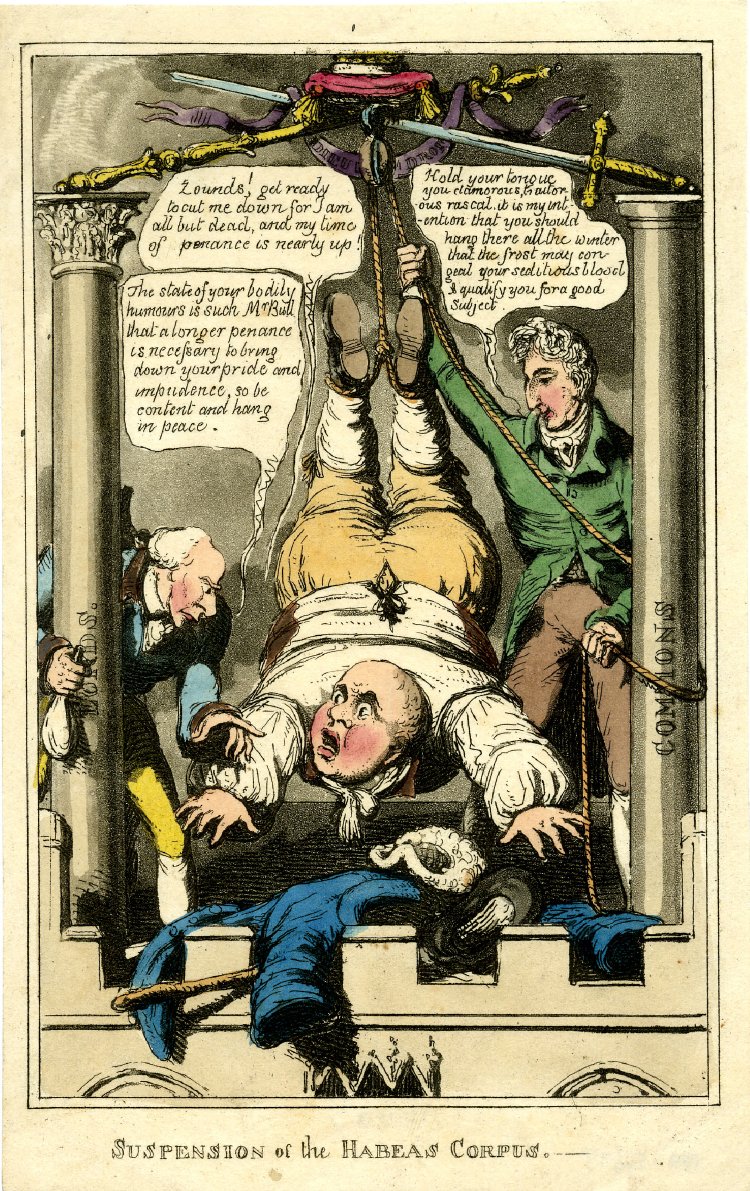
Wellesley-Pole was not vocal enough in support of Government repression

After 1818 Wellesley-Pole was angling for a new role in Government – His long-term ambition was to become First Lord of the Admiralty, something dear to his heart as a former naval officer and services as Secretary to the Admiralty (1805-1808). But he needed advancement to the peerage to make this possible. The only problem was that Lord Liverpool’s government had barely any Ministers sitting in the House of Commons. The Prime Minister really wanted to see Wellesley-Pole at his fiercest in the Commons alongside Lord Castlereagh – defending the crackdown on civil liberties. Instead Wellesley-Pole made repeated requests for advancement, so Liverpool became instead convinced that the time had come to get rid of him. In 1814 Wellesley-Pole had been an important pawn in the political rapprochement with the Duke of Wellington – but when the Iron Duke himself joined the Cabinet in 1818, Liverpool realised that one Wellesley was quite enough – and so the dye was cast for Wellesley-Pole’s removal

Ultimately it was events elsewhere which kept Wellesley-Pole in office until 1823. After the death of George III in 1820, the new King George IV was only to happy to ennoble his friend and confidante – and Wellesley-Pole became Baron Maryborough. But the trial of Queen Caroline, delayed the King’s coronation by two years, putting both Royal and Government business onto the back burner. Hence it was not until 1823 that Wellesley-Pole was ‘no longer Minted.’

maryborough

Wellesley-Pole ennobled – and sacked at the same time

We have now seen Wellesley-Pole’s legacy – and also found out how and why he was removed from office. But what of the Mint? How did they feel about the loss of their Master after 9 tumultuous years? The answer to this can be found at the National Archives where a 300-page document details the full period of Wellesley-Pole’s tenure at the Mint. Most importantly of all it reveals how popular Wellesley-Pole was amongst his staff and colleagues. Sir Joseph Banks (quoted at the head of this post) was just one of many contemporaries who, at least privately, were fulsome in their admiration of his achievements. Luckily for us, and for the Royal Mint – it was Banks’ admiration for Wellesley-Pole that enabled the establishment of the Royal Mint Museum (1816). Both men had a sense of the importance of retaining examples of old currency for continuity of British culture.

Main Mint book - 300 pages

Mint Book at the National Archives

After Wellesley-Pole resigned – the Royal Mint scrambled to lavish him with lasting thanks for what he had done to enhance their reputation. A copy of his bust by Nollekins was commissioned and placed in the Mint boardroom alongside Sir Isaac – reckoned to be the greatest of all Mint employees. He also had the honour to be elected by the Goldsmiths to their Livery, a rare token of esteem. Finally Pistrucci designed a special medal which was awarded to Wellesley-Pole with a Latin inscription, the translation of which follows:

The Officers of the Royal Mint have caused this Medal to be struck in the year of our Lord 1823 in honour of the Right Honourable William Wellesley-Pole, Baron Maryborough (nine year Master of the Mint) as a mark of their respect and esteem for his Lordship: who when the coin of the realm, from long wear had become much deteriorated, not only restored it to its pristine beauty but replaced it by an entirely new coinage, far more perfect both in design and execution, and who also in transmitting the new coinage to all parts of the Kingdom conducted the undertaking with so much Wisdom, Consideration, and Equity that the old money ceased, and the new began to obtain currency in every place, at nearly the same moment

latin

For those Latin aficionados – here is the Latin version

Perhaps Wellesley-Pole’s greatest legacy of all was framed by his constant insistence that there should be  ‘no impairment in the coins beauty or quality’. Because of this the designs remained in circulation until decimalisation in 1971. For over 150 years British citizens carried his handiwork in their pockets, surely the greatest testimony to what he achieved.

 nollekins

Bust of Wellesley-Pole by Nollekins – Placed in Mint Boardroom

I hope you have enjoyed ‘The Mint with a Pole’ and come back soon as there are more episodes from the Wellesley-Pole family with which I hope to entertain you.

Any comments or feedback would be gratefully received.

To find out where Wellesley-Pole went after the Mint, please follow him to Royal Ascot – or see why Wellesley-Pole fought to prevent prosecution of a vagrant. Alternatively you can help the Duke of Wellington choose which niece he liked the most.

Sources

  1. National Archives MINT 1/56
  2. Daily Mail June 29 2009
  3. Humphreys H., Gold, Silver and Copper Coins of England (6th Ed, London: Bohn, 1849)
  4. Craig J., The Royal Society and the Royal Mint in, Notes and Records of the Royal Society of  London,  (London: The Royal Society, V19, No 2– Dec 1964)
  5.  Mays J., The Splendid Shilling, (Hampshire: New Forest, 1982)