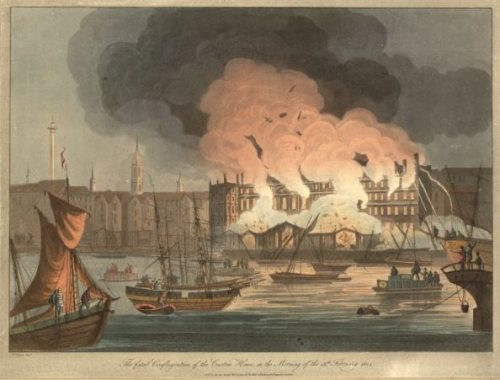
Ratcliff – The other Great Fire of London

Not just 1666! – Fires were a regular occurrence in London

The Great Fire of London is a very important and well-remembered event in the timeline of London’s life story. Over a period of 4 days beginning 2nd September 1666 the fire destroyed most of the medieval City of London, sweeping away over 13000 houses, numerous wharves and businesses, and 87 churches – including St Paul’s CathedraI. This disaster has been widely recorded, not least by diarist Samuel Pepys. Its aftermath led to the reconstruction of early modern London, replacing narrow thoroughfares and wooden structures with wide streets and brick buildings – and brought us 51 new churches designed by Sir Christopher Wren. ‘Great Fire’ certainly befits this calamity; but it should not mask the fact that London (like many other early modern cities) always lived under the constant spectre of fire, and that buildings and places of importance were lost to fire on a fairly regular basis. Hence it is useful to look beyond the Great Fire of 1666, and at other fires in order to fully appreciate the extent to which blazes were a very real and life-changing disaster for the people affected. The best place to start, therefore, is to find another great fire of London- so we head east of the City to Ratcliff.


Ratcliff Cross (1791)

This blog examines the Ratcliff Fire, said to be the biggest conflagration that London saw between 1666 and the Blitz in 1940. This fire seems to have escaped attention perhaps because its victims were poor (who were irrelevant) or tradesmen (who were probably insured), but hopefully because its aftermath was dealt with so quickly and humanely. Ratcliff(e) in earlier times was also known as “sailor town”, was originally known for shipbuilding but from the 1300s more for fitting and provisioning ships. By the end of the 1700s Ratcliff was a village-cum-shanty-town on the Thames situated between Shadwell and Limehouse, due south of Stepney village, still offering various maritime services, but now also containing warehousing and storage for a variety of imported goods, from which manufacturing industries nearby relied. Ratcliff tended to specialise in docking of combustible cargoes considered too risky to be bulk-handled in the City, and this ultimately proved to be its downfall. Here are some contemporary reports of the fire:

On Wednesday afternoon at 3 o’clock on July 23rd 1794 the hamlet of Ratcliff suffered a dreadful fire. It began at Mr Clove’s, a barge-builder at Cock Hill, and was occasioned by the boiling over of a pitch kettle that flood under his warehouse, which was consumed within a very short time. It also set light to a barge (it being low water) lying close to the premises, laden with saltpetre – which subsequently spectacularly exploded. The blowing-up of the saltpetre occasioned large flakes of flame to rain down upon riverside buildings – one of which belonged to the East India Company, from which a store of saltpetre was in the process of removing to the Tower of London – 20 tons of which had been fortunately removed the preceding day. Consequently the fire wrought carnage both on land and river – and very soon all the houses on either side of Brook Street were destroyed as far as Ratcliff Cross, as well as several alleyways – and several large ships, including the East Indiaman Hannah, which was about to depart for Barbados, and other smaller boats were utterly burnt out. The fire found new fuel at Ratcliffe Cross when it over-ran a sugar-house. This new ignition point meant that the adjacent glassworks and a lighter-builders yard were lost.
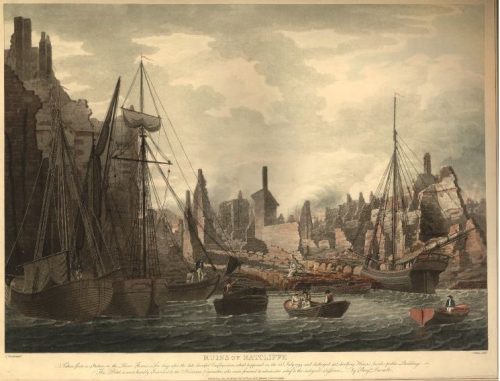
Ratcliff Fire damage – as seen from the Thames

The blaze continued until the following morning and its progress was helped mainly by the narrowness of the streets, which prevented fire engines being of any practical service. The wind blowing strong from the south fanned the flames onwards: it reached the premises of Joseph Hanks, a timber merchants, in London Street and extended on into Butcher Row – the whole of the west, and part of the east side of which was consumed. At Stepney Causeway the fire caught the premises of Mr Shakespeare, a rope-maker, and burnt through to the fields at the other side before dying down. It was only the boundaries of urban development that prevented further progress of the inferno. Almost no property in the vicinity was spared loss or damage, though it was singularly odd that the dwelling house of Mr Bere – a very extensive building – was surrounded by fire but emerged entirely unscathed.
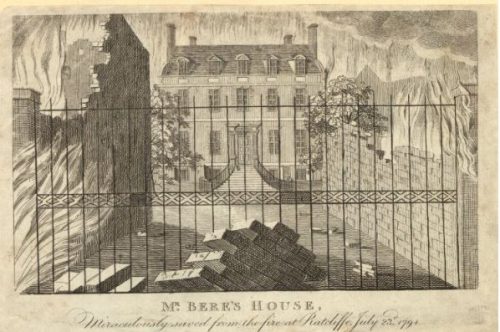
Scene showing Mr Bere’s house escaping the inferno

It was reported that Mr Clove broke an arm fighting the initial fire, and one of his servants was sent to London Hospital with terrible burns. A survey carried out after the fire showed that only 570 out of 1200 buildings survived – and that most of those lost served as housing for the poor. The Government reacted by erecting 120 tents in Stepney Fields to accommodate the poor – hardly a generous deed given that 1000+ people were made homeless. The loss to tradesmen was equally bad – for example Mr Whiting, who owned the sugar-house, lost £40,000 worth of stock. There is no record of any loss of life resulting from the fire, but Lloyd’s Evening Post does seem to imply death amongst the poor without enumerating the extent.

The distress of the miserable inhabitants exceeded all description. In the surrounding fields were deposited a few goods, consisting chiefly of bedding, they were able to save. Stepney Church was opened for their reception, and above a thousand people were obliged to remain all night in the fields, watching the remnants of their property. Children crying for their lost parents, and parents lamenting the fate of their children, added to the horrors of a scene not equalled during the present century

Before any financial assistance arrived in the Ratcliff area, a very different kind of flood inundated the scene. This was in the form of thousands of spectators arriving from the City to view the extensive ruins. It was reported that a great many carriages deposited men and women decanting on foot for a closer look at the scene, including a tour of the rows of tents erected for the poor. But these were not mere gawping onlookers, because evidence reveals their prime motivation was charitable feeling towards to the distressed families they came to see. Within a week the True Briton was able to report that charitable subscription from all quarters had already exceeded £4000 – a figure that rose to £15000 within a few weeks. Business was also quick to resume in the area. By November 1794 the Whitehall Post announced that the East India Company had commenced rebuilding its saltpetre works at Ratcliff, engaging 200 men in the process
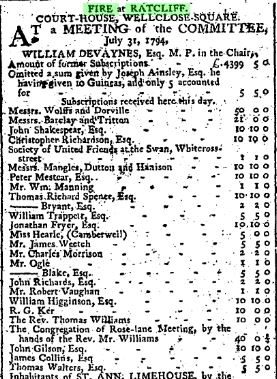
The public responded quickly for victims of the fire

Historic UK has a detailed report and more images of the Ratcliff Fire together with the pleasing news that the Corporation of London, Lloyds and the East India Company also contributed almost £2,000 to the relief of the homeless.

This is one of a series of posts I will be doing in 2017 based upon the Crace Collection at the British Museum – all images used here come from that source.You may wish to know more about Frederick Crace or Thomas Hosmer Shepherd (one of his principle contributors).

For other London related posts, you might be interested in the death of a Regency Prizefighter, or see how multicultural Regency London may have been via this post on Thomas Hood . Finally, for a wider look at Regency era sketches why not join Anne Rushout on tour.


The Last Victims Of Waterloo? Sea Horse Tragedy 1816

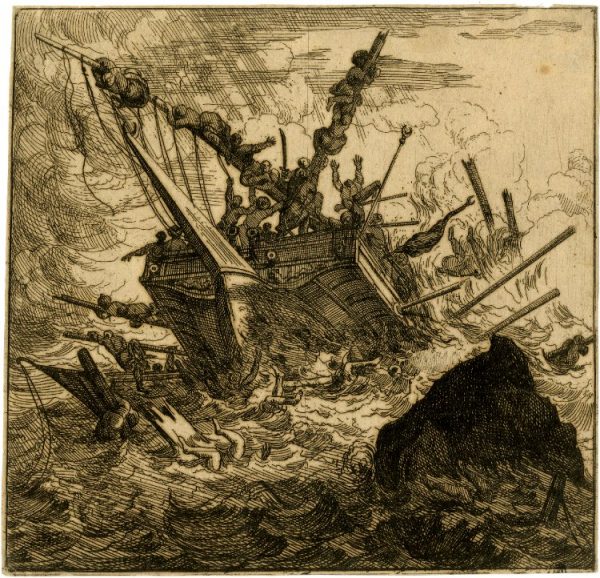
The Wreck of the Sea Horse, Tramore, 1816

On January 30th 1816 Waterloo veterans met a watery grave

As a second-generation Irishman whose parents live in deepest Tipperary, it is almost obligatory that my visits to Ireland include an excursion to Tramore in County Waterford. Its lovely sandy beach, funfair and (one-time) myriad of slot machine arcades providing something for all ages, PLUS the added bonus of Dooly’s truly excellent fish and chip shop – supplies the perfect end to any day trip. They don’t serve seahorse, but you don’t have to look far to see them in this town.

Yet, amidst my nostalgia for Tramore, the presence of a shipwreck on the beach (when I was a lad) was always a stark reminder of the perils facing mariners daring to enter her waters. To this end I have long appreciated why each side of Tramore Bay has so many large beacons – one of which is be-topped by a ‘Metal Man’ which I was wrongly informed had been erected as a kind of corporate stunt. Compounding things further, I always assumed that Tramore’s cute seahorse emblem was just an obligatory tacky seaside symbol, on a par with saucy postcards, donkeys and kiss-me-quick hats.

tramore golf club

Tramore Seahorse Logo – not tack, but genuine respect

But thanks to the magnificent people of Waterford, a monument is about to be unveiled which not only makes me humbly eat my words about Tramore and its logo, but is also a very sincere and poignant memorial for a maritime disaster of the highest order, which occurred on 30th January 1816 involving the ill-fated transport ship Sea Horse.

sea horse memorial

The new Sea Horse Memorial at Tramore

Whilst walking the promenade at Tramore this weekend I came across this delightful stone-built memorial commemorating the bicentennial of the tragedy of the sinking of the Sea Horse – when 363 lives were lost as she foundered during a storm in Tramore Bay. The story of the Sea Horse is very sad, not least for the 2nd Battalion, 59th (2nd Nottinghamshire) Regiment – who were all but wiped out in the icy waters of Tramore Bay. This Battalion (formed in 1806) had been garrisoned in Ireland until 1814 when they were called up to form part of the army of occupation in Paris. After Napoleon’s escape from Elba, the 2/59th were present at the Battle of Waterloo on June 18th 1815. In this bloodiest of battles, the 2/59th were fortunately spared – having not been called into action by the Duke of Wellington.

waterlooaftermath

The 2/59th Regiment – Escaped death at Waterloo (but not for long)

In the aftermath of Napoleon’s final defeat, peace and subsequent demobilisation – the 2/59th sailed back to Dover, making the short journey to Ramsgate, for embarkation upon the Sea Horse which was commissioned to return them to barracks in Ireland. The full story of what happened to the 2/59th is recounted by the Lancashire Infantry Museum. It reveals that Sea Horse was one of a convoy of ships wrecked along the Irish coast that fateful night – raising the overall death toll in this regiment to 550 souls.Their account highlights one important event – in itself a tragedy – but which triggered the horrendous loss that ensued:

At 4pm Ballycotton Island was seen at about 12 miles distance. On board the Sea Horse, the Mate, John Sullivan, who was the only person aboard with knowledge of the approaching coast, climbed the foremast to spy out the land, but he fell, breaking his legs and arms. He died three hours later in his wife’s arms; a loss of local knowledge which was to have tragic consequences for his ship….

Local knowledge was indeed essential because the treacherous bay of Tramore could easily be mistaken for the calm waters of the Waterford Estuary – which lay just east of where the Sea Horse ultimately foundered

shipwreck4

Shipwrecks were almost daily reported in the early C19

Contemporary newspaper reportage of what was at that time (and perhaps until the sinking of the Lusitania) Ireland’s worst maritime disaster, was scant. All I could find was a report in the Morning Post (6th February 1816)

The transport Sea Horse sailed from a port in England a few days ago bound for Waterford or Cork, with a large detachment of the 59th Regiment, consisting of about 16 officers, 287 men, 33 women and 31 children… On the morning of the 30th ult the vessel was driven into Tramore Bay by a desperate gale from the south. The severity of the weather had compelled her to cut her mizen mast, before she came within the bay… she continued beating off with a view to get around Brownstown Head, and thus to reach the harbour in safety, but totally without effect. The top fore-mast fell, killed the mate, and broke the leg of one of the seamen. Two anchors were thrown out but these were dragged by the violence of the storm, and rendered totally unavailing. The vessel was then driven forward, within half a mile of the shore, in presence of hundreds of people, who could give the unhappy persons on board no aid. It was low water at the time, about one pm, which on such a beach, rendered every chance of escape almost utterly hopeless. Much of them on board then retired below, and resigned themselves to their awful and impending fate. The vessel struck upon the sands… and in a few minutes went entirely to pieces. There were 363 drowned and only 31 saved… One of the [surviving] officers clung onto something belonging to the ship… had nearly abandoned himself to his fate, when a countryman rushed into the sea, at the peril of his life, and rescued the stranger from death… It was not within the compass of human power to prevent the sad catastrophe..

shipwreck1

363 lives were lost in Tramore Bay

Captain Gibbs was one of the few survivors and later wrote a full narrative of events. He said of his fellow passengers

There was no disturbance amongst them, most were saying prayers, women were heard encouraging husbands to die with them, and a sergeant’s wife, with three children clasped in her arms, resigned herself to her fate, between decks.

Children fared worst of all, for many had been placed in trunks by their parents in futile hope they might float to safety. One large chest was later recovered containing the bodies of 4 tots – another child was found in the arms of his father who had refused to give him up to save his own skin. Corporal Malone (a survivor) found his son amongst many bodies piled upon the shore, and he removed his shirt to wrap the naked boy for burial.

Christ Church Tramore

Sea Horse Memorial in Christ Church, Tramore

For those left behind, the human cost can perhaps best be summed up via this advertisement from the Morning Post (February 10th 1816), which reveals the awful situation to which one widow was plunged. If only I had a time machine to help the family of ship’s carpenter Russell from Rotherhithe, who had only recently joined the Sea Horse crew and by his death left a wife and 6 children

t russell dead sea horse

An uncertain fate awaited the bereaved families

To conclude, I have to say that I felt a immense pride and admiration for the people of Waterford when I learned how much this awful event is woven into their cultural history, and how fitting and respectful their hard work to memorialise the victims has been. As for me, I now understand why the Sea Horse logo so aptly befits Tramore – and I’ve finally realised that the ‘corporate’ bigwigs I believed responsible for the Metal Man – were in fact Lloyds of London who erected these maritime beacons in 1823 on the orders of the Admiralty in London, as a direct consequence of the Sea Horse disaster.

metal man tramore

So, if you are ever in Ireland and fancy a day out – why not go down to Tramore and see for yourself their heartfelt recognition for the loss of 363 souls who might, in a less tolerant society, have been disdained as soldiers from an army of occupation – rather than desperately sad victims of mother nature’s wrath.
 

For Further Information

Ivan Fitzgerald’s Blogspot is absolutely the best resource for information on the Sea Horse – not least for this 1820s poem lamenting the loss of life in Tramore Bay

tramore poem

For information as to where the wreck of the Sea Horse rests visit Wreck Site, or you might like the Sea Horse Commemoration Facebook Page. James Donahue has written a great piece on why the Sea Horse tragedy still resonates today

The Sea Horse Tramore Blog is a voluntary group comprising of various local bodies in Tramore dedicated to the memory of this event, and the Waterford Chamber of Commerce considers it to have ‘left a lasting mark upon the people of Tramore’

I have strayed off usual territory a bit here, but if your interest is The Battle of Waterloo, you might like to read about Wellington and Fitzroy Somerset or the history of the Waterloo Medal. Or if you are more of a landlubber like me, some information on London stagecoaches might be in order


Principal Departures for London Coaches (1819)

Rules of the Road | Wanstead | UK Destinations | Porters, Goods & Luggage

coaching inn porter 4 1829 satire

If you are heading out of London in 1819, you ought to be aware the best coaching inn from where to begin your journey. First and foremost it is important to remember that London is served by over 120 stagecoach inns, and every one of them offers a selection of destinations. Where stabling is ample, such as the Golden Cross in Charing Cross, the widest selection of options are available. However, most inns concentrate on specific routes to the same part of the country. A good example of this is the Blue Boar Cellar at Aldgate, which heavily relies upon Essex trade. Inns cited near important industry or London markets such as Smithfield will place greater emphasis on waggons or carts with much less traffic by stagecoach. Blossoms Inn (see below) has taken advantage of the recent boom in tourism by providing  a frequent and regular service to Brighton.  Some inns are owned by the same businessmen. The Swan with 2 necks, the Spread Eagle and the White Horse all belong to William Chaplin. Chaplin is ahead of his time in regard to corporate branding because all coaches have livery relating to the specific inn from where they operate. Thus it is common to see coaches with either a two-necked swan, a white horse or an eagle emblazoned across their rear.


In this blog have I have listed the principal London departure points for major towns throughout Britain in the year 1819, and tried to give some background information on each inn selected.

swan with 2 necks lad lane - london coaching inn

The Swan with Two Necks, Cheapside

The Swan with Two Necks was in Lad Lane (renamed Gresham Street in 1851). Known to have existed since the 16th Century this large inn was significant from early days of organised coach travel, and was a key departure point for the mail coaches until the 1840s

Depart here for: Andover, Axminster, Basingstoke, Bath, Bristol, Bury St Edmunds, Camelford, Chester, Coventry, Daventry, Dartmouth, Devonport, Exeter, Falmouth, Ipswich, Leicester, Liverpool, Macclesfield, Manchester, Nottingham, Penzance, Plymouth, Preston, Reigate, Salisbury, Southampton, Stroud, Totnes, Towcester, Truro, Winchester, or Wolverhampton

golden cross charing x - London coaching inn

The Golden Cross, Charing Cross

This famous inn was a thriving transport hub back in the days when Charing Cross was a mere village between the cities of London and Westminster. Probably reaching its apogee in 1819, a combination of pressure for urban redevelopment and the onset of railways lead to a sudden death for this inn. By 1827 The Gentleman’s Magazine reported that the Golden Cross and its ‘extensive stables’ had been acquired by commissioners acting on behalf of the architect John Nash for the princely sum of £30,000 – and Trafalgar Square’s development was underway. There is a great literary connection to Charles Dickens as The Golden Cross features in Sketches by Boz, David Copperfield and The Pickwick Papers

Depart here for: Ashby de la Zouch, Ashford (Kent), Birmingham, Burton-on-Trent, Chichester, Dover, Durham, Eastbourne, Harrogate, Hastings, Hull, Leeds, Litchfield, Ludlow, Maidstone, Mitcham, Nantwich, Newmarket, Potteries (Stafford), Stratford upon Avon, Tamworth, Taunton, Thetford, Worcester, Wrotham (Kent),  or York

La Belle Sauvage, Ludgate Hill, London Coaching Inn

La Belle Sauvage Inn, Ludgate Hill

This coaching inn has been around since Elizabethan times where it also served as a playhouse and venue for sporting events, its rear balconies serving as upper and lower circles for crowds attending. Famous lodgers include Pocahontas (1616), and it is said to be the place where the first rhinoceros brought to England was kept. This is one of several pubs and inns mentioned in Dickens novel The Pickwick Papers. La Belle Sauvage was literally swept away by the railways when it was demolished in 1873 to make way for a viaduct.

Depart here for: Anglesey, Chippenham, Colchester, Darlington, Downham (Norfolk), Ely, Fulham, Holyhead, Kew, (Kings) Lynn, Maidenhead (Berks), Norwich, Shepton Mallet, Sherborne (Dorset), Shrewsbury, St Austell, Swindon, Tiverton, Trowbridge, Walsall, Warminster, Warrington, Warwick, Wimborne, or Windsor

white horse fetter lane - London coaching inn

The White Horse, Fetter Lane

The yard of this inn provided stabling for over 70 horses, and there were ample lodgings for both long and short-term visitors to the capital. It was demolished and rebuilt to a smaller scale in 1899, as the stables were no longer needed for the hotel guests, most of whom now travelled by rail.

Depart here for: Aberdeen, Aldborough, Arundel, Barnet,Barton Mills, Bishop Auckland, Blackburn, Bradford, Bury, Canterbury, Cromer, Croydon, Darlington, Dartford, Douglas (Isle of Man), Edinburgh, Gosport, Halifax, Hartlepool, Holmes Chapel, Hounslow, Huddersfield, Inverness, Kidderminster, Kilmarnock, Kirby Lonsdale, Kirkaldy, Knutsford, Lancaster, Leek, Milford Haven, Newark, Newcastle Upon Tyne, Newport Pagnall, Nuneaton, Peterhead, Pontefract, Rugby, Stockton on Tees, Selkirk, Sheerness, Sheffield, Stevenage, Stockport, Stockton upon Tees, Sunderland, Swansea, Ware (Herts), Wetherby, Wisbech, OR Worksop


Saracens Head Aldgate 1855 - London coaching inn

The Saracen’s Head, Snow Hill

The Saracen’s Head Hotel, Snow Hill (Holborn) is described in Chapter Four of Charles Dickens Nicholas Nickleby

Near to the jail, and by consequence near to Smithfield…and on that particular part of Snow Hill where omnibus horses going eastwards seriously think of falling down on purpose, and where horses in hackney cabriolets going westwards not unfrequently fall by accident, is the coach-yard of the Saracen’s Head inn, its portal guarded by two Saracens’ heads and shoulders…frowning upon you from either side of the gateway, and the inn itself, garnished with another Saracen’s Head, frowns upon you from the top of the yard

Knocked down to make way for the Holborn Viaduct in 1868 this ancient inn was once frequented by Samuel Pepys

Depart here for: Arbroath, Barnsley, Braintree, Burnley, Chelmsford, Cheshunt, Colne, Egham, Falkirk, Fishguard, Forfar,Greenwich, Grimsby, Hertford, Huntingdon, Kendall, Malmsbury, Marlborough, Minehead, Montrose, Newbury, Oldham, Padstow, Paisley, Perth, Poole, Reading, Sidmouth, Stirling, Thirsk, Ulverstone (Lancs), Upminster, Wakefield, Welwyn, Wentworth (Yorks), Weymouth, Whitehaven, OR Wigan

Bull and Mouth St Matrins le Grand 1830 - London coaching inn

The Bull & Mouth, St Martins Le Grand

This inn was situated near Smithfield Market was originally named ‘Boulogne Mouth’ in reference to a siege laid upon this French port by Henry VIII. It was burned down in the Great Fire of London and rebuilt as a thriving coaching inn until 1831, when it was replaced by The Queen’s Hotel. On his excellent London rambles blog Mark Rowland has written an intriguing post about the mystery of the Bull & Mouth

Depart here for: Bangor, Cardiff, Carlisle, Carnavon, Chesterfield, Dublin, Dudley, Dunstable, Glasgow, Fakenham, Henley, Knaresborough, Leighton Buzzard, Melton Mowbray, Northampton, Pembroke, Ripon, Rotherham, Scarborough, Skipton, St Albans, Stamford, Stourbridge, Stow on the Wold, Stranraer, Sutton Coldfield, Tipton, Wells (Norfolk), Woburn, OR Wrexham

Inner yard Blossoms Inn, Lawrence Lane Cheapside 1850 London coaching inn

Blossoms Inn, Cheapside

A corruption of the somewhat bawdy ‘Bosoms Inn’ this coaching inn dates back to the 14th century. In 1331 it was the venue for a jousting tournament that lasted three days. Pickfords Travel Company based their London headquarters here in 1720.

In 1822 The New Monthly Magazine published a popular ode to the coach journey from Bloossoms Inn to Brighton
blossoms inn poetry - London coaching inn

Depart here for: Brighton, Folkstone, Ramsgate, OR Sittingbourne,

spread eagle gracechurch st - London coaching inn

The Spread Eagle, Gracechurch Street

This pub is recorded as a very important commuter hub for counting-house (banking) employees in the 1760s with a service 4 times daily to Camberwell. By 1819 it was still a very important meeting place and venue for commercial activities. One such businessman who used the Spread Eagle for deliveries was Thomas Twining the tea merchant.

Depart here for: Bromley (Kent), Epsom, Gravesend, Harwich, Lewisham, Lincoln, Lowestoft, Peterborough, Rochester, Sleaford, Stilton, Stoke (Suffolk), Streatham, Tooting, Woodbridge (Suffolk), OR Yarmouth

Bell Inn Holborn 1853 rear view - London coaching inn

The Bell and Crown, Holborn

This Holborn pub was largely concerned with routes from London into Hampshire, with Southampton and Winchester fairly important goods destinations.It was a very important masonic meeting place – Well past its best by 1819 – constrained by size and competition from a myriad of inns in and around Holborn

Depart here for: Aylesbury, Banbury, Berkhamstead, Edgware, Edmonton, Hampstead, Harrow on on the Hill, Hemel Hempstead, Leatherhead, Lewes, Rickmansworth, Stokenchurch, Teignmouth (Devon), Tottenham, Walthamstow, Watford, OR Wendover

blue boar aldgate - London coaching inn

The Blue Boar Cellar, Aldgate

If Eastenders had a coaching inn, this would be it. The bulk of all coach travel into Essex originated at the Blue Boar Cellar. But in the 1750s it was more renowned as a departure point for young men heading on a Grand Tour of Europe – Stagecoaches ran to the port of Harwich which was the favoured port for those travelling to the Low Countries or Germany. By 1819 and the restoration of peace with France, Dover and Folkestone had gained the ascendancy for cross-channel trips.

Depart here for: Barking, Bishops Stortford, Brentwood, Chigwell, Dagenham, East Ham, Epping, Grays, Harlow. Hornchurch, Ilford, Plaistow, Rayleigh, Romford ,Southend-on-Sea, Stanstead, Stratford (Essex), OR Waltham Abbey

The Bolt and Tun Fleet St 1859 - London coaching inn

The Bolt in Tun, Fleet Street

The Bolt in Tun is recorded as open as long ago as 1443, and it survived right up until 1853. The coming of the railways put paid to the vast majority of coaching inns by 1850, so the demise of the Bolt in Tun was not surprising. Bolt-in-Tun is Regency period slang for a man who has absconded from lodgings, or escaped from jail. The pub itself had a reputation for riotous celebrations and drunkenness amongst its clientele, so perhaps it was popular with wild youth of the Georgian era. Book your journey from here by all means, but don’t hang around after dark!

Depart here for: Aberystwyth, Battle (Hastings), Cheltenham, Cowes (Isle of Wight), Esher, Eton, Froom, Gloucester, Guildford, Havant, Hereford, Margate, Monmouth, Oxford, Petworth, Portsmouth, Sevenoaks, Shepperton, Tewkesbury, Tunbridge, Twickenham, Walton on Thames, OR Wells (Somerset),

For a very comprehensive guide to London’s lost pubs and inns look no further than Pubs History

If you like Georgian London, then try Death of a Regency Prizefighter or a brief history of Royal Ascot – or you can find out just how multicultural our great city was 200 years ago

In the final part of my blog series on transport from 1819 I will describe the role of the inn porter: what was expected of him, and what recourse disgruntled travellers have when things don’t go according to plan. I will also give you some guidance on transporting goods – what you can take and how much it is likely to cost. Finally we can consider some of the many wharfs and docks serving London and providing an equally important and reliable transportation system

Some Advice on Coach Travel in Regency London

Rules of the Road | Wanstead | UK Destinations | Porters, Goods & Luggage

Please bear in mind the following ground rules to ensure your acceptance as a passenger, and more importantly what you might expect to pay, should you ever find yourself back in Regency London, at the start of 1819.

rates 1

Much like modern times, basic fares can be liable to surcharge
  1. The Coachman is entitled to decide whether to calculate the fare according to time OR distance. A journey of 5 miles for example would cost 5 shillings – which is the same charge as a 2 hour journey would cost. These charges are per Coach, not per person. Hence it would be wise to ensure you travel with others to avoid meeting the full expense of your journey. (See table of charges above). Should traffic out of London be heavy the Coachman may recalculate his fare according to time, and you will end up footing the bill.
  2. Every Coach or Chariot hired to go out into the Country, and setting down passengers, after 7pm (between Michaelmas Day and Lady-day, or Sept 25th and March 25th to you) is entitled to the full rate or fare back to the nearest paved roadway, or to any designated taxi tank which lies beyond the paved roadway. Who would have thought that pavements played such an important role in determining fares charged? It is clear that pavements represented urban areas where passengers could be picked up, so the traveller was obliged to compensate his coachman for however long he was off-grid and unable to find new clients.
  3. Any Coach or Chariot leaving London during the day-time is entitled to sixpence per mile for every mile above 4 miles ridden. So, if you are unlucky enough to live in Woodford Bridge you may incur a surcharge of up to 3 shillings.
  4. This is an age before standardised times, so it has been decided that sunset begins at 8pm between Lady-day and Michaelmas (25th March to 25th September) and during the winter months sunset falls at 5pm.
  5. Every Hackney Coachman is obliged to carry four adult persons inside his coach, and a servant outside (on top), if required. Chariots can only take three persons inside, and obligatory servant braving the elements outside. However, if the client wants to squeeze more passengers on board – he must pay one shilling for each person (not being a child in arms or on lap) in addition to the fare.

coach overturned

Beware the Overloaded Coach

Armed with the above information, you should feel more confident about making your way to one of a myriad of London Inns and Wharves from where your journey can be booked, and the fun begins!

blue boar trade card

Coaching inns were a hub of commercial and social activity

In 1819 there were over 120 different coaching inns available in central London, each having a unique timetable of departure times and modes of transport. Many inns were a hive of commercial activity, where goods and services could be traded – quite often tradesmen used their local inn on business cards. Most inns also offered entertainment alongside accommodation for their clients. Sports such as boxing were a common draw, delaying passengers from leaving too soon. The Magpie & Stump, for example, was able to offer rooms overlooking the courtyard of Newgate Prison, where public executions were held. By tradition the pub sent a final pint to each condemned man.

Magpie and Stump4

Coaching Inns – important business centres

If Regency London appeals to you, you might be interested in the fascinating history of one Georgian mansion – or, to learn more about the Regency boxing scene, hear the sad tale of Tom Shelton. For a sense of occasion you could always go to Wicked William’s Hunt – or spend the day at Royal Ascot

Some tips on Visiting Archives


archives 1

For anyone interested in history I cannot recommend too highly how rewarding trawling through an archive can be. Whether you are a novice taking your first steps into family history or an expert at the cutting edge of historical research, archival records can offer invaluable clues, enriching your knowledge and understanding.

Over the years I have benefitted greatly from dealing with archives throughout the UK compiling a comprehensive research database – which formed the backbone of my University of Westminster thesis. I may not be the most prolific blogger but I always try to use original information – the fruit of personal research – in order to offer original perspectives on the topics chosen.

During this summer I expect many historians will head off to libraries, museums and archives searching for tantalising pieces of evidence to bolster their areas of study. No doubt they will be joined by countless novices on day trips intending to uncover their family history.

To help you make a success of your visit, I have cobbled together the following tips

archives 3

A CARN Reader’s Ticket will get you into most regional archives (See Point 3)
  1. Opening Times – days and hours of opening vary greatly. If you think you might need a lot of time – chose to visit on a day where the archive opens late
  2. Advance Contact – Always try to contact the archive in advance to give them some idea of what you are looking for and what you hope to achieve. Documents and maps may not always be ‘off the shelf’ items so you will save a lot of time and trouble by ascertaining whether items need to be retrieved ahead of your visit
  3. Permission to Access – Always check what documentation you may need to provide in order to obtain a Reader’s Card. Most archives will only issue a Reader’s Card once 2 or 3 forms of identification are provided. Once you obtain a Reader’s Card, however, you should be able to come and go as you please – depending on the expiry date given on the card. If in doubt always ring the archive before you make a visit. Some Reader’s Cards can be used in more than one location, such as the County Archive Research Network (CARN) – these are very handy to have.
  4. Knowing What You Want –  Always prepare a list of exactly what items you wish to see prior to your visit. If possible send this to the archive 48 hours in advance. Failing this ALWAYS order the most important documents the moment you arrive because you will often be delayed while your documents are being retrieved. You can then get a cup of tea or settled at a desk while you await your treasure trove. Then each time you return one document, order the next one on your list. This means you can avoid the frustration of lengthy wait times between receiving items. Always check the rules on ordering items as some archives have a limit on how many items you can have at a time, and some will refuse to provide new items during lunch hours. If you are smart and pre-plan your day you can overcome these obstacles. It really is all about the timing
  5. Laptops and Cameras – Please be careful about checking whether you will be allowed to bring laptops or cameras to an archive. In the case of laptops, remember there is nothing more frustrating than going to an archive with no available plug points – so make sure your battery is fully charged! Please be understanding about the rules laid down because archives nowadays have to adhere to very strict copyright laws which may prevent any use of any electronic equipment. Thankfully most archives will permit the use of cameras – but you may be asked to sign up to their terms and conditions of use –which quite often requires you to pay a license fee. It is vitally important to remember that photographs are for private use only – you must not publish any documents copied without permission of the copyright holder, especially not for financial gain.
  6. Photocopying – Archival policy on photocopiers is similarly complicated. Some documents are no longer permitted to be photocopied because of the damage caused by laser copiers. If you are faced with this problem it is always best to ask the archivist how you can obtain a copy – and offer to pay for it to be sent on to you at a later date. Generally speaking, however, photocopiers are freely available in archives. Usually you will be asked to purchase a copying card permitting a fixed number of copies depending on the price you paid.
  7. What Not to Take – Never bring pens to an archive – always use pencils (without rubbers) and don’t forget your pencil sharpener! You will be asked to put valuables, bags etc in a locker so its best not to turn up with too much baggage – and remember that items are left in lockers at your own risk.
  8. Dealing with Archivists  – Remember that archive staff are always willing to help. Don’t be afraid to ask how to use equipment such as microfiche, or to seek advice if you are stuck. You are dealing with highly trained professionals whose earnest desire is to help you achieve your goal. Above all, be patient and polite!
  9. Support your Archives – Before you leave the archive I would urge you to remember to leave positive feedback whenever and wherever possible. Most archives are hanging on by their fingertips during this era of austerity. Nothing defends an archive better than regular visitors and generous praise, so please do your bit. If there is an option to donate, please give generously so that we can all continue to enjoy this fantastic free British resource


archives 4

Essex Record Office – Light and Airy, perfect for study

Some General Information

The best place to begin any historical research is via the National Archives  Access2Archives website. This tremendous search engine will pinpoint exactly where your documents can be found. I would always recommend contacting the libraries, museums or archives listed for further and better information before you set out on a visit. If the archive is too far afield, you may be able to order photocopies and have them posted on. This could cost a lot less than a lengthy journey and possible overnight stay.

If your interest is local or family orientated it is always worthwhile visiting your nearest public record office, as they might already have a Family History Group or a local history Society where you can go for help and support.

archives6

Don’t be deterred by its brutalist architecture – The National Archives is a treasure trove

The Holy Grail of historical research is the National Archives in Kew – not only a great day out in a lovely location down by the Thames, holding a vast array of military, social, and governmental records, but it also host regular exhibitions and events.

archives5

Gwent Archives – A beautiful setting and wonderfully helpful staff

My personal favourite archives have been The University of Aberdeen, Gwent, National Library of Ireland in Dublin, Southampton, Keele University Library and Essex Record Office

Based on research at Gwent Archives, you may like the story of Fitzroy Somerset’s arm. City of Westminster archives provided background info for Wellesley-Pole’s vagrant, and Keele University Library yielded the tale of Lady Westmoreland’s rebuke. Last but not least a brief history of the Epping Hunt relied upon documents found at Essex Record Office

I hope you find this blog helpful and be encouraged to make use of your local archive and would welcome any comments and suggestions on anything I may have omitted to mention. Happy searching!

Black representation in ‘Tylney Hall’ (1834)


Overview of Thomas Hood & Wanstead

Review of Tylney Hall | Finding Wanstead in Tylney Hall  | Black representation in Tylney Hall

black opera

High status black Georgians, fact or fiction?

Thomas Hood’s Tylney Hall would make a great film because it offers historical drama which doesn’t merely include black roles, but positively revolves around them. To think that Britain in 1834 could (and did) celebrate black culture is something we should all be proud of, and Tylney Hall may well be regarded as a by-product of public opinion in the year that slavery was finally abolished. Whilst it was a rarity, the occurrence of high status black people in Georgian society was not beyond the bounds of probability, hence Hood was not stretching credibility beyond its limits.

This final post examines three characters from Tylney Hall – each of whom provide a valuable insight into the presence and status of black people in late Georgian England. By 1800 black people were a relatively common sight throughout Britain. Historian Grechen Gerzina (who has written a number of excellent books and articles upon this subject) calculates that by 1800 up to 3% of Londoners were black. So let’s meet those created by Hood

Pompey (A servant)

kitchen stuff - black servants

Black servants were highly sought after

The character of Pompey is engaged as a black footman by Mr Twigg, a Londoner who has recently bought a house near Tylney Hall. Hood does use racial stereotyping by having Pompey utter phrases such as ‘Nebber mind’  and ‘me berry glad to see him face’ but this should not be taken out of context. Throughout Tylney Hall Hood relies on accents for comic effect; not just for national but also class differences, and perhaps the most ridiculed of all is the Scottish dialect. So what impression do we get of Pompey?

From the first moment Pompey appears he is impeccably dressed in ‘a new suit of sables’ provided for him by pretentious boss Mr Twigg. We learn that Pompey had formerly served as a soldier under Herbert Tyrell, Sir Mark’s recently deceased brother – who is lying in state at Tylney Hall, and had followed him back to England. Pompey causes a bit of stir by sneaking into the room where his former commander lay, and Hood shows us the loyalty and respect of this ‘affectionate African’. We soon learn that the real target of Hood’s satire is in fact Mr Twigg, a city-dwelling ‘cockney’ whose chav-like behaviour grates upon all and sundry. We get the measure of Twigg’s snobbery when he declares:

It is a strange thing that a man like me can’t have a black footman as well as other people of property

We see how highly regarded for black servants were amongst the upper classes in late Georgian England, and though Pompey is firmly a comic character – his positive attributes are always foregrounded.

Marguerite (A mysterious woman living in the forest)

fortune teller

Marguerite – Scary lady from the forest

Marguerite is without doubt the best character in Tylney Hall. Early in the book the local magistrate Justice Rivers warns Sir Mark Tyrell of a strange woman living in the forest outside Tylney Hall. ‘She possesses, at least, the remains of beauty… as for age she may be 50 or 30.’ Though Marguerite’ as she is known is harmless, her exotic ways and palm-reading skills have made her appear very frightening to the superstitious locals, most of whom live in dread of encountering her.

When Sir Mark finally meets Marguerite upon the road, Mr Twigg decries her as ‘a witch’ but he sees a woman ‘dressed in faded mourning [that] could not conceal the symmetry of a shape that had belonged to that fine order of forms, which is peculiar in the half-caste families of the West Indies. She had the taper waist, the full round limbs, and the graceful easy carriage.’ Immediately we see beyond Twigg’s prejudice, the real person standing before them, and Hood drives the point home exquisitely: When the Squire offers Marguerite sixpence she replies with contempt  ‘Give it to your slaves’.

The dignity with which Marguerite is presented more than makes up for her eccentric behaviour, and of all the characters in Tylney Hall she is bestowed with the best lines. When Marguerite finally meets young Walter she reveals her former role as nursemaid to him back in the West Indies, and is able to give him some personal possessions entrusted to her by Walter’s long-dead mother. ‘I was your mother’s dearest friend – her sworn sister, your nurse.’ We can only applaud her for adding

As for my poverty I feel it not; so put up your purse. Should I want money… your hand Walter Tyrrel is the only one on earth that would not revolt my pride… the world is a worthless weedy place to me, but its prejudices are of importance to the young and hopeful. My acquaintance can do you no credit. You must neither name me, nor recognise me, before others… Seek me not, heed me not, mention me not; but if I should summon you at any time… be sure…to come to me.

Perhaps her most emotive scene occurs when Marguerite is finally hauled up before the magistrate for vagrancy and she walks free after declaring

I will tell you I have the same natural privileges as yourself; the same right to live where I will, or how I will, to starve on wild herbs and berries in preference to the menial’s pittance, and to sleep under the bare cape of heaven rather than the roof of a poor house… The Liberty that God gave me, man shall not wrest from me.

We see the depth of Marguerite’s devotion to Walter in that she is prepared to accept any hardship on earth in order to help and protect him when she tells him he is ‘the last link of a chain of love, the whole tie that attaches me to a weary world’.When she hands Walter a copy of his parents’ marriage certificate, Marguerite relieves the boy of his greatest pain, that of being labelled a bastard – and she coalesces in his plot for revenge but urges him to wait for the right opportunity

the time is not yet come. But remember every wrong, record every insult; add word to word, and deed to deed, till the whole heap of injury be worthy of a stern and deep revenge, a full and final atonement.

Marguerite plays a crucial role when the time does come, helping Walter persuade Raby to flee after his accidental shooting of older brother Ringwood.  There is one important twist to the story in regard to her, which I feel ought to withhold in case you may wish to read the book. Suffice to say that this poverty-stricken (yet noble woman) plays a significant part in the denouement. Her final scene is perhaps the most unsatisfactory aspect of Tylney Hall as it is seems not only hurried but also unworthy of her character.

Nevertheless Marguerite brings a strong presence to Tylney Hall and I find it refreshing that whilst being black is a device Hood uses to emphasise her outsider status, he paints a very positive picture of her as a strong woman of principle.

Walter Tyrell (member of the Tyrell family of Tylney Hall)

black 2

Walter is depicted as a noble but resentful character

Walter is not only the central character of Tylney Hall but for the most part of the book we observe events from his standpoint – we feel the prejudice against him, we understand the pain he endures and what leads him to exact his revenge. Any reader of Tylney Hall might argue that Walter’s ultimately awful actions negate his positive foregrounding as a black person. But I think this would be unfair since Hood has ample opportunity of making Walter a savage (as was perhaps expected at that time), but he instead consciously invites us to sympathise with Walter’s ordeal and to hope he came come through it unscathed.

My review of Tylney Hall goes into more detail about Walter’s rivalry with his cousins Ringwood and Raby Tyrell, so all I want to stress here is the status and placement of Walter as a black noble in the pages of this novel. If Tylney Hall tells us anything it reveals the rigidity of class-lines within Georgian society. For, as soon as Sir Mark takes Walter into his care and up to his social position, there is no sign of any racial prejudice. Walter is enabled to go to Oxford, where he gets a degree – and enjoys exactly the same privileges as cousins Ringwood and Raby. The primary issue is not race but the question of Walter’s legitimacy – because being a bastard was perhaps the greatest barrier of all to social advancement. It is on this head that Walter’s enmity with Ringwood originates. Walter’s determination for equality with his cousins leads onto the second conflict – his plain old-fashioned jealousy of Raby’s love affair with Grace Rivers. Though we are made a party to Walter’s evil machinations, these are ALWAYS stirred following some kind of unfair slight has come his way. An example of this occurs at Mr Twigg’s garden party after Ringwood is splashed by a water hose operated by Twigg’s naughty son, when Ringwood instantly blames Walter (who happens to be nearby) and humiliates him in front of the assembled guests.

When there IS racial prejudice against Walter it is conveyed in a way that shocks reader and fellow characters alike. Sir Mark is perhaps the most representative of this push against racism because he steadfastly protects Walter and treats him as one of his own. Other characters, for the most part, treat him with due deference as an aristocratic person – meaning that when Walter finally does turn evil he has not already accumulated any bias because of the colour of his skin. In the end Walter’s actions alone define him, as they should any character in a well-written novel.

Conclusion

black street traders

Street scene c.1840s reveals multicultural London

I hope you have enjoyed my series of blogs on Tylney Hall and will share with me the hope that this far from perfect, yet still important and interesting, novel really ought to be revived. Its insight into the lives of black people in Georgian England may be unique. Also the date of publication (1834) plus the very recognisable representation of Wanstead and Epping Forest provides a prototype of early multicultural suburban life.

For more information on Thomas Hood and Epping Forest you might like ‘A Fond Farewell’ or why not find out how one London home can contain so much history

The best websites for Epping Forest are The Corporation of London (for activities) or the Essex Record Office (for historical research). For modern-day Wanstead news and views look no further than Wansteadium

I always welcome comments and suggestions, and will be blogging again soon on the subject of Wanstead Park


Thomas Hood, Tylney Hall & Multicultural Wanstead

Overview of Thomas Hood & Wanstead

Review of Tylney Hall | Finding Wanstead in Tylney Hall  | Black representation in Tylney Hall

 thomas-hood-5

Thomas Hood (1799-1845) is a shamefully overlooked 19th century literary great – for whom a renaissance must surely beckon. His obscurity is all the more surprising when we consider how immensely popular he was throughout the Victorian era. Try Googling him and you will find scant reward. During his own short lifetime Hood overcame debilitating illness and grinding poverty to become a national treasure. He contributed humorous articles to popular magazines such as Athenaeum and Punch & also single-handedly ran his own magazine The Comic Annual (1830-42). He wrote just one novel – Tylney Hall (1834) – which I will be discussing in this blog, but poetry was his real forte.

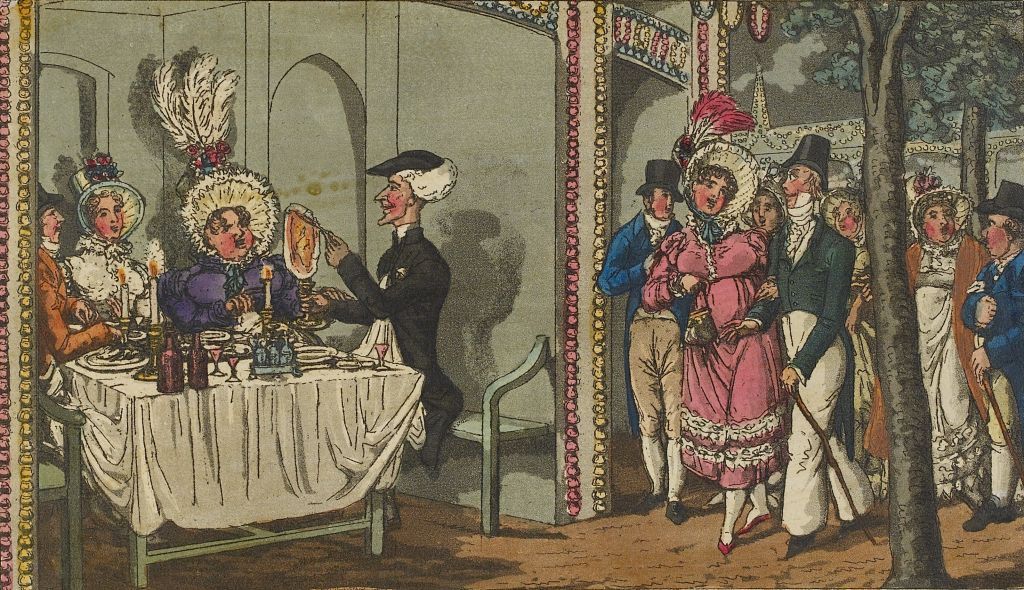
sonnet to vauxhall

Hood’s Sonnet to Vauxhall – illustrated by Rowlandson

Hood’s output was created at great cost to his health. In his early days he was a talented engraver working alongside artists such as Thomas Rowlandson (a man with whom he later often collaborated), but was compelled to abandon this profession and seek an outdoor life to recover his strength. It was a tough existence for by 1841 when Hood became an invalid he was only saved from financial ruin thanks to the intervention of Prime Minister Sir Robert Peel, who was a great fan of his works. When Hood eventually died his family were granted a state pension – and the public continued to adore him. A memorial was later built by public subscription in Kensal Green cemetery. As the century progressed Hood’s poetry and witticisms remained familiar enough to be often quoted in ordinary conversation. As late as 1903 William Rossetti (of Pre-Raphaelite brotherhood fame) described Hood as ‘the finest English poet between the generations of Shelley and Tennyson’. However, since these heady heights of appreciation Hood has quietly slipped into obscurity, and has long-since vanished from the modern-day English literature curriculum.

 lakehouse

Hood wrote Tylney Hall whilst living in Wanstead Park

Yet one bastion of recognition for Thomas Hood still remains intact, and it can be located in the environs of Epping Forest, and most particularly Wanstead. After his marriage in 1824 Hood lived in Islington but made frequent visits to the countryside beyond London,  especially to Epping Forest, and he formed a deep affinity with the area. I have already described how Hood encapsulated the rough and tumble tradition of the Epping Hunt (1829), recording for posterity the rituals of that annual cockney jamboree. He was also fully cognisant of the scandalous loss of Wanstead House, ironically benefitting from its destruction by renting the Lake House in Wanstead Park from ‘Wicked’ William Long-Wellesley.

wickedwilliam


Wicked William – Hood’s shady landlord (1832-35)

Hood’s arrival in Wanstead in 1832 coincided with Wicked William’s enforced exile – so it is unlikely that landlord and tenant spent much time together. Though he was always a feckless waster, William was notoriously generous and probably offered Hood terms well below the market rate. Perhaps Long-Wellesley’s vanity was sated by Hood’s eulogy to the Epping Hunt – because the men were already acquainted. This unlikely friendship endured, for it is recorded that William regularly visited Hood’s sickbed in 1837, when both men were living in Belgium.

eppinghunt-1

This scene from The Epping Hunt  shows Hood preferred whimsy to satire

Hood was active during a time of great social and technological change – as the long 18th century drew to a close and young Queen Victoria assumed the throne. From the outset of his career Hood purposefully rejected the brutality of late Georgian satire which sought to undermine its subject, preferring to adopt a kinder and more affectionate style. His whimsical humour presaged the rising sense of decency and respectability throughout society, foreshadowing the sentimentality and mawkishness which defined popular Victorian literature. Hood’s style is very like Thackeray’s early writing, light-hearted and amusing – never over-analytical.

Despite his comic reputation, Hood was capable of portraying the biting hardship of contemporary poverty. For example, Song of the Shirt (1843) highlighted appalling working conditions of the era – where Hood showed remarkable foresight in writing from a female perspective – describing a needleworker’s daily struggle for existence and the cruelty of her employer

song of the shirt

Despite being penned by a man, Song of the Shirt ought to be considered one of the most important proto-feminist works of literature ever written. It was based on a contemporary court case involving a woman who was forced to sell her employer’s equipment simply to put food upon the table – a decision that led to prosecution. The case is long forgotten but this poem became a standard-bearer for highlighting the effect of inequality upon humanity, inspiring a generation of mid-Victorian artists

bridge of sighs

Opening stanzas of Bridge of Sighs 

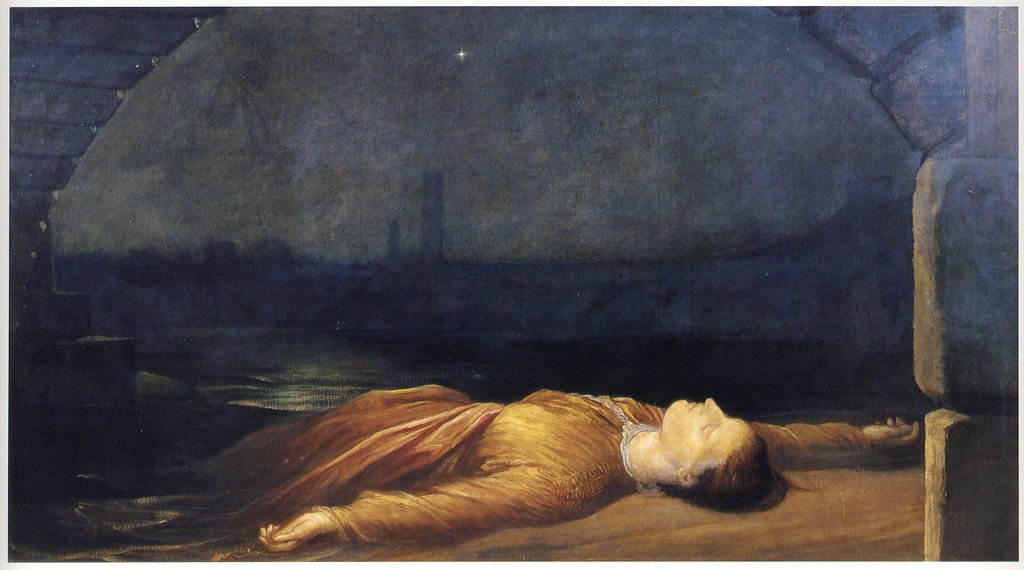
Another poem Bridge of Sighs (1844) again draws on real life by recounting the tale of a homeless young woman who committed suicide by throwing herself from Waterloo Bridge in London – At a time when suicide was frowned upon Hood declares that whatever sins she may have committed are cleansed by the sadness of her death

 found drowned

Hood’s poem inspired Found Drowned by Frederick Watts (1852)

Were it not for Hood’s own untimely demise he may have further developed his talent for social commentary. But in death as in life Hood has been unlucky, for the gentle observational humour of his earlier years has become his posthumous trademark.

grave

I will be turning to Hood’s only novel Tylney Hall in the second part of this blog. Written in 1834, whilst he was living in Wanstead, the title is a very thinly veiled reference to Long-Wellesley’s once great mansion, Wanstead House. But attempting to cash in on Wicked William’s story was an unwise move because it raised expectations that Tylney Hall would reveal the truth about Wanstead House, and satisfy public curiosity as to why it was demolished. – This led to criticism and affected sales, forcing Hood to add a note in the preface explaining that ‘Tylney Hall’ alluded to the topography of Wanstead Park, but not its disreputable owner.

wansteadcolour

Tylney Hall – not about Wanstead House

It is easy to see why a desperately poor artist with young mouths to feed would use any means possible to promote his work. But by choosing ‘Tylney Hall’ for a title Hood inadvertently and fatally undermined his novel – by unnecessarily calling into question the accuracy of its content.

Easter Monday 1817 by Henry Thomas Aitken

Tylney Hall does show Wanstead as it was to Thomas Hood

Because Hood’s works were always inspired by his own life experiences I believe that the world created in the pages of Tylney Hall should not be rejected, as we are offered a tantalising and surprising viewpoint of life in multicultural Wanstead 200 years ago. Additionally we find perhaps the first English novel to centrally feature strong and noble black characters, to whom we can sympathise and relate. The second part of this study will examine this more closely, proving that that Hood really was ahead of his time thus worthy of a new and more fitting appraisal.

Dr Sara Lodge has written a comprehensive critique of Thomas Hood in her book Thomas Hood and nineteenth-century poetry: Work, Play, and Politics (Manchester University Press, 2007)

To read more of Thomas Hood’s poems click here – or try a tasty selection of his best quotes

Gerald Massey has an excellent website devoted to Thomas Hood

You may also like to read about more Epping Hunt related buffoonery courtesy of Wicked William or to know about his short-lived military career.

3 Savile Row – Its role in British history


Within These Walls: 6 Layers of History

savilerow

No 3 Savile Row, Mayfair

Let me introduce you to a Grade II listed mansion house in London’s Mayfair that has recently been in the news due to an unsuccessful campaign to prevent its conversion into an Abercromby & Fitch childrenswear store. Knowing the history of this grand old building it is somewhat ironic to find that an American transformation has materialised. For the truth is that this building has some very interesting and important connections.  Since its construction in 1733 this house has been occupied by people who have helped shape the course of British military and cultural history. Let’s go inside…

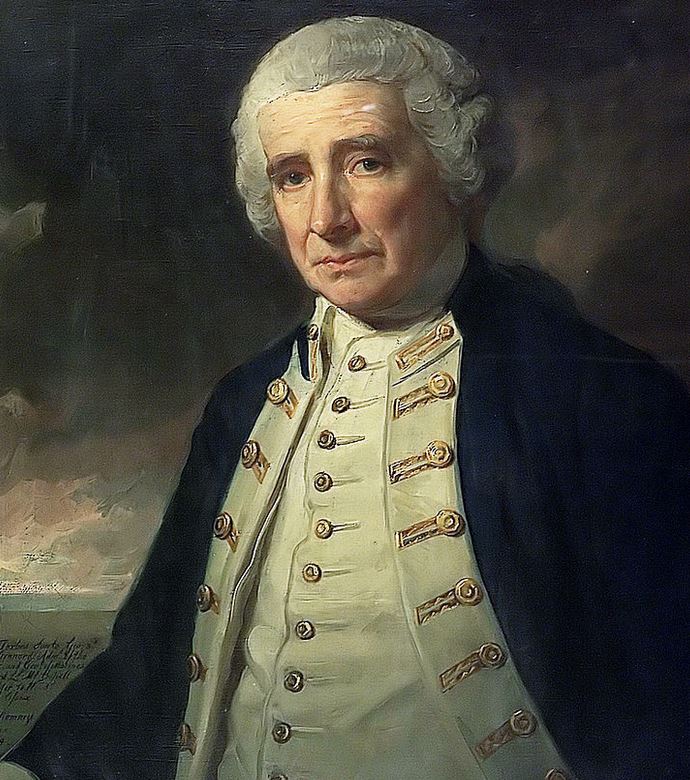
1. Admiral John Forbes (1714-1796)

forbes

John Forbes was Wellesley-Pole’s father in law

John Forbes began his naval career at the age of 13 and progressed up through the ranks until he became Admiral of the Fleet from 1781 until his death. This was an era when a great many servicemen returned from war incapacitated, and disability was not considered a barrier to high office. Even though Forbes was unable to walk and rarely seen in society he still managed to exercise overall control of the British Navy – and he did so by holding meeting as his house at 3 Savile Row, where he had lived from around 1760.

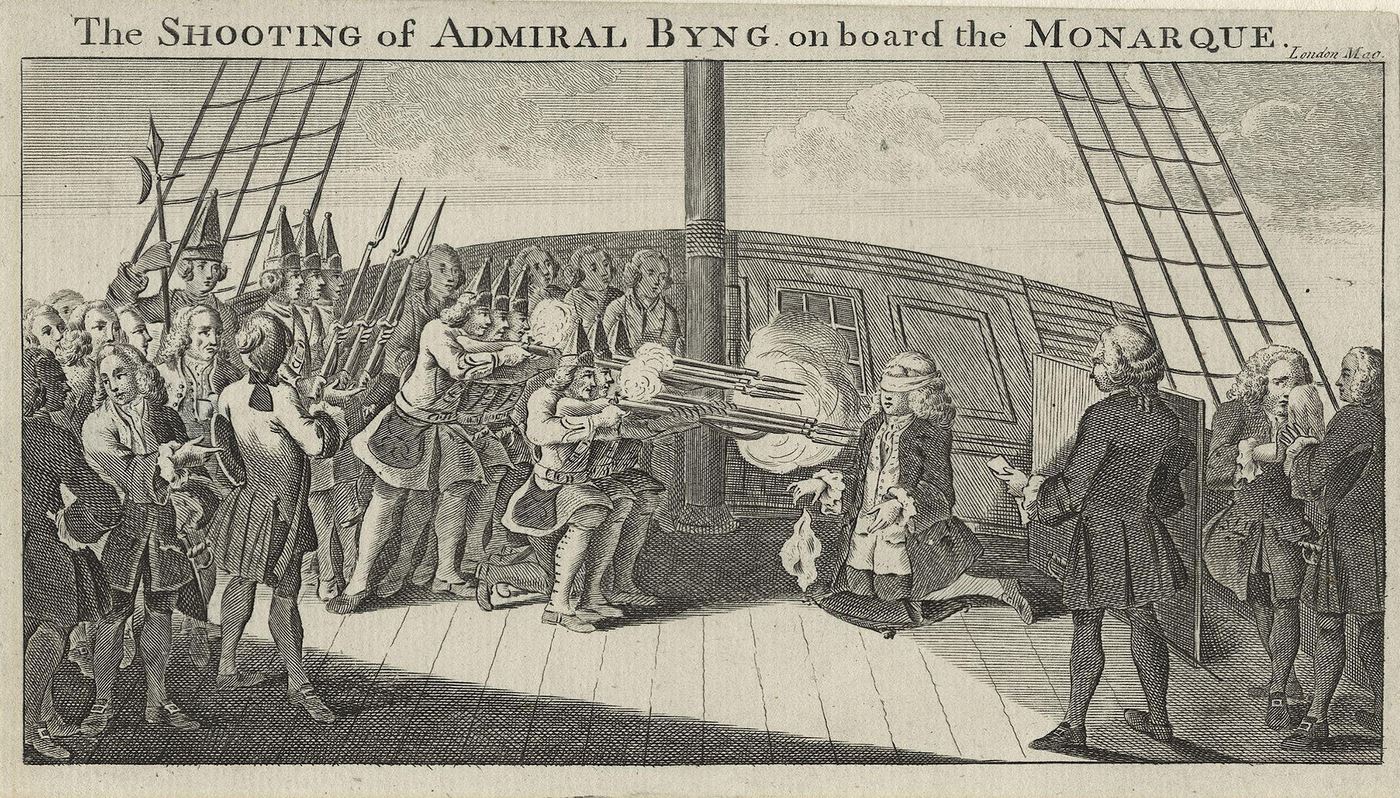
byng

Execution of Admiral Byng (1757)

Forbes most important contribution to British history came when he was involved in the trial of Admiral Byng, who was blamed for the loss of Minorca in 1756. He was tried and found guilty of failing to “do his utmost” to prevent the defeat. When Byng was sentenced to death an appeals for clemency was angrily refused by King George III. Forbes was the only Admiral to refuse to sign Byng’s death warrant though his action failed to prevent Byng’s execution by firing squad on 14 March 1757. Such was the effect upon the public mind that this was the last time a serving naval officer was executed on this charge. Forbes fearless refusal to bow to enormous pressure singled him out as a compassionate man of principle and made him a role model for fairer treatment of naval personnel.

In 1784 Forbes twin daughter Katherine married 3rd Lieutenant William Wellesley-Pole in a ceremony at 3 Savile Row with guests including Arthur Wellesley, later Duke of Wellington. Wellesley-Pole inherited the house in 1797 but decided to rent it out

2. General Robert Ross (1766-1814)

ross

Perhaps Wellesley-Pole’s most famous tenant was Robert Ross a famous British general who is best known across the water in the United States. Irish-born Ross lived at Savile Row until 1805 after returning from action at the Battle of Alexandria (1801). He was subsequently present at the Battle of Corruna (1809) before serving under Arthur Wellesley during the Peninsular War. Despite being seriously wounded at the Battle of Orthes on 27th February 1814, Ross agreed to lead command a British expeditionary force to attack the United States

washington burning

Hard to believe even today – Britain burning down the White House (1814)

Having routed the Americans at Bladensburg (27th August 1814) Ross advanced into Washington DC where he destroyed all the public buildings including the White House. For this act Ross is perhaps the best remembered of all British soldiers ever to set foot on American soil.

death of ross

The death of General Ross

It was not to end well for Ross as he was killed by American snipers near North Point on 12th September 1814. He is buried in the Old Burying Ground at Nova Scotia but has a monument inscribed to him in St Paul’s Cathedral.

3. The Duke of Wellington (1769-1852)

wellington

When Arthur Wellesley returned from 8-years service in India the first place he stayed was with the Wellesley-Pole family in Blackheath, for he was at that time unmarried and had no London home. However, he was to repeat the exercise in 1814 when he triumphantly returned from the Peninsular War following Napoleon’s surrender and exile. It’s very telling that the newly ennobled Duke of Wellington chose Savile Row rather than his own marital home. Imagine if you can the thousands of people who gathered outside, mounting a daily vigil to catch a glimpse of their conquering hero. Wellington remained at Savile Row for a month before returning to Paris.

4. William Wellesley-Pole (1763-1845)

wwp by pistrucci

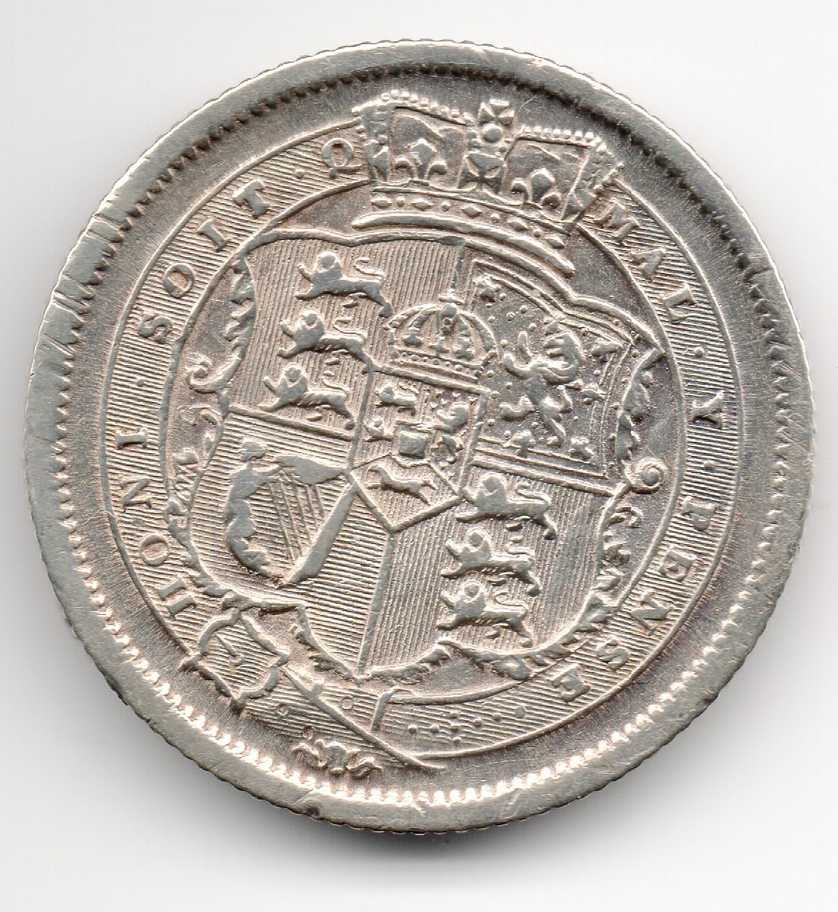
Wellesley-Pole owned 3 Savile Row between 1797 and 1842. In his role as Master of the Mint Wellesley-Pole presided over the introduction of new silver currency that was to remain in circulation from 1817 right through until decimalisation in 1971.

shilling

The humble shilling must surely be on of the greatest symbols of Britishness. Wellesley-Pole he also helped to create the instantly recognisable St George & Dragon motif designed by Benedetto Pistrucci which is still in use today.

double sovereign

5. The Bowler Hat (1849)

bowler hat

Quintessentially British – The bowler hat

Perhaps the greatest stereotypical representation of the English gentleman must be the wearing of a bowler hat. No 3 Savile Row can claim the distinction of being recognised as the place where the bowler hat originated. William and Thomas Bowler are credited with creating the first prototype for the bowler hat in 1850, but it is generally acknowledged that the hat was after a design by British soldier and politician Edward Coke, who was fed up with seeing his gamekeeper’s hats continually knocked off by low-hanging branches when out riding. When he was in Town, Coke lived at 3 Savile Row.

bowler2

Bowler hats have travelled up the social spectrum

Initially very popular with the Victorian working classes, the bowler hat went on to become standard uniform for middle-class businessmen, and by the 1960s it had elevated to the aristocratic realm.

6. The Beatles (1969)

beatles

On January 30th 1969 the Beatles played their last ever public performance on the roof of Apple Records HQ at No 3 Savile Row. Just a year earlier the Beatles paid £500,000 to purchase the mansion and they are said to have spent the best part of 18 months living there leading up to that famous rooftop escapade.

advert

Not surprisingly, to this day 3 Savile Row is still considered a tourist attraction for Beatles fans and there has been a steady clamour for a blue plaque to recognise their use of this building.

Conclusion

Whilst researching this post I came across a reference to Lady Hamilton, Admiral Nelson’s lover, stating that she too once lived at 3 Savile Row. But I have not included her in this blog as I can’t see where she would fit in this timeline, unless she rented the property before General Ross. However, I think there is sufficient here to demonstrate that we should hold Savile Row dear not just because of the Beatles, or to keep American tailoring out of this important British fashion location, but because of its connections to everything British: from the stiff upper lip (Forbes), to military escapades (Ross & Wellington), the British currency (Wellesley-Pole), Quintessentially British headwear (Bowler hat), not to mention The Beatles.

In fact No 3 Savile Row has given us a wealth of characters and symbols that mean a lot to our notion of Britishness.

Kier Holdings paid £20 million for the mansion in 2009 but its fate today remains undecided. Who knows what the future holds…

demo

If they knew their history, these chaps would be wearing bowler hats!

Links

A marvellous set of 1950s photographs showing some amazing interiors of No 3 Savile Row

For more info on General Ross I recommend War of 1812 website

The Daily Telegraph has written a splendid history of the bowler hat

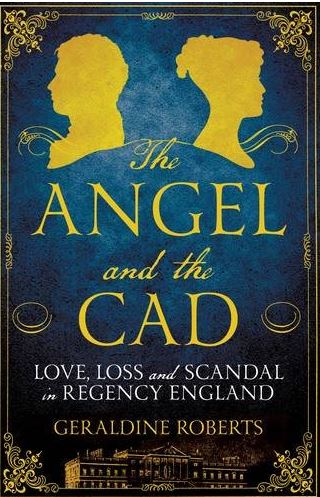
Until such time as Geraldine Roberts Angel and the Cad is published by MacMillan, my main focus on this blog will be Wicked William’s father Wellesley-Pole. There is much to write about Wicked William so stay tuned on that score!

However, you might like to know about Wicked William and the Epping Hunt, or why the Duke of Wellington considered him lamentably idle – alternatively you could always read about the death of a Regency Prizefighter

I hope you have enjoyed this post and would be most grateful for any feedback for any additional information you may be able to provide to fill in the gaps.

Photographs from my Year: 2014

I have never been particularly astute in the art of photography, so it is very pleasing that the advent of smart phones has provided me with ample opportunities to record various events and scenes I have enjoyed in 2014. I hope you wont think me too indulgent for sharing a few with you here

January - Draycot HouseJanuary 2014 – St James, Draycot burial place of Catherine Tylney-Long of Wanstead House renown
February - Laid UpFebruary 2014 – Laid up at home convalescing
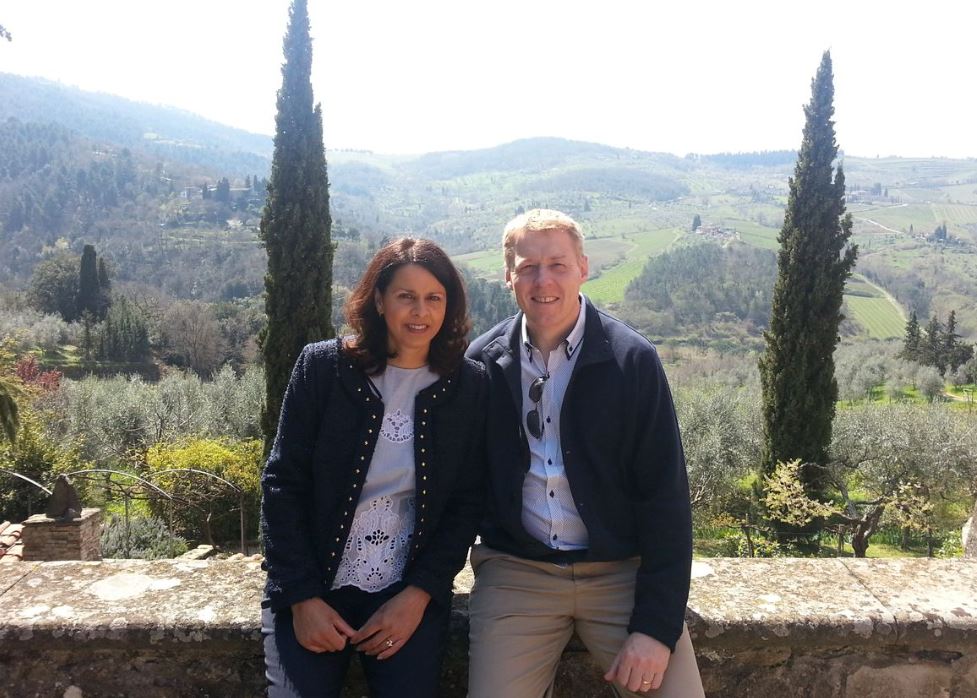
March -TuscanyMarch – On the trail of Wicked William in Tuscany, Italy

April-Kent

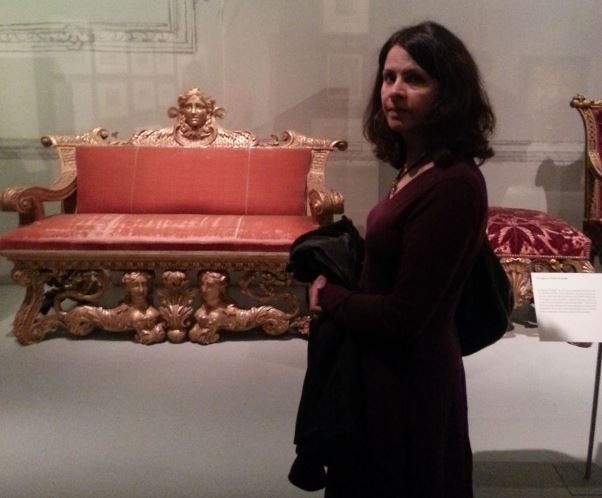
April – sneaky pic of Wanstead House chairs at William Kent Exhibition
May-bluebellsMay – Bluebell Wood at Wanstead Park


June-Kilcooley HouseJune- The very wonderful Kilcooley House in Tipperary, Ireland
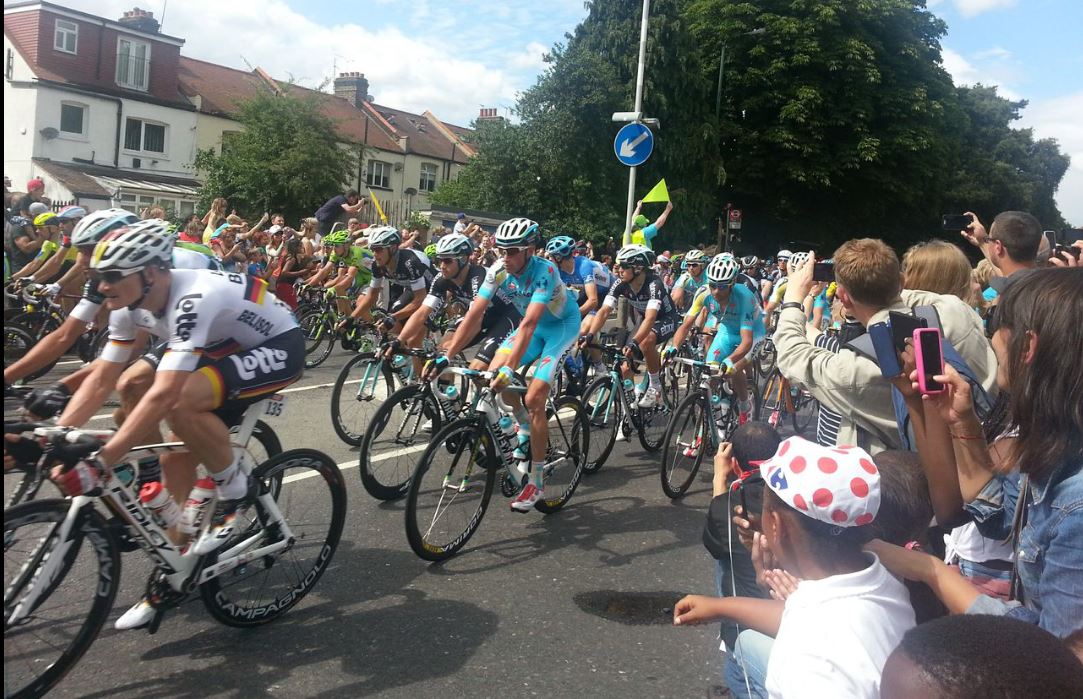
July-TourdefranceJuly – The Tour de France comes to South Woodford… for 28 seconds
August - SwansAugust – Swans in Wanstead Park
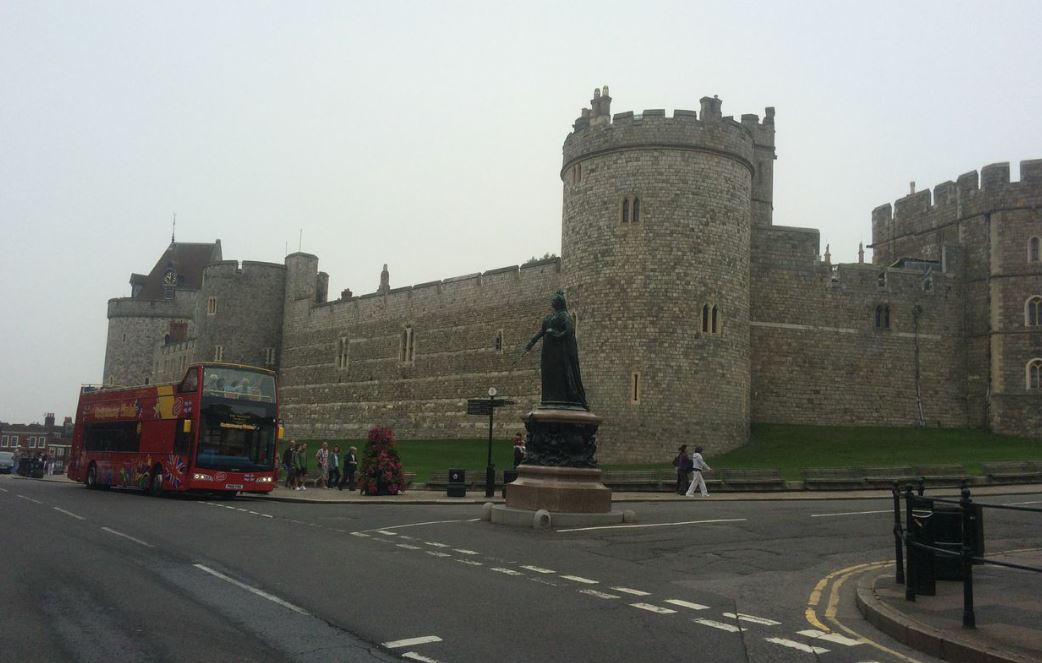
September - WindsorSeptember – A trip to Windsor Castle
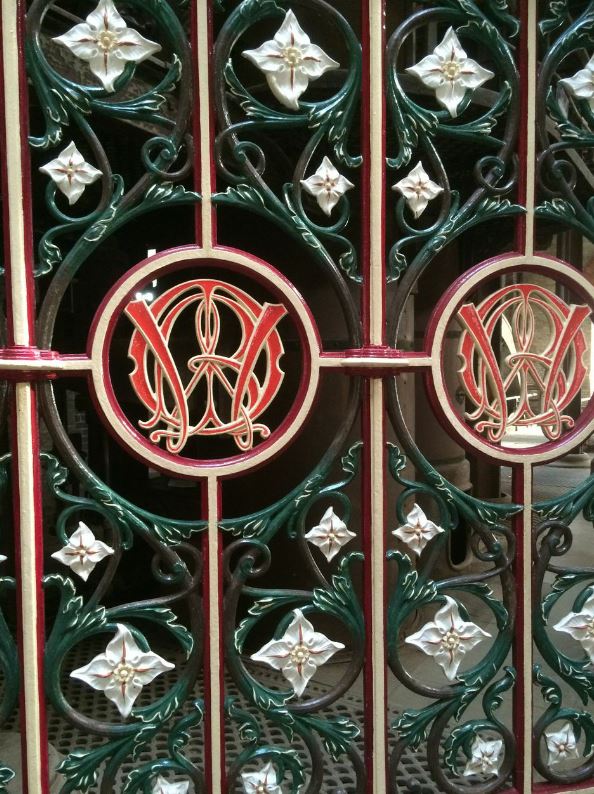
 October - Crossness Engine TrustOctober – Victorian wrought iron design – Crossness Pumping Station

 November - Poppies

 November – Well-intentioned but futile attempt to see the Tower of London poppies

December - Angel

December – MacMillan cover for Geraldine’s book on Wanstead House

Its been a great year and I hope you enjoy these pictures. Thanks for all the feedback and responses regarding my blog, it really has been a great source of encouragement and inspiration.

If you’ve got a year in pictures, why not share it too?


Three to See at the First Georgians Exhibition, Queens Gallery

first georgians

The beauty of going to any exhibition is the fact that each and every item being shown has the power to strike a chord, providing every visitor both a unique and a personal experience.

This fact can be no better demonstrated by going to ‘The First Georgians’ which is on at the Queen’s Gallery, Buckingham Palace until October 12th. Organised to mark the 300th anniversary of the accession of George I, Britain’s first constitutional monarch – this exhibition focusses on works of art collected by the royal family (at various times) dating from 1714 until the death of George II in 1760, what we might describe as the early Georgian era.

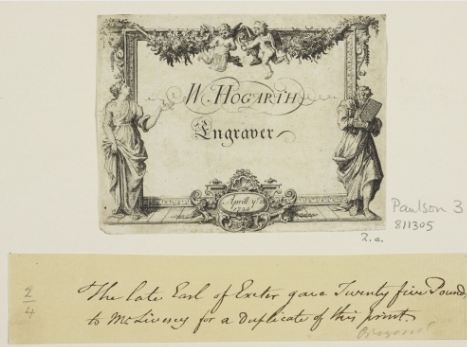
 hogarths card

Hogarth’s business card as an engraver – but he was so much more

Fans of William Hogarth (1697-1764) will not be disappointed. His series of six paintings A Harlot’s Progress (1732) & Marriage A La Mode (1743-45) can be seen side-by-side in a section dedicated to perhaps the first exponent of British satirical art.

Seeing Johannes Kip’s incredibly detailed London maps and Canaletto’s overly idyllic views of the Thames from Somerset House was a great pleasure, but for me there are three stand-out exhibits worthy of the admission price alone.

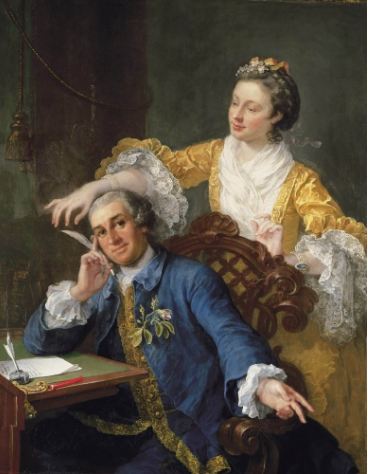
  1. David Garrick and his wife, Eva-Maria Veigel, by William Hogarth (c.1757)

garrick

I have always associated Hogarth with the representation of idleness and debauchery via engravings such as Gin Lane (1751) but here we find an almost seaside-postcard style of painting with truly vibrant colours and little nuances of humour encapsulating his subjects perfectly.

David Garrick (1717-79) was one of the most frequently painted subjects in eighteenth-century Britain. He befriended Hogarth after the artist painted Garrick as the King in William Shakespeare’s Richard III in 1745 (Liverpool, Walker Art Gallery). But it is thought that the pair fell out over this particular portrait. Garrick was displeased with his likeness and disliked the original domestic setting. Hogarth amended the scene by adding a hanging chord in the background reminiscent of the stage, but Garrick never collected the painting and it was still in Hogarth’s possession when he died in 1764.

What I especially like is the depiction of Veigel sneaking up behind her husband to snatch his pen away. This gives me a sense of the warmth of their relationship, with Garrick’s smile adding further to the playfulness of the scene.

This painting is hung in the main gallery well away from the other Hogarth exhibits, and for this I think it benefits greatly and the style in which it is painted makes it refreshingly timeless.

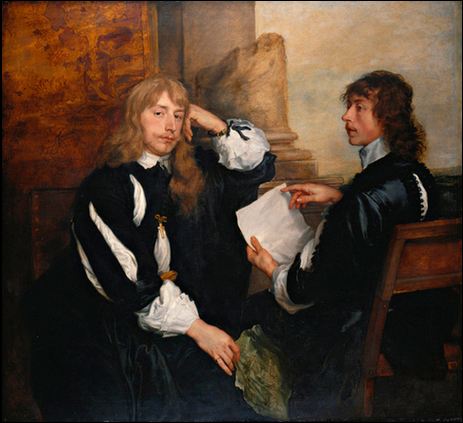
  1. Thomas Killigrew with an Unidentified Man, by Van Dyck (1638)

 killigrew

This painting really is mesmeric to see in the flesh. Painted by Sir Anthony van Dyck (1599-1641) it depicts two figures united by grief. On the left is Thomas Killigrew (1612-83), who is in mourning for his wife Cecelia Crofts, who died in 1638 just two years into the marriage. Killigrew wears his wife’s wedding ring attached to his left wrist by a black silk band. A silver cross inscribed with her intertwined initials is attached to his doublet and he wears a mourning ring next to his wedding band. In his hands is a piece of paper on which there are drawings, possibly made with a funerary monument in mind. Killigrew is being comforted by a friend, but is too distracted by grief to acknowledge what he is being shown.

Such is the incredible clarity of van Dyck’s brushwork that Killigrew really does come to life and his doleful eyes seem to draw you in from far away so you can come and pay your respects. Killigrew’s expression and his long hair would not look out of place on a 1960s hippie, but the sombre tone really does transmit his pain. There are some interesting theories about who the other gentleman may be, but I think the beauty of this painting renders knowing an irrelevance.

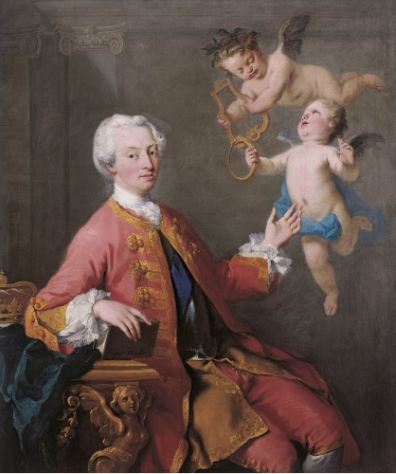
  1. Frederick, Prince of Wales, by Amigoni c.1736)

 frederick

This may seem like an odd choice for my top three, but I have selected it because one of the very knowledgeable curators at the Queen’s Gallery gave a very informative 10-minute talk about it during my visit. Unfortunately she had to compete with a completely ignorant guide who stood at the opposite end of the main gallery talking very loudly to a party of tourists. Given that the guide had ample other points of interest to show her enthusiastic troupe, it was incredibly bad manners for her to blather on whilst the curator bravely soldiered on.

Above all this painting has exposed my ignorance about the Georgian succession. Up until now I have been happily deluding myself that George III was the son of George II and followed him as naturally as princes follow kings. But the fact is that Frederick, Prince of Wales (1707-1751) was the man who ought to have succeeded George II, & whose death meant that it was a grandson who became George III in 1760.

Frederick seems to have had a very neglected childhood, having been left back in Hanover at the age of 7, and not seeing his parents for the next 14 years. Not surprisingly his relationship with George II was strained, and he spent his life trying to carve a separate identity. As Prince of Wales he fraternised with opposition politicians and became a patron of the arts. His knowledge and good taste led to the accumulation an outstanding cache of art, which now forms part of the Royal Collection.

Frederick was eventually banned from the King’s court in 1737 after he sneaked his heavily-pregnant wife out of Hampton Court Palace in the middle of the night, to ensure that the King and Queen could not be present at the birth. His poor spouse was forced to get into a carriage which raced over to St James’s Palace just in time for the birth. The King and Queen were furious at this perceived snub and never forgave Frederick for this act of independence.

This portrait by Amigoni was commissioned by the Prince’s friend, George Bubb Dodington (1691-1762), & given to Frederick as a peace-offering following a spat between them. As is appropriate for a friend’s portrait the Prince appears in an informal and affable guise, as patron of the arts. Frederick holds a book inscribed ‘Pope’s Homer’, alluding to Pope’s famous recently-published translations of The Iliad and The Odyssey. Cherubs fly above the Prince holding a lyre (the attribute of Poetry) and a snake biting its tail (the attribute of Eternity, the duration of a true poet’s fame).

Though his pose is relaxed, the Prince does have formal attributes: a crown on the table, and a riband of the Garter reminding us that this is not just any patron of the arts but a heroic and a royal one.

Frederick certainly seems a character worthy of greater investigation, not just for his contribution to the development of the arts, but also for his love of English culture. Whenever you next hear ‘Rule Britannia’ spare a thought for our lost King for it was Frederick, Prince of Wales whose patronage brought this song into creation.

Because I am really more of a Regency historian, I have shamelessly pillaged the Royal Collection website for background information on these great works of art. Any errors made are all mine though.

If you have been or are considering going to the First Georgians Exhibition I’d love to hear back regarding the works of art you found most compelling – As I have a free return voucher and it would be great to look from another perpective!!

Click Here for more info and facts on the First Georgians Exhibition:

The peerless Lucy Worsley has made a BBC4 TV show about the current exhibition

If you liked this you may like the following excellent Georgian era  Blogs:

Jacqueline Riding is a fountain of knowledge on Georgian art amongst other skills

Who could resist the legend that is Madame Gilflurt 

The British Society for Eighteenth Century Studies promotes all things Georgian

And finally, partly because Ireland is steeped in Georgian era culture, and partly because Frederick, Prince of Wales served as the tenth Chancellor of the University of Dublin (1728-51), I would recommend a visit to the Irish Georgian Society  – Me being Irish might have had a hand in this too.