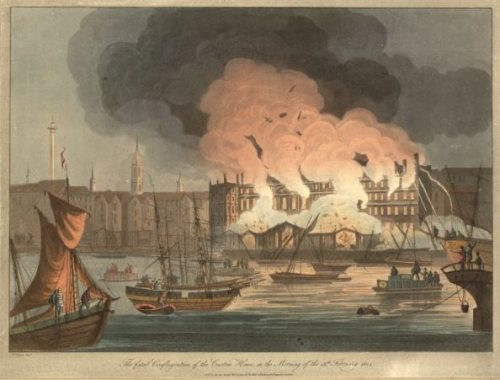
Not just 1666! – Fires were a regular occurrence in London
The Great Fire of London is a very important and well-remembered event in the timeline of London’s life story. Over a period of 4 days beginning 2nd September 1666 the fire destroyed most of the medieval City of London, sweeping away over 13000 houses, numerous wharves and businesses, and 87 churches – including St Paul’s CathedraI. This disaster has been widely recorded, not least by diarist Samuel Pepys. Its aftermath led to the reconstruction of early modern London, replacing narrow thoroughfares and wooden structures with wide streets and brick buildings – and brought us 51 new churches designed by Sir Christopher Wren. ‘Great Fire’ certainly befits this calamity; but it should not mask the fact that London (like many other early modern cities) always lived under the constant spectre of fire, and that buildings and places of importance were lost to fire on a fairly regular basis. Hence it is useful to look beyond the Great Fire of 1666, and at other fires in order to fully appreciate the extent to which blazes were a very real and life-changing disaster for the people affected. The best place to start, therefore, is to find another great fire of London- so we head east of the City to Ratcliff.

Ratcliff Cross (1791)
This blog examines the Ratcliff Fire, said to be the biggest conflagration that London saw between 1666 and the Blitz in 1940. This fire seems to have escaped attention perhaps because its victims were poor (who were irrelevant) or tradesmen (who were probably insured), but hopefully because its aftermath was dealt with so quickly and humanely. Ratcliff(e) in earlier times was also known as “sailor town”, was originally known for shipbuilding but from the 1300s more for fitting and provisioning ships. By the end of the 1700s Ratcliff was a village-cum-shanty-town on the Thames situated between Shadwell and Limehouse, due south of Stepney village, still offering various maritime services, but now also containing warehousing and storage for a variety of imported goods, from which manufacturing industries nearby relied. Ratcliff tended to specialise in docking of combustible cargoes considered too risky to be bulk-handled in the City, and this ultimately proved to be its downfall. Here are some contemporary reports of the fire:
On Wednesday afternoon at 3 o’clock on July 23rd 1794 the hamlet of Ratcliff suffered a dreadful fire. It began at Mr Clove’s, a barge-builder at Cock Hill, and was occasioned by the boiling over of a pitch kettle that flood under his warehouse, which was consumed within a very short time. It also set light to a barge (it being low water) lying close to the premises, laden with saltpetre – which subsequently spectacularly exploded. The blowing-up of the saltpetre occasioned large flakes of flame to rain down upon riverside buildings – one of which belonged to the East India Company, from which a store of saltpetre was in the process of removing to the Tower of London – 20 tons of which had been fortunately removed the preceding day. Consequently the fire wrought carnage both on land and river – and very soon all the houses on either side of Brook Street were destroyed as far as Ratcliff Cross, as well as several alleyways – and several large ships, including the East Indiaman Hannah, which was about to depart for Barbados, and other smaller boats were utterly burnt out. The fire found new fuel at Ratcliffe Cross when it over-ran a sugar-house. This new ignition point meant that the adjacent glassworks and a lighter-builders yard were lost.
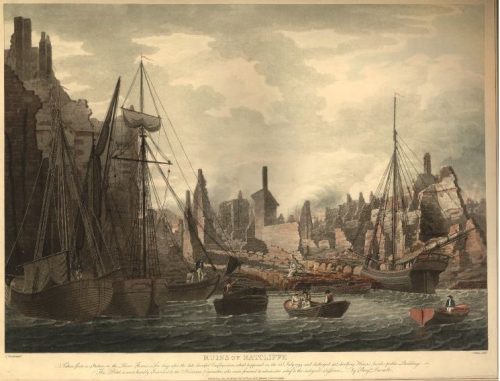
Ratcliff Fire damage – as seen from the Thames
The blaze continued until the following morning and its progress was helped mainly by the narrowness of the streets, which prevented fire engines being of any practical service. The wind blowing strong from the south fanned the flames onwards: it reached the premises of Joseph Hanks, a timber merchants, in London Street and extended on into Butcher Row – the whole of the west, and part of the east side of which was consumed. At Stepney Causeway the fire caught the premises of Mr Shakespeare, a rope-maker, and burnt through to the fields at the other side before dying down. It was only the boundaries of urban development that prevented further progress of the inferno. Almost no property in the vicinity was spared loss or damage, though it was singularly odd that the dwelling house of Mr Bere – a very extensive building – was surrounded by fire but emerged entirely unscathed.
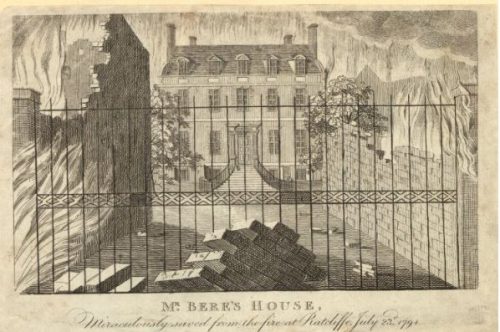
Scene showing Mr Bere’s house escaping the inferno
It was reported that Mr Clove broke an arm fighting the initial fire, and one of his servants was sent to London Hospital with terrible burns. A survey carried out after the fire showed that only 570 out of 1200 buildings survived – and that most of those lost served as housing for the poor. The Government reacted by erecting 120 tents in Stepney Fields to accommodate the poor – hardly a generous deed given that 1000+ people were made homeless. The loss to tradesmen was equally bad – for example Mr Whiting, who owned the sugar-house, lost £40,000 worth of stock. There is no record of any loss of life resulting from the fire, but Lloyd’s Evening Post does seem to imply death amongst the poor without enumerating the extent.
The distress of the miserable inhabitants exceeded all description. In the surrounding fields were deposited a few goods, consisting chiefly of bedding, they were able to save. Stepney Church was opened for their reception, and above a thousand people were obliged to remain all night in the fields, watching the remnants of their property. Children crying for their lost parents, and parents lamenting the fate of their children, added to the horrors of a scene not equalled during the present century
Before any financial assistance arrived in the Ratcliff area, a very different kind of flood inundated the scene. This was in the form of thousands of spectators arriving from the City to view the extensive ruins. It was reported that a great many carriages deposited men and women decanting on foot for a closer look at the scene, including a tour of the rows of tents erected for the poor. But these were not mere gawping onlookers, because evidence reveals their prime motivation was charitable feeling towards to the distressed families they came to see. Within a week the True Briton was able to report that charitable subscription from all quarters had already exceeded £4000 – a figure that rose to £15000 within a few weeks. Business was also quick to resume in the area. By November 1794 the Whitehall Post announced that the East India Company had commenced rebuilding its saltpetre works at Ratcliff, engaging 200 men in the process
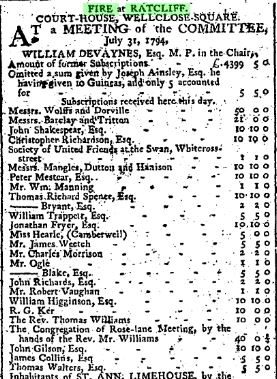
The public responded quickly for victims of the fire
Historic UK has a detailed report and more images of the Ratcliff Fire together with the pleasing news that the Corporation of London, Lloyds and the East India Company also contributed almost £2,000 to the relief of the homeless.
This is one of a series of posts I will be doing in 2017 based upon the Crace Collection at the British Museum – all images used here come from that source.You may wish to know more about Frederick Crace or Thomas Hosmer Shepherd (one of his principle contributors).
For other London related posts, you might be interested in the death of a Regency Prizefighter, or see how multicultural Regency London may have been via this post on Thomas Hood . Finally, for a wider look at Regency era sketches why not join Anne Rushout on tour.
On ancestry an ancestor of mine named Anne Lucas lived in Ratcliff, London and she did in 1666 I understand there is no record of any loss of life but I wanted to ask is anyone knew anyway I could try and find out? I inferred the fire was her cause of death, she would have been 63, she may have died of natural causes but I would like to know for defenite.
Hello Leah
Ratcliff was a fair bit east of the area affected by the Great Fire of London in 1666 so it is not very likely that Anne was a victim of that blaze. However, London was ravaged by bubonic plague that year and many thousands died, especially those living in squalid slum areas such as Ratcliff. So Anne might have been killed by the plague.
But you must consider that 63 years of age was a very long lifespan for the 17th century and that Anne most likely died of natural causes.
Good luck with your further research
This is the best report of the Great Fire of Ratcliff that I have read. I am researching the Crew Family who were shipping butchers provisioning ships at Ratcliff in the 1790’s. They lived on Butcher Row – just steps away from the shipping wharf on the Thames. Thanks to your blog, I now know that they would have lost everything in the fire. They resumed business just as your report says. William Crew’s address later became Phoenix Square at Ratcliff – I assume it was so named as it rose from the ashes – I don’t think it existed before the fire.
Thank you again for your report. I have referenced it on the profile page William Leech Crew (1762 to 1820) on ancestry.co.uk.
Helo Shiela
How fascinating that you have been able to use my blog to add to your own family research. I think you are right about the Phoenix name in regard to redeveloment following the blaze
Regards
Greg Roberts
Thank you for your interesting article. My ancestor was the mariner Thomas Coates [Coats], son of Capt. William Coates [Coats], who was employed by the Hudson Bay. Thomas inherited a house in Narrow Street, Ratcliffe in 1751; one of two houses in possession of Capt. William Coates [Coats] at the time of his death in 1751 in Limehouse. He owned a further property in Stockton-on-Tees, Durham, the home town of his mother and origin of the Limehouse Coates family.
I have been unable to find a death record of Thomas or his wife Mary Godby and now that I have found out, about the Ratcliffe Fire, I wonder, if Narrow Street and the residents were affected by the fire and this may be the reason, Thomas and his wife seemed to have disapeared without leaving any trace behind. Anne Coates, Thomas’ daughter got married in St. Anne’s Limehouse in 1795, so at least one member of the family remained in the area …
Do you know, by any chance, if houses on Narrow Street were destroyed. And also, do you know, if there are any documents around that would contain names of the people affected by the fire.
Hello Barbara
According to contemporary records there were very few fatalities during the Ratcliff Fire. But life was cheap then so I expect some of the victims were quietly forgotten
The best place to discover more about the area around Narrow Street may be the London Metropolitan Archives. They may have maps and plans, and even possibly rates books for the area in which you are concerned.
Perhaps your relative will be located there.
In the decades after the Radcliffe Fire a lot of sluums were cleared and new areas such as St Katharine’s Dock (1828) replaced them. Countless people were made homeless and forced to move on by the first wavbe of East End gentrification.
All the best
Greg Roberts