Tally Ho! – A Brief History of the The Epping Hunt Part 3 – The Cockney Hunt

Introduction | Origins | The ‘Cockney Hunt’ | Wicked William’s Hunt | A Fond Farewell

Cockneys in Essex? Well I never!

1741 - cockneys ridiculing countryfolk

Rivalry between town and country folk is a long-established tradition


The origins of ‘cockney’ can be traced back as far as C14, when it had a middle-English meaning of ‘cocks-egg’. It was not until around 1600, when Samuel Rowland coined the phrase ‘Bowe-bell Cockney,’ that the word adopted specific geographical connotations. However, long before this time ‘cockney’ had already been adopted by country people as a derogatory reference to London-dwellers, whom they considered bereft of the manly attributes of horsemanship, hunting and civility. By the 1700s, as London rapidly increased in size and population, divisions between town and country folk widened. The above print from 1741 shows that Londoners (or cockneys) considered country folk to be slow, badly dressed, and backward. This particular yokel is waiting for ‘Mr Stuart’ to get off his horse before addressing him, unaware he is referring to a well-known statue. Rustic gullibility and simple-mindedness was a common theme throughout the Georgian era, used by satirists such as Hogarth and Rowlandson and perpetuated by urban domination of the press.

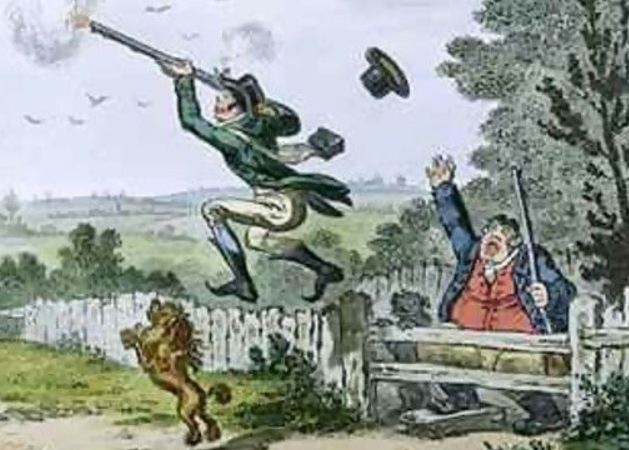
What a godsend it must have been therefore when the Epping Hunt began to attract large numbers of Londoners, providing a much-needed opportunity to redress the balance between town and country lifestyles. Notwithstanding its association with Bow bells, as the century wore on the phrase ‘cockney’ increasingly became linked with ‘townies’ attempting to partake in country pastimes. This is demonstrated by searching print media after the 1750s, & especially satirical prints, where there are numerous instances of clownish ‘cockney’ sportsmen. The Epping Hunt was perhaps the most high-profile event at which ‘cockney’ behaviour was lampooned.
cockney sportsman

Rowlandson portrayed the perceived stupidity of Cockneys in rural settings

As stated in part 2 the Epping Hunt reached its apogee in terms of ceremonial importance in 1749.  As late as 1753 the London Daily Advertiser recorded that the Lord Mayor ‘set out at 5am from Mansion House for Chigwell Row’ to attend the Epping Hunt, but thereafter London’s dignitaries increasingly shied away. Also when the Lord Warden of Epping Forest, (Lord Tylney of Wanstead House), went abroad to Italy, the Hunt lost its chief patron and became less of an attraction for London’s elite. Given that the Epping Hunt was by tradition a ‘Common Hunt’ it began to fall upon ordinary Londoners to fill the void. In order to do this they relied on the assistance of Essex landowners and tradesmen who were loath to see this lucrative tradition die out.

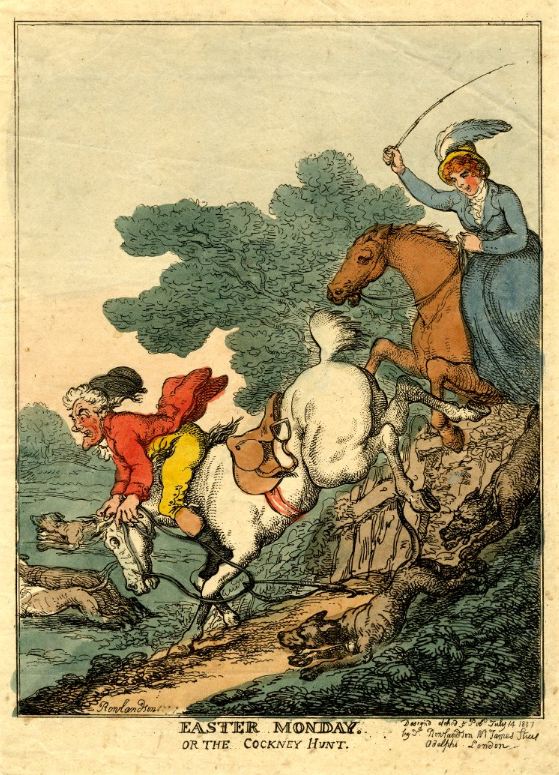
Just off The Highway in Wapping (or Ratcliffe’s Highway as it was once known) is a small lane adjacent to Tobacco Dock named ‘Chicwell Street’.This is named so  according to legend, because it was the the site from where cockney sportsmen annually congregated on early on Easter Monday to make their pilgrimage to Chigwell in Essex. Located close to East India House and the heart of mercantile London, this became a more proletarian departure point for the Epping Hunt when the Lord Mayor lost interest in attending. By the 1770s organisation of the Epping Hunt fell upon William Mellish, MP for Essex, ably assisted by his brother Joseph, who was responsible for providing the pack of hounds on the day. They had an inauspicious start in 1774 when two horses died in a direct collision, though their riders escaped unscathed. The following year in a bid to attract back the fairer sex and lessen the perception of a cockney monopoly, the event was promoted as a ‘Lady’s Hunt’. This backfired because a young gentleman was thrown from his horse and killed on the spot prior to the stag being turned out. Then the stag headed down Bucket’s Hill towards Smitham Bottom ‘to the great disappointment of the cocknies who wanted him driven towards London’- thus no sport was had that day.
Rowlandsons Cockney Hunt 1811

In an attempt to upgrade its image Epping became a ‘Lady’s Hunt’

However the attempted feminisation of the Epping Hunt continued right up to 1800. In 1785 The London Chronicler reported

Soon as gloomy night had withdrawn her veil from the smiling face of morn, the keen sportsman quitted his warm bed, and was mounted on his high-mettled steed before the sun spread his beams into the neighbouring vale: not a horse was to be seen East of Temple-bar, whose head was not turned towards Epping, not a citizen, who could procure a palfrey for love or money, who was not mounted and posting away to the Ladies Hunt. It is well for those who live on the road, that this important day comes but once a year, as it would be impossible for them to exist, were they to be frequent spectators of such a grotesque assemblage. [Huge numbers] arrived at the spot from whence the poor stag was to be liberated, however, there were many mishaps between that and town… The place was very much crowded with post-chaises and glass-coaches for the day, filled with sober cits and their loving dames; and notwithstanding the accidents which happened, the attendants of the chase were very numerous, both male and female, all, seemingly determined to be in at the death, but so elate they were with the idea of distancing their neighbour, they forgot they were to manage their horses, and so became distanced themselves. The stag had been turned out but a few moments before the plain was covered with the riders, ladies rolling over the beaux, and the beaux over ladies, and the horses left at full liberty.

The above-described hunt ended tragically for a Mr Humphries, a taylor from Tower Hill, who broke his neck when riding under a tree.

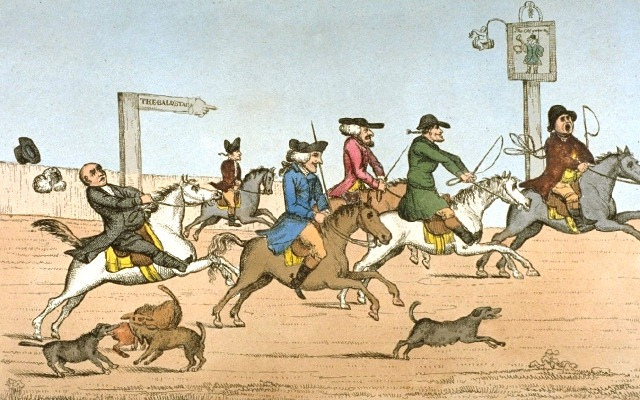
By 1788 Epping Hunt was openly described as ‘The Cocknies Hunt’ and its participants included ‘mercers, taylors, barbers, bakers and even bruisers – for Mendoza (a famous wrestler) and several of his tribe were there.’ The Literary Chronicle published the following insight into the excitement roused in London by the Epping Hunt

For weeks before Easter in every year, all the riding schools are filled with cockney Nimrods; every nag is employed on the Sundays; the visits to Hyde Park, in order to see the deer, and thus be able to identify the Epping stag, when they catch a glimpse of him, become frequent; and nothing is read at the London Institution but Daniel’s ‘Rural Sports’ or Beckford on ‘Hunting’… When the important day arrives early in the morning all the livery stables were so cleared… and every kind of vehicle was in requisition. There were horses of all colours and sizes… not were their riders less various, they included all orders and degrees of men; some went to share in the diversion of the hunting, others to laugh at the hunters. A friend from Epping invited me down and [when] the stag was let out, within five minutes I could have had my choice of fifty horses, who have just thrown their riders… while the forest was strewn with hats, and various contents from the pockets of hunters.
easterhunt1807

By 1795 the Epping Hunt was almost universally derided as a parody of what an organised hunt should be. Despite this condemnation The Times reported ‘tens of thousands of spectators and participants from the metropolis.’ Yet just when it seemed that nothing could diminish public enchantment with the Hunt, a piece of lawlessness jeopardised its future. Early in 1798 hunt-organiser Joseph Mellish was killed by highwaymen on the road near Woodford, thus with no pack of hounds available (and possibly as a mark of respect) the hunt was cancelled. Then two years of extremely wet weather led to a Hunt washout, meaning that a hiatus unwittingly set in during which cockney hegemony was wrested by the resumption of interest from Wanstead House.

In 1802 Wanstead House was leased to the Duc de Conde, who was a member of the exiled French Royal Family. In tribute to these French guests, 1802’s Epping Hunt was switched to the Bush at Wanstead, and over the next 3 years held at the Bald Faced Stag in Bucket’s Hill. For security reasons ‘cockney’ participation very much curtailed. When the City of London abolished the Common Hunt in 1807 it was thought that the Epping Hunt would end. But the ordinary citizens of London were not quite ready to give up this tradition, and attempted to keep it alive. Tommy Rounding, a publican from the Horse and Wells in Woodford was nominated to provide stag, venue and hounds for all-comers once more. But he could not emulate the golden years and by 1810 the Morning Post reported an event lying on its deathbed

To drive the deer with hound and horn, The Cocknies took their way

Yesterday, previous to the buck being enlarged, there was an immense concourse of sportsmen appeared on the ground, the majority of whom were mounted on animals not capable of keeping up with a lame goat. Then buck’s horns were adorned with ribands; and as the scent did not lie in consequence of the warm and dry weather, the hounds were once or twice at fault, to the great delight of the lazy hunters and bad horsemen. The hounds did not run a mile before several of the Cockney sportsmen were thrown out, while they were mortified by the gibes and jeers of those who followed on foot. Such a scrambling up hedges, and falling into ditches, was never before witnessed, and the old buck soon gave the hounds and the hunters the go by. There were some of the company exceedingly well mounted and well understood the chase: but, on the whole, the equestrian display was highly ludicrous and laughable.
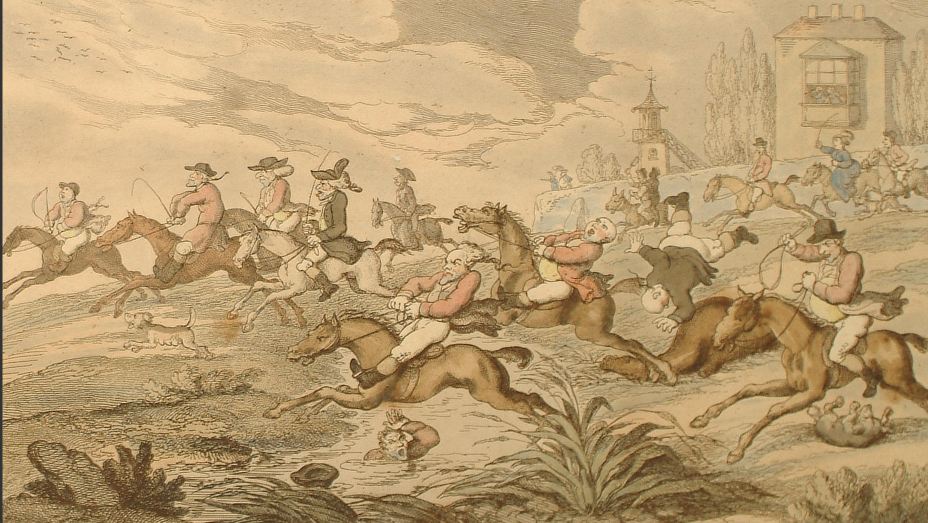
Rowlandsons the city hunt 1810

Rowlandson’s The City Hunt – 1810


Given the farcical level at which the Epping Hunt languished, and its association with lower-class ‘cockney’ yobs, it would have taken a complete fool to consider reviving it as a high-calibre event. Step forward ‘Wicked William’ Long-Wellesley….


Tally Ho! A Brief History of the Epping Hunt – Part 1 Introduction

Introduction | Origins | The ‘Cockney Hunt’ | Wicked William’s Hunt | A Fond Farewell

Introduction to the Epping Hunt

Believe it or not, there was a time when country-folk from Buckhurst Hill, Loughton and Woodford found themselves inundated with Cockneys, but it was only for one day annually. That day was Easter Monday and the occasion was the Epping Hunt. It is more than a little ironic that an area nowadays considered the epicentre of ‘cockneyism’ (thanks to TV shows like TOWIE) should have once gaped and sniggered at the ‘Oh Gaw Blimey’ accents and godawful clothing worn by these town-dwelling visitors, who were exercising an ancient right granted to the City of London – allowing ordinary citizens one day’s hunting in Epping Forest.

eppinghunt wolstenhome

The Essex Hunt, near Epping by Dean Wolstenhome (1757-1837)

Throughout the 1700s Easter Monday provided ordinary Londoners with three options for holiday entertainment. Firstly there was a fair at Greenwich Hill where there were organised picnics where excellent ginger bread and other delightful treats on offer, and you could enter the prestigious ‘rolling down the hill’ competition and win a prize. This tame sounding pastime was undoubtedly a rough and tumble affair taken seriously by the competitors. For those hedging their bets against inclement weather, a second option was Sadlers Wells, which offered performances of new musicals and pantomimes throughout the day[i].

But for sportsmen and spectators alike, there was nothing to beat the Epping Hunt, whose rituals embraced the entire community from the heart of London’s metropolis into the Essex countryside. First established during the reign of Henry III in 1226, the Epping Hunt was more than just a chase. It began with an early morning breakfast near the Tower of London, followed by a 10-mile procession from London, through Mile End, Stratford and Wanstead. Along the way new participants swelled its ranks until they all arrived at either the Roebuck or Bald Faced Stag Inns in Buckets Hill (nowadays Buckhurst Hill), where the stag was traditionally turned out. The finest carriages from London and the surrounding area occupied prime positions on the hill, attended upon by a myriad of food and drink vendors. Whilst the men saddled up and joined the hunt, the ladies had ample opportunity to display their fashionable attire –  enjoying music, promenading and engaging in gossip.

At a typical Epping Hunt thousands of ordinary folk lined the streets to catch a glimpse of the noble elite, or manned stalls selling a variety of produce to the visiting hordes. This undoubtedly proved a massive boost to the local economy proving that it really was an occasion to remember.

Over these next four blogs I will examine the history and traditions of the Epping Hunt and add links between each blogs as and when they are posted:

  1. Origins and Establishment of Tradition (1226-1750) – Here I will look at how Epping Hunt was established as an aristocratic event under the patronage of the Lord Mayor of London, alongside the Lord Warden of Epping Forest.


  1. Gor‘ Blimey Mate!! (1750-1810) – By 1787 Epping Hunt was generally regarded as the ‘Cockney Hunt’ because its participants were increasingly drawn from London’s merchant classes. In this period there was the tremendous comedy value of watching a collection of badly-dressed city-folk chase about the forest in the fruitless pursuit of their goal. Not surprisingly the Epping Hunt became an object of public ridicule and by 1810 the consensus was that it would soon die a natural death – a relic of a bygone age.


  1. Wicked William’s Hunt (1813) – In 1813 William Long-Wellesley of Wanstead House hosted an extremely extravagant event, reckoned to be the most lavish ever –  in an incredible attempt to restore tradition and quality to the Epping Hunt. I will look at the day in question plus the ramifications it had for the future of Wanstead House.


  1. A Fond Farewell (1820-1850s) – More than any one person Thomas Hood is responsible for restoring the Epping Hunt in a positive way for future generations to recall. His eponymous poem (1828) served as a gentle reminder of the mirth and pleasure to be had on such an occasion, whilst at the same time acknowledging its inevitable demise.


eppinghunt-4

One of Rowlandson’s plates from Thomas Hood’s The Epping Hunt poem (1828)


The Epping Hunt might be best remembered by this quote taken from Hunting in the Olden Days by William Scarth Dixon, which was published in 1912:

It was one of the ironies of Fate that the Epping Hunt should be chiefly remembered [in caricature]…For the Epping Hunt was the common hunt of the City of London, and as such its rights were jealously guarded. It was the most important of those city hunts of which we have had so many in England…. So though the Epping Hunt outlived its usefulness… let us look kindly on those good city sportsmen of a bygone age. Let us remember that they helped to foster the general love and admiration of sport without which, I make bold to say, hunting would have been seriously curtailed in our day, if not abolished altogether.


[i] Perhaps the most enduringly popular Easter Monday performance at Sadlers Wells was in fact entitled The Epping Hunt – which was put on by popular demand for a great many years. So, whether you went in person or witnessed a hilarious reproduction at Sadlers Wells, the Epping Hunt was a pivotal component in the Easter calendar for Londoners.


Wicked William – The Last Word

“This is not an epitaph”

wickedwilliam


‘Wicked’ William Long-Wellesley (1788-1857) was one of the best-known characters of the Regency period. His rollercoaster life played out like a primordial soap opera through a multitude of satirical images, newspaper reports, books, pamphlets, and journals. His antics were commented upon throughout the world. When he was at his most arrogant, the mob cornered him in the street baying for blood. Yet when he was beaten down they rallied to his defence. Eventually debts and a failed political career forced him into exile. He remained in the news but the public tired of him. He had come to epitomise the worst excesses of a corrupt and unloved era, whose values were an anathema to early Victorian society. From the 1840s Long-Wellesley was consciously marginalised, his removal from contemporary memoirs the equivalent of a literary ‘social cut’.

My blog will show that Long-Wellesley directly contributed to his own notoriety in his pursuit of celebrity. For three decades he adeptly harnessed the power of the press to his own advantage, feeding newspapers tantalising details that kept the public enthralled.

But, as we all know, public opinion and press sympathy can easily change. Therefore with no little irony these last words about ‘Wicked William’ appeared in the Morning Chronicle the day after his death (4th July 1857):

The mockery of heraldry was never more displayed than in the case of this most unworthy representative of the honour of the elder house of Wellesley. A spendthrift, a profligate, and gambler in his youth, he became a debauchee in his manhood [and] his children, whose early tastes and morals he wickedly endeavoured to corrupt, from a malicious desire to add to the agonies of their desolate and broken-hearted mother. Redeemed by no single virtue – adorned by no single grace – his life has gone out, without even a flicker of repentance – his “retirement” was that of one who was deservedly avoided by all men. We have no wish, further, to illustrate such a theme by writing what should be his epitaph.

Luckily for me, so many outrageous events from the scandalous life and times of ‘Wicked William’ were recorded for posterity, that I will have ample opportunity of detailing them over time via this forum.

“She may be a vagrant, but she’s MY VAGRANT..”

       Gentleman & The Tramp

Tramp                          maryborough

For centuries London was filled with a plethora of poor, invalid or destitute people living day-by-day, scraping an existence by any means possible.  But then a middle-class inspired march to morality (which found its origins in the 1790s) sought to clear the poor from the streets and out of plain sight. The instrument for this purge was the Vagrancy Act (1824) whereby it became an offence throughout England and Wales to sleep rough or beg. Critics including William Wilberforce denounced the rigidity of the Act because it made no allowance for circumstances as to why someone might be on the streets, leaving magistrates with no power of discretion – no matter how unjust their rulings became.

One such case involving Lord Maryborough occurred in 1826. Lord Maryborough (or William Wellesley-Pole, 1760-1845), was a man often berated for being ‘angry at all times… advancing in age without improving in reputation’. Being the father of notorious rake ‘Wicked Willam’ Long-Wellesley can’t have helped, but the fact is that Maryborough garnered negative sentiments throughout his life and since, as he is still considered a ‘nonentity’ by modern historians. However, this blog will over time provide sufficient examples of Maryborough’s achievements, loyalty and personal integrity to counter such unbalanced views. This case in particular shows that Maryborough was far from being a reactionary old Tory, and that his ethos was always one of Christian charity, even if he did think everyone belonged in their rightful place in the social hierarchy.

On 17th August 1826 a poor blind woman named Ellen Goodall was arrested and charged with acts of vagrancy, appearing before Marlborough Street Magistrates a few days later when the full extent of her ‘crimes’ were revealed. On that day the prosecution declared that begging was the least of 70-year-old Ellen’s nefarious activities. The court heard that Goodall was living in sin with a man of 80 and that this state of ‘unlawful wedlock’ had gone on for 22 years. This evil woman needed to be ‘separated from this paramour with whom she lived in prostitution, by removing her to the workhouse’. For all her poverty, however, Goodall was rich in loyalty and steadfastly refused consent to be placed in the workhouse because she would not sacrifice her aged companion.

Lord Maryborough appeared before the Magistrate explaining that he had already procured Ellen’s discharge on two or three occasions before, suggesting that she was effectively targetted for arrest. He explained that he had known her for over 20 years and she was in the habit of coming to his house in Savile Row from where she often received ‘broken victuals, and also clothes’. Also, ‘to enable her to earn a little extra money the family provided Ellen with a basket filled with cakes’ which she sold in or about the streets locally. Maryborough challenged the court to prove that Ellen was begging as he had never seen her do so.

Then the very Dickensian-named Mr Fagan, a beadle of the parish, and member of the Society for the Suppression of Vice, spoke for the prosecution. His hostility towards Ellen was entirely to be expected given his membership of a group of zealots who believed that punishment was the only way to make the poor mend their ways.

Fagan asserted that Goodall was guilty of ‘constructive begging’ for she was clearly witnessed ‘holding out her hand whilst holding a basket’. He added that her refusal to give up the lodgings and enter a workhouse proved her guilt and immorality beyond question.  Fagan conceded he had been ordered by members of the Society for Suppression of Vice to bring Ellen and her partner to justice. Given these facts, the magistrate stated his belief that the old woman before him could have been bending down to do her shoelaces, yet the outcome of her arrest would have been the same.

Maryborough replied that the case was ‘nonsense, talking about an old woman, nearly 70 years of age, living by prostitution, and that to support a man of 80; and because she will not enter into a workhouse, to lose by that act all her little comforts, she is to be persecuted…. Supposing they are living together, what is that to any person? Where is the immorality of such, then?’

During a lengthy discussion that followed, the Magistrate pointed out that he had no room for manoeuvre, therefore the law must apply. Goodall was sent to Newgate Prison for 15 days.  As he left the Court, Maryborough stated that he did not care what trouble and expense he would be put to, on behalf of this poor woman, and if the Magistrate could not oblige he would go to a higher authority.

A few days later Maryborough was finally thwarted when senior Magistrate Mr Roe informed him that he had no power of pardon under the Vagrancy Act, and Goodall remained in prison.  Sadly we do not know what became of this unfortunate woman, but her ageing partner got the worst of all outcomes in that he was discharged but thrown out of their lodgings. Yet, thanks to Maryborough’s involvement  Ellen’s case did come to the attention of the public.

A letter to the Editor of the Morning Post on 25th August declared Lord Maryborough  ‘a man of feeling actuated by motives which do him honour… At this moment, when distress stalks about the land, every latitude ought to be allowed to those who, not able to pay shop rent, make the street their bazaar – where an honest penny may be gained to keep a life together… Lord Maryborough is an honour to his country for the humane interference he has shewn in a case that really demands serious enquiry’.

The Morning Chronicle decried that fact that the Vagrancy Act allowed ‘parish beadles and the like to tyrannise the poor, to wound their feeling, and to pry into their affairs… Because Ellen Goodall was old and poor, it was presumed naturally that she could be nothing less than a vagrant.

Finally, on 27th August an open letter to Home Secretary  Sir Robert Peel was published in The Examiner asking how it can be right to ‘punish the poor for being so, for suffering under a state of things they could not avoid?  Who would remain poor if he could avoid it? Who would be a burthen on others if they could be independent? Who would ask for charity or vend cakes in Savile Row, if he could sell jewellery in Bond Street?  The Vagrancy Act denies one thing that the very poorest in this land has rights to: and that is justice’.

When we consider the changes to the benefit system brought about since the Lib/Tory Coalition in 2010, the above seems peculiarly relevant today.